Ancient rocks on rogue paths
Asteroids are the leftover building blocks of the solar system—chunks of rock and metal that never formed into planets. Most orbit peacefully in the asteroid belt between Mars and Jupiter. But gravity, collisions, and time conspire to kick some of them into paths that cross Earth’s orbit. These are called Near-Earth Objects (NEOs), and while most are small and harmless, a few could do real damage.
Some are city-sized. Others are merely car-sized. But speed matters. A rock the size of a bus moving at 30 km/s carries enough energy to level a town. The larger ones could devastate continents, or even end civilizations.
In 1994, the solar system gave us a dramatic warning shot. The fragments of Comet Shoemaker–Levy 9 slammed into Jupiter with unimaginable force, carving enormous scars into the gas giant’s atmosphere. If such an object had hit Earth, the results would have been catastrophic. Jupiter’s gravity, in fact, helps shield us from some of these impacts—its massive pull captures or redirects many rogue bodies. But not all.
How we keep watch
The first step to stopping a disaster is seeing it coming. To know whether an asteroid will do a fly-by or crash into Earth, astronomers must determine its orbit with high precision.
This is done by observing it from different locations on Earth—or at different times from the same telescope—and measuring how its position shifts against the background stars. Much like how our two eyes create depth perception, these small differences allow astronomers to triangulate the asteroid’s distance and path through space. With a few accurate observations, they can plug the data into orbital equations and predict whether it poses a risk—often decades in advance.
Around the world, telescopes like Pan-STARRS in Hawaii and the Catalina Sky Survey in Arizona scan the night sky for anything moving against the backdrop of stars. New software, using artificial intelligence and improved optics, flags any suspicious motion—possible asteroids.
Once spotted, astronomers trace the object’s orbit. Using a few data points and Newtonian physics, they can project its trajectory for decades into the future. If it looks like it might get too close, they raise the alarm.
Still, we’re far from complete coverage. NASA estimates we’ve found over 90% of the planet-killer-sized asteroids (>1 km), but only a fraction of smaller ones. Many space rocks—especially dark ones—can slip past unnoticed until they’re right on top of us. Missions like the Vera Rubin Observatory, coming online soon, aim to plug that gap.
What if one is coming?
If we discover an object on a collision course, our best defense is time. The more lead time we have, the smaller the nudge needed to shift an asteroid’s path away from Earth.
In 2022, NASA tested one such idea with the DART mission (Double Asteroid Redirection Test). The spacecraft crashed into a small asteroid moonlet, changing its orbit—a real-world demonstration that we can, in principle, deflect asteroids.
Other proposals include using spacecraft as gravity tractors, lasers to vaporize surface material and push the asteroid off course, or even painting it white so that reflected sunlight slowly alters its orbit. But all of these require early detection—no last-minute Hollywood-style heroics.
What could go wrong? A lot
A sufficiently large asteroid impact could cause wildfires, tsunamis, earthquakes, and trigger a years-long “impact winter” by throwing up enough dust to block sunlight. Crops would fail. Food chains would collapse. Mass extinctions are not theoretical—they’ve already happened.
The asteroid that likely wiped out the dinosaurs 66 million years ago was about 10 km wide. It struck with the energy of 10 billion Hiroshima bombs, creating a crater over 150 km across and changing Earth’s climate in a matter of hours. While such events are rare, smaller impacts—like the Tunguska explosion in Siberia (1908), which flattened over 2,000 square kilometers of forest—are far more frequent.
More than just threats
Asteroids are not only harbingers of doom. They are also time capsules from the early solar system, preserving the chemical recipes that formed planets and possibly seeded life. Space agencies have launched sample-return missions like OSIRIS-REx and Hayabusa2, which brought asteroid dust back to Earth for analysis. Some of these rocks contain organic molecules and hints about Earth’s early chemistry.
Looking further ahead, some visionaries see asteroids as mining targets. Rich in metals like nickel, platinum, and cobalt, they could one day fuel in-space construction or provide rare resources without digging up Earth.
India and the global watch on asteroids
India too is stepping up its asteroid-tracking efforts. ISRO has initiated sky-survey programs, and Indian astronomers contribute to global databases tracking thousands of NEOs. The country is also part of international planetary defense discussions.
Meanwhile, space agencies around the world—NASA, ESA, JAXA—are building partnerships to share data and improve global readiness. Because when it comes to planetary defense, the whole world is on the same team.
A final reflection
The cosmos doesn’t just whisper in radio signals or twinkle with light—it throws rocks. And we’re finally watching.
For the first time in history, we have the means to detect and potentially deflect incoming threats. It’s a rare moment where foresight, physics, and global cooperation might actually save the world—not in theory, but in practice.
Shravan Hanasoge is an astrophysicist at the Tata Institute of Fundamental Research.

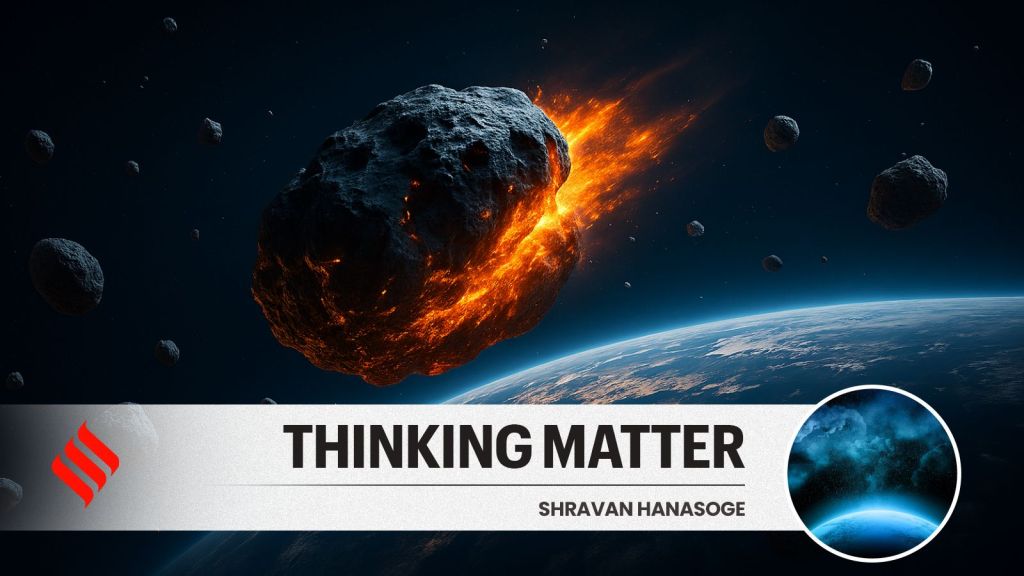 Asteroids are relics of the early solar system, and potential doomsday threats to our home planet. (AI-generated image/DALLE)


 Share


