3 min read
© IE Online Media Services Pvt Ltd



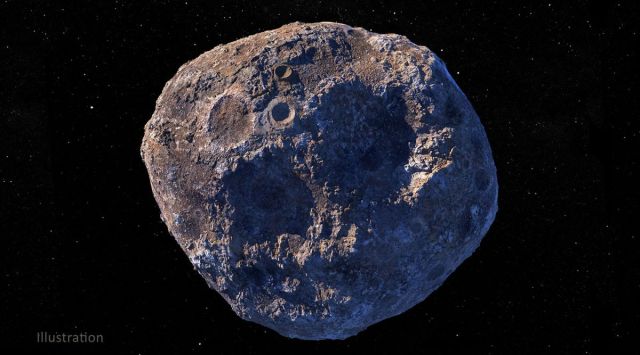 An artist's illustration of the asteroid Psyche. (Maxar/ASU/P. Rubin/NASA/JPL-Caltech)
 Elon Musk-led SpaceX is set to launch the National Aeronautics and Space Administration’s mission to the asteroid Psyche on October 5. The mission is set to launch on the company’s Falcon Heavy rocket from the Kennedy Space Center in Florida.
Psyche is the name for both the asteroid and the NASA mission that plans to visit it. The mission is led by Arizona State University, and the space agency chose it in 2017 as one of the two missions for its Discovery Program. The Discovery Program funds relatively low-cost missions to targets within the solar system.
Deep inside terrestrial planets like Earth, there are metallic cores. Studying these cores would help scientists understand the dynamic processes of collisions and accretion that created rocky planets. But we cannot see or measure Earth’s core directly. That is where metal-rich asteroids could offer a unique opportunity to observe what could have become a planet’s core.
Psyche is only the 16th asteroid to be discovered in history, according to Arizona State University. Italian astronomer Annibale de Gasparis found it in 1852 and named it after the goddess of soul in ancient Greek mythology.
It holds the interest of scientists because it is very rich in metal, meaning that it may be made of metal from the core of a planetesimal, which is one of the building blocks of a planetary system. If it were a perfect sphere, it would have a diameter of about 226 kilometres, which is around the distance from Delhi to Chandigarh. Scientists estimate that it has a surface area of about 165,800 kilometres. For reference, the state of Tamil Nadu covers a land area of about 130,058 square kilometres.
The Psyche spacecraft will travel to the asteroid using low-thrust solar-electric propulsion. It will also take advantage of a Mars fly-by and gravity assist. After it arrives at the asteroid, it will take science observations from four staging orbits. The spacecraft will get closer and closer to the asteroid with each orbit.