


Journalism of Courage
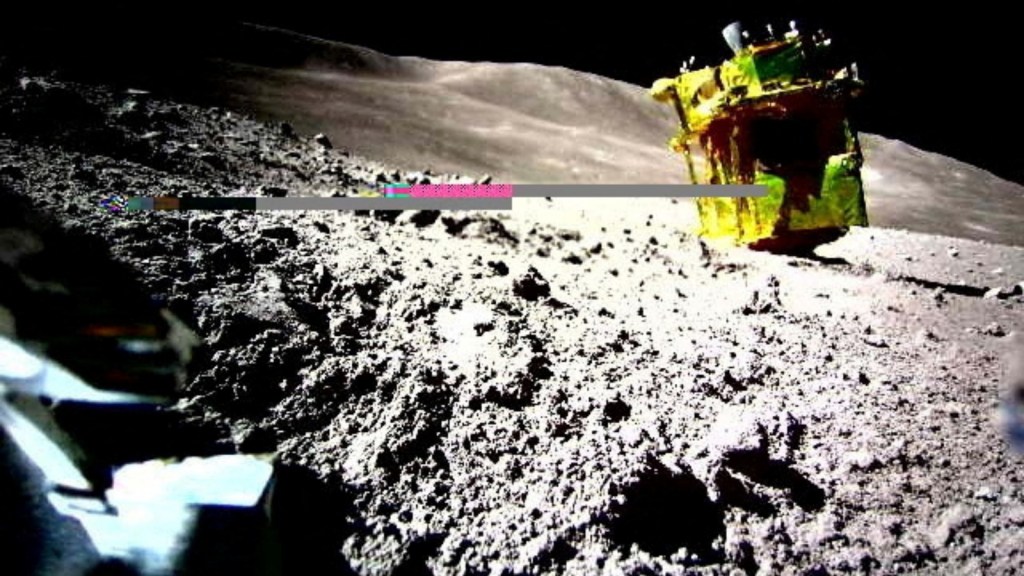 The Smart Lander for Investigating Moon (SLIM), is seen in this handout image taken by LEV-2 on the moon, released on January 25, 2024. Photo credit: Japan Aerospace Exploration Agency (JAXA), TAKARA TOMY, Sony Group, Doshisha University /via Reuters
Japan’s moon explorer, the Smart Lander for Investigating Moon (SLIM), successfully regained power on Monday, overcoming a setback that occurred more than a week after the probe’s touchdown. The issue arose when the lander’s solar panels were positioned at the wrong angle upon landing, causing it to run out of electricity.
The Japan Aerospace Exploration Agency (JAXA) said that it re-established contact with its moon lander on Sunday night as the spacecraft resumed its mission, taking pictures of the Moon’s surface and transmitting them to the Earth.
On January 20, SLIM made a touchdown on the moon within 55 m (180 ft) of its target in a crater near the lunar equator, an AP news report said. But shortly before its landing, the spacecraft had a last-minute engine failure causing it to land a few metres away from the target, with its face-down on the lunar surface. And since its left solar panel was facing away from the sunlight, it could not generate power. The craft was then turned off to wait for the sun to rise higher in the lunar sky in late January.
“The Lunar Excursion Vehicles (LEV-1 and LEV-2) were successfully separated just before landing in this contingency situation. The multi-band spectroscopic camera (MBC) onboard SLIM was also operated on a trial basis and captured images until the power was turned off,” the JAXA stated in a press release.
 Daichi Hirano, Hitoshi Kuninaka, Shinichiro Sakai and Masatsugu Otsuki from the Japan Aerospace Exploration Agency (JAXA), smile in front of a screen showing an image taken by LEV-2 on the moon, after their press conference on SLIM’s moon landing mission, in Tokyo, Japan January 25, 2024. (Reuters)
Now with power, the craft has continued its work of analysing the composition of olivine rocks on the lunar surface with its multi-band spectral camera, the JAXA said.
The space agency also posted a black-and-white photo on social media zooming in on a lunar rock that has been named “toy poodle”.
The mission team has picked out specific rocks near the landing area and given each one the name of a dog breed — apparently to indicate the size of each rock.
 The mission team has picked out specific rocks near the landing area and given each one the name of a dog breed – apparently to indicate the size of each rock. (Photo: global.jaxa.jp)
Speaking to BBC News, Open University lunar scientist Dr Simeon Barber said, “The camera responds differently — in different wavelengths — to each of the minerals that are in this rock.” This will enable scientists to get clues about the Moon’s origin and evolution.
“If toy poodle is completely different to the rocks around it, that might suggest it was transported there by an impact event. All this detail allows us to piece together more about what’s happened on the Moon since it was formed,” Dr Barber explained.
According to an AP news report, SLIM is expected to have enough sun to continue operations for several Earth days, possibly until Thursday.
This landing has made Japan the world’s fifth country to reach the moon’s surface, after the United States, the Soviet Union, China and India.