6 min readBengaluruMay 6, 2022 02:52 PM IST
First published on: May 6, 2022 at 02:52 PM IST
Global warming is inevitably going to change biogeography, causing shifts in habitats. Species will come in contact with other species with whom they had no prior contact whatsoever. Mammals and viruses will be no exceptions, and the number of pathogens jumping from one mammal species to another related species (most viruses are transferred only between related species) will only increase, according to a new study in Nature by a team of climate scientists and biologists.
In this study, Carlson et al. (2022) ask a pertinent question: will climate change increase the risk of viral transmission in the future? Global warming will drive species intolerant to high temperatures to cooler climes. In particular, this refers to the high-altitude regions of the tropics, for the tropics have the highest biodiversity. This will bring together species of wildlife that have, thus far, been geographically isolated. By even the most conservative estimates, ‘many species’ geographic ranges are projected to shift a hundred kilometres or more in the next century.’ Further, the study says that even if the cap on increasing temperatures by no more than 2 °C is observed, the instances of species running into each other for the first time is likely to double.

Given that these host-animals will introduce their pathogens to newer environments, what implications might it have for first-time viral transmissions to other species, including humans?
The exercise entailed developing models that simulated changing habitats and virus jump-overs over a five-year period. The model pertaining to changing biogeography tries to find out where most mammal species would move in the event of global warming. The focus on mammals is explained by their direct relevance for human health, besides the fact that they have the most complete biodiversity data available. This is supplemented by the parallel model on viral transmission that builds up on a previous study. Given the information about species coming into contact with each other for the first time, the viral transmission model tries to measure the instances of cross-species viral spill overs.
These first-time-contacts will be the highest in the tropics i.e. Asia or Africa. There are two reasons for this. One, the tropics have the highest biodiversity and the highest population density, increasing the risk of transmission. Two, when species migrate latitudinally, they tend to carry the same species that already existed in their community earlier. On the other hand, migrations along altitudes at the same latitude tends to bring more previously geographically isolated species in contact and give rise to newer community compositions.
Bats will have a significant role to play in such a scenario, because (a) they harbour a diverse range of viruses, (b) are airborne mammals, and their ‘dispersal capacity’ likely to be hindered by changing biogeography, and (c) constitute nearly twenty percent of the mammalian fauna. Factors like the inability to fly, body size, nutritional requirements do place their own constraints on an individual or species. The study argues that these constraints are going to reduce the number of first encounters by 61% and associated viral sharing events by 70%. However, unlike other flightless mammals, where the inability to fly renders them incapable of colonising newer areas to their fullest potential, bats are rather unbridled.
A case in point is the coronavirus pandemic, which, according to many studies, had its origins in zoonotic transmission. In case of both the 2002 SARS-CoV (Severe Acute Respiratory Syndrome – Coronavirus) and the 2012 MERS-CoV (Middle East Respiratory Syndrome – Coronavirus) outbreaks, the scientific consensus is that the viruses had originated in bats. Then, they jumped over to civets (for SARS-CoV) and dromedary camels (MERS – CoV), and then, finally, to humans. Genomic sequences of 2019 novel coronavirus (2019-nCoV (1); the coronavirus we are most familiar with as of now) bear close resemblance to SARS-like coronaviruses that originated in bats. Again, bats might have been the original hosts of the nCoV, and an animal sold in Wuhan, China, acted as an intermediate to humans.
Studies over the last few decades have well-testified to the ability of bats to traverse large distances over small timescales. Carlson et al. (2022) observe that even nonmigratory bats can travel hundreds of kilometres within a lifetime, whereas small mammals are able to cover only a fraction of that distance. This also means that bats can breed and mate over continental scales – and, therefore, transmit even more viruses.
This ultimately has repercussions for human health. Even in the best-case scenario, wherein temperature increase does not surpass 2 °C, a ‘total of 0.3 million first encounters would lead to 15311 novel sharing events.’ In order to illustrate this, the study modelled the potential spill over of Ebola virus (ZEBOV). They found that even accounting for no more than a 2 °C increase in temperature and constraints imposed by the species’ physiology, the thirteen host species of ZEBOV are likely to ‘produce almost one hundred new viral sharing events,’ taking viruses like ZEBOV far beyond their current confines. Tropical areas with high human populations — like the Sahel, the Ethiopian highlands and the Rift Valley, India, eastern China, Indonesia and Philippines — are the ones where we are likely to witness maximum viral sharing by 2070.
Researchers caution that the inevitability of this scenario should not be misinterpreted ‘as a justification for inaction.’ Rather, nations and governments should buttress their public health infrastructure systems as well as their wildlife disease surveillance in order to shield themselves against these as-yet-unforeseen impacts of climate change.
The author is a research fellow at the Indian Institute of Science (IISc), Bengaluru, and a freelance science communicator. He tweets at @critvik

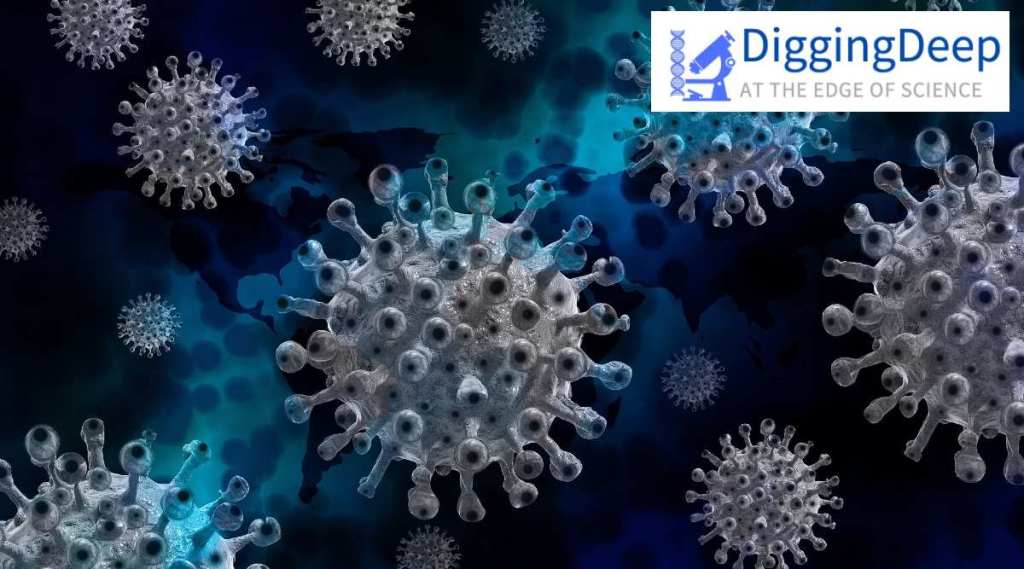 A case in point is the coronavirus pandemic, which, according to many studies, had its origins in zoonotic transmission. (Image Source: Pixabay)


 Share


