4 min readKochiDec 11, 2023 02:54 PM IST
First published on: Dec 10, 2023 at 12:00 PM IST
The Indian Space Research Organisation (ISRO) on Friday shared the first -ever full disc image of the Sun in infrared light captured by the Aditya-L1 mission. The images are the first efev full-disc representations of the Sun in wavelengths from 200 to 400 nm according to the space agency.
India’s neighbours have been busy as well. Chinese private space technology firm LandSpace Technology on Friday launched three satellites on its pioneering Zhuque-2 rocket, which is powered by a mixture of methane and liquid oxygen. Using methane in commercial launches could potentially help slash costs and make it easier to reuse rockets and LandSpace was the first company to demonstrate the technology.

All space exploration does not involve launching rockets. Scientists this week announced the results of a study where they used the James Webb Space Telescope to identify AzTECC71, a dusty galaxy that is so faint that it has for many years been invisible to telescopes on the ground and in orbit.
ISRO’s Aditya L1 mission
The images were captured by the Solar Ultraviolet Imaging Telescope (SUIT) instrument on Aditya L1. It is one of the seven payloads on the mission and is designed to capture UV images of the Sun’s photosphere and chromosphere and to examine variations in the light energy emitted.
Before the full disc images, the Solar Wind Ion Spectrometer (SWIS) and the wind Particle Experiment (ASPEX) had already begun their science operations. The mission also captured its first high-energy X-ray look at solar flares using its Orbiting X-ray Spectrometer, which ISRO released last month.
The main overall objective of the Aditya L1 mission is to help get a deeper understanding of the Sun and how its radiation, heat, magnetic fields and particle flows affect the Earth. Interestingly, it might even give clues about a long-standing mystery of the Sun’s corona.
Chinese methane-powered rocket
The Zhuque-2 Y-3 mission took off from the Jiquan Satellite Launch Center in China’s Inner Mongolia region at 5.09 PM IST on Friday, according to Reuters. The launch vehicle had already taken off in July without satellites. That launch made LandSpace the first company in the world to launch a methane-liquid oxygen rocket. The mission that launched on Friday carried two 50-kilogram test satellites developed by Chinese startup Spacety.
The company asserts that these two successful launches prove its Zhuque-2 rocket is ready for commercial launches. It is currently capable fo carrying a payload of up to 1.5 metric tons into a 500-kilometre-orbit. LandSpace plans to increase that number to 4 tons with upgraded future versions.
Landpsace has also unveiled plants for the future Zhuque-3 rocket, which will use stainlessteel propellant tanks and clusters of methane-liquid oxygen propellant engines. The two-stage rocket will have a payload capacity of up to 20 metric tons, when used in expendable mode. In reusable mode, the launch vehicle will have between 11 and 16.5 tons based on the configuration.
James Webb Space Telescope’s ghost
It was first seen as a glowing blob in land-based telescopes before it was blurrily imaged by the Hubble Space Telescope. But it soon vanished completely from the telescope’s eye. Now, it has reappeared as a faint galaxy in an image taken by the James Webb Space Telescope.
The object is called AzTECC71 and it has been identified as a dusty star-forming galaxy. The fact that it is shrouded in dust makes it very difficult to see through but it is forming many new stars at a rapid pace. We are observing the dust galaxy as it was more than one billion years after the Big Bang. To put that into context, scientists estimate the Big Bang happened about 13.8 billion years ago.
Dusty, star-forming galaxies are quite difficult to spot because the dust usually absorbs most of the light emitted by stars. They then later radiate all that energy, mostly in the form of infrared light. This made it quite difficult for Hubble to observe them. The researchers went on a hunt, narrowing down the location of the object using data from multiple ground telescopes, before looking at it and capturing it with Webb.

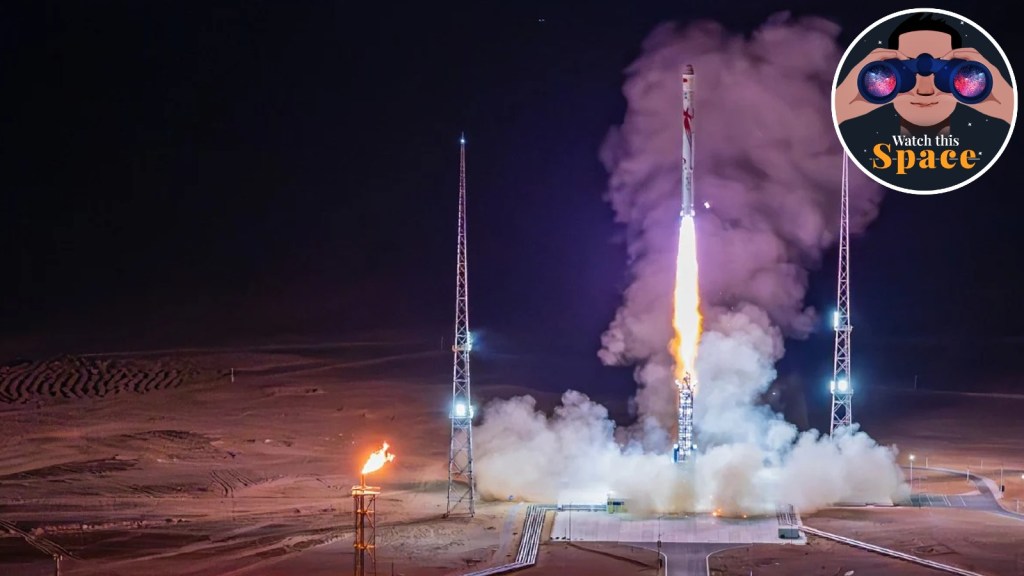 Zhuque-2 rocket powered by a mixture of Methane and liquid oxygen (Image credit: Weibo/LandSpace)


 Share


