
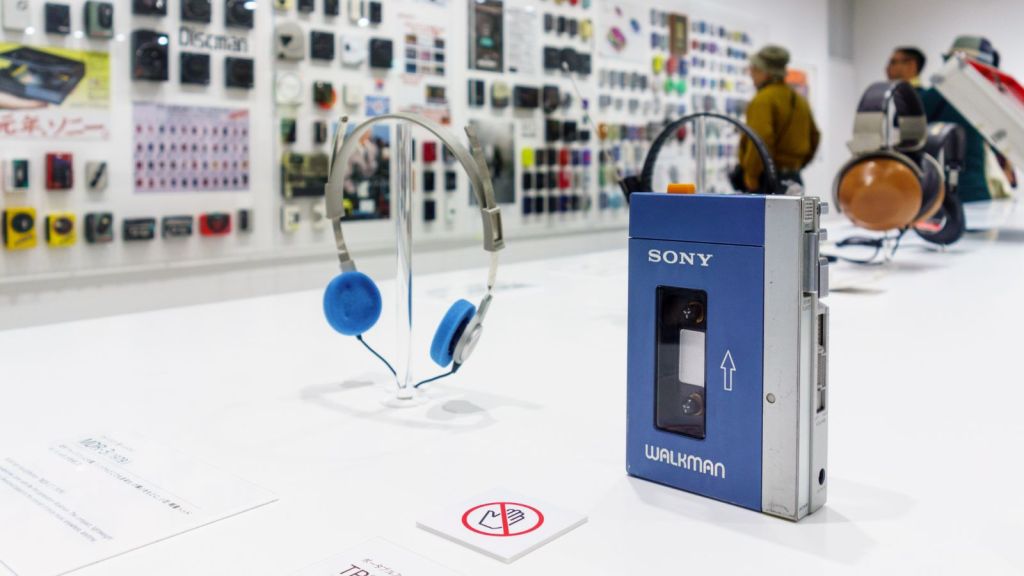
In the late 1970s, music was a communal affair. Families gathered around bulky stereos, teenagers cranked up car radios, and break-dancers spun to boom boxes in city streets. Music was loud, shared, and rooted in place.
Then came the Walkman. A 14-ounce device barely larger than a cassette tape, it let people carry their soundtracks anywhere. Suddenly, music became private — a portable bubble of sound that transformed daily life. As cyberpunk author William Gibson wrote in a 2019 article for The New Yorker, “The Sony Walkman has done more to change human perception than any virtual reality gadget.”

An idea takes off
The Walkman’s story began with Masaru Ibuka, Sony’s co-founder and a devoted classical music fan. Tired of long, music-less trans-Pacific flights, he approached Sony’s tape recorder division in February 1979, asking, “Can you make a playback-only version of the Pressman?”
The Pressman, originally designed as a compact recorder for journalists, was reimagined. Engineers removed the recording functions, microphones, and speakers, crafting a sleek, lightweight device – first made of aluminum, then plastic. They paired it with 45-gram headphones built for mobility, a leap from the era’s heavy, stationary models.
The Walkman’s design was simple but revolutionary. Its high-quality audio playback minimised hiss and emphasised clear tones, delivering hi-fi sound through stereo headphones. Its low power consumption allowed 3.5 hours of use, or up to 8 with a heavy-duty battery, making it practical for daily use.
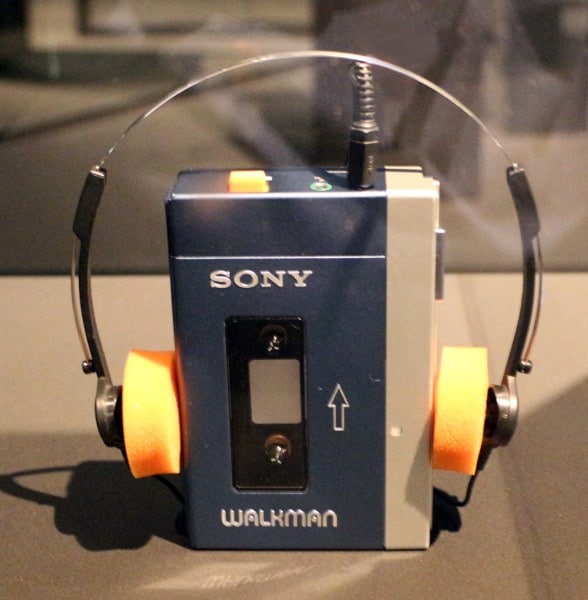 The Walkman quickly became a symbol of style and status. (Wikimedia Commons)
Ironically, the Walkman wasn’t built on groundbreaking technology. As Eric Alder observed in a 1999 article in the Edmonton Journal, “Portable transistor radios with little earpieces had been around for decades. And home stereophiles wishing to listen to their favourite tapes or albums in solitude always had their headphones.”
Even Sony’s engineers were initially unimpressed. Cassette players and headphones weren’t new, and the Walkman couldn’t record. “Everyone knows what headphones sound like today,” Sony designer Yasuo Kuroki wrote in a 1990 memoir, “but at the time, you couldn’t even imagine it.”
What made the Walkman brilliant was its ability to seamlessly combine existing technologies into something entirely new, and something individualised and portable. As author Rebecca Tuhus-Dubrow wrote in Personal Stereo in 2017, “It gave people the power to enhance their experiences while tuning out their surroundings.”
A personal soundscape nobody knew they wanted
The possibility of having a personal soundscape that one could walk around with did not exist in the 1970s. With no clear market, Sony had to create one.
Their marketing was a stroke of genius.
In Tokyo, young demonstrators roamed streets, parks, and subways, sharing Walkman earbuds with curious onlookers. Ads showed people running, skateboarding, or studying, each immersed in their private soundtrack. The $200 device at the time wasn’t sold as tech but as a lifestyle.
It sold out its initial 30,000-unit run in Japan, and in New York, Bloomingdale’s had a two-month waiting list.
“It was the first mass mobile device,” Tuhus-Dubrow notes, and “it changed how people inhabited public space in a pretty profound way.”
It let users play what they wanted, wherever they were, without commercials.
For many, it felt like freedom. “It was so liberating, it was like a whole new world,” 67-year-old Matt Richards, a software engineer in Los Angeles, told indianexpress.com. “Kids today are used to the iPhone, smartwatch, iPad, but this thing came out before any of us even had a computer!”
Richards remembers pleading with his parents for one. “At first it was expensive,” he says, “but eventually everyone had one.” With the Walkman, everyone could listen to what they wanted, he says. His favourite? “Led Zeppelin, without a doubt.”
A cultural symbol, a companion
The Walkman quickly became more than just a player — it became a symbol of style and status. Dentists used it to calm patients. American visual artist and film director Andy Warhol tuned out the din of Manhattan, commenting, “It’s nice to hear Pavarotti instead of car horns.” Paul Simon, half of the legendary duo Simon and Garfunkel, wore his Walkman at the 1981 Grammys.
Strapped to jeans or clipped to a belt, the Walkman signalled wealth and tech-savviness, much like the iPhone today. It quickly became a fixture of everyday life. “We just got back from Paris and everybody’s wearing them,” Warhol enthusiastically told the Washington Post in 1981.
Mike Ma, a California-based sound engineer who grew up in an Asian-American family, recalled his teenage years filled with saggy jeans and a Walkman. “My friends and I, we’d all be showing up with our jeans down to our butts, and with the Walkman on them, they’d slip down to our ankles,” he told indianexpress.com.
For many, it was also an extension of privacy. According to Ma, “My friends were allowed to do whatever they wanted, but my parents were like nah, you have to study, you have to meet family. The only me-time I got was when I was lying on my bed listening to my Walkman.”
As Michael Marsden, co-editor of The Journal of Popular Film and Television told Reason Magazine in 1999, put it, the Walkman embodied “personal space that you’ve created, in a world in which we don’t have a lot of personal space. It’s a totally private world.”
Yet, this privacy stirred debate. Michael Bull, Professor of Sound Studies at the University of Essex, in the book Sounding Out the City (2000), called personal stereos “visual ‘do not disturb’ signs.” Vince Jackson, in Touch magazine, wrote, “The experience of listening to your Walkman is intensely insular. It signals a desire to cut yourself off from the world at the touch of a button.” Researcher Shing-ling Chen’s 1998 study for Qualitative Magazine dubbed the Walkman “electronic narcissism,” suggesting that its users grew self-absorbed.
Even Sony’s Akio Morita, concerned about antisocial behaviour, added a second headphone jack for shared listening. Yet, a social culture flourished with people sharing earbuds and making mixtapes. “I gave my first girlfriend a mixed cassette for Valentine’s Day,” Patel says.
However, the Walkman had other flaws. British music journalist Norman Lebrecht argued it dulled musical taste, favouring “crump-crump rhythm” over melody, possibly hurting classical concert attendance. Safety issues emerged, too. States like California and New Jersey banned headphone use while driving, cycling, or crossing streets after a 1981 New York Times article reported over 70 pedestrian accidents linked to Walkmans.
Echoes that still resonate
Yet, the Walkman reshaped the tech landscape. As Tuhus-Dubrow writes, “The Walkman – arguably the first mass personal device – introduced possibilities that we now take for granted, but that were largely unprecedented at the time.”
Steve Jobs was notably inspired by the Walkman, dissecting the one gifted to him to inspect its parts. “Steve’s point of reference was Sony at the time,” Apple engineer John Sculley recalled in Steve Jobs’ Life by Design (2014). “He didn’t want to be IBM. He didn’t want to be Microsoft. He wanted to be Sony.”
Apple’s iPod, launched in 2001 with iTunes and .mp3 support, eventually overtook Sony, which resisted .mp3s to protect its entertainment interests. In a 2006 BBC interview, Sony’s CEO, Sir Howard Stringer, said, “Steve Jobs was smarter than we are at software.” By 2009, Apple sold 210 million iPods in eight years, surpassing half of Sony’s 30-year Walkman sales.
None of that takes away from its cultural impact. As Andreas Pavel, who patented a similar device before Sony, said in 1998 about the Walkman, “Life became a film. It emotionalised your life. It actually put magic into your life.”
From Ibuka’s desire to hear classical music in flight, the Walkman redefined how we live with sound. It paved the way for AirPods, Spotify, and the personal tech ecosystem. Once, hearing Led Zeppelin through lightweight headphones clipped to your belt felt like the future.
For a time, it was.

 Share


