


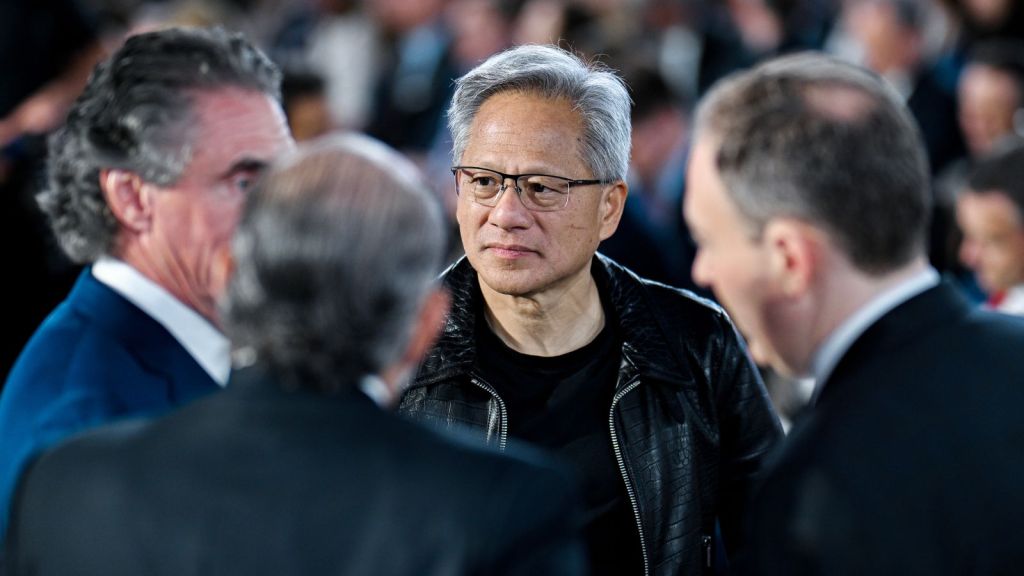
 Jensen Huang, chief executive leading U.S. chip maker Nvidia, at a Trump administration summit titled “Winning the AI Race,” in Washington, July 23, 2025. (Kenny Holston/The New York Times)
Nvidia has agreed to buy open-source AI repository Hugging Face for $12.9 billion, a move that underscores the chip giant’s growing AI power across the industry and is likely to raise eyebrows among rivals and regulators.
Following initial reports of a deal, Nvidia on Thursday, September 3, confirmed that it has entered into a formal agreement to acquire Hugging Face. The platform has emerged as one of the most popular hubs for open-weight AI models, hosting over three million of them along with other tools and datasets.
Hugging Face was officially last valued at $4.5 billion, on the heels of a funding round in 2023 that Nvidia participated in, according to a report by Financial Times. The acquisition could help Hugging Face boost its current user base of 18 million developers to 100 million.
It also gives the platform access to significant enterprise distribution through Nvidia, particularly to address private and sovereign AI priorities of CIOs [Chief Information Officers]. More than 200,000 companies already use the platform to discover, evaluate, customise and deploy AI models.
Nvidia, meanwhile, has turned its early AI success into a potentially lasting role as kingmaker in the sector. The deal could give the trillion-dollar company greater influence over which chips developers use, although Nvidia CEO Jensen Huang has said the company will not use the acquisition that way.
“Hugging Face will continue to support open source and open weight models from across the ecosystem, from every model builder. It will continue to support multi-cloud and multi-accelerator development and deployment, so builders can use the hardware and infrastructure that best fit their work,” Huang said in a blog post on Thursday.
“Nvidia compute will not be required to build on or deploy through Hugging Face,” he added. However, social media commenters pointed out that Nvidia could still set things up so that AI models on Hugging Face work fastest on its hardware, giving it an edge over rivals such as Broadcom and AMD.
“Nvidia’s acquisition of Hugging Face proves that the next battleground in AI is who owns the developer rather than the best model. It will subsidise open weights to keep the model market fragmented and its hardware in demand,” Arun Chandrasekaran, Distinguished VP Analyst, Gartner, told The Indian Express.
There is little reason to expect Nvidia’s chip rivals will welcome the acquisition as it puts them in an awkward position.
Hugging Face has become a major hub for hardware designers looking to test, optimise, and distribute computing power via the platform. Despite Huang’s assurances, these companies may be less willing to continue to rely on Hugging Face once it is owned by Nvidia.
“So far, Hugging Face has acted as an impartial platform among different technology providers. If it is owned by a major player in this space, true neutrality may not be possible,” the Gartner analyst said.
Acquisitions in the AI industry are increasingly fueling distrust among rivals. Earlier this week, OpenAI said its models will not be available on AI coding startup Cursor from November 2026, because it cannot be sure that Elon Musk-led SpaceX – which recently acquired Cursor parent Anysphere for $60 billion in an all-stock deal – will not violate its contract.
The Nvidia-Hugging Face acquisition is also expected to draw scrutiny from antitrust authorities in the US and Europe, where Hugging Face has a big presence. For context, Nvidia holds more than half of the market for the GPU (Graphics Processing Unit) chips that run the data centres powering AI models and applications.
In 2024, the US Department of Justice launched an antitrust probe looking at whether Nvidia pressured cloud providers to buy multiple products, after complaints from competitors alleging abuse of market dominance. But the case appears not to have gone anywhere, given the Trump administration’s focus on AI progress.
The company has also faced antitrust probes in other regions such as France and China. While the Hugging Face acquisition may clear US regulators, whether it will pass scrutiny in Europe remains to be seen.
“Both the frontier AI model space and its distribution are highly competitive markets. The critical question here is can this acquisition result in Nvidia gaining control over critical developer infrastructure and use that position to reinforce its hardware dominance,” Chandrasekaran said.
The argument in support of Nvidia’s Hugging Face acquisition is that it could strengthen the US’ open-source AI ecosystem and ensure it does not lose its lead in the AI race to China.
In the past few months, Silicon Valley has become increasingly divided over how to respond to a wave of new Chinese open-weight AI models such as Moonshot AI’s Kimi K3, which have closed the performance gap with US-developed frontier models while undercutting them on cost.
Huang and Nvidia’s position has been clear: open-weight AI is key to maintaining the US’ technological leadership, and any premature restrictions against such models could limit innovation. “Open weights broaden access to AI and help ensure that AI leadership is distributed across companies, institutions and communities,” Huang said.
Nvidia is one of the largest contributors to Hugging Face, having uploaded over 500 models to the platform. The company’s Nemotron family of open-weight models are developed in-house. It has further invested billions of dollars in open-weight AI model providers such as Thinking Machines Lab, Poolside, Reflection, and others so they can continue to afford its expensive chips.
That puts Nvidia in an interesting position as a counter-weight to closed AI model providers such as Anthropic and OpenAI, which have come to rely heavily on Nvidia’s chips but are also working to reduce that dependence by developing their own chips with help from Broadcom.
The Hugging Face deal is not Nvidia’s largest acquisition. That title goes to its $20 billion assets deal with Groq, a designer of high-performance AI accelerator chips. Beyond chips, it has sizable stakes in neoclouds such as CoreWeave and Nebius, along with AI firms OpenAI, Anthropic, and SpaceX.