


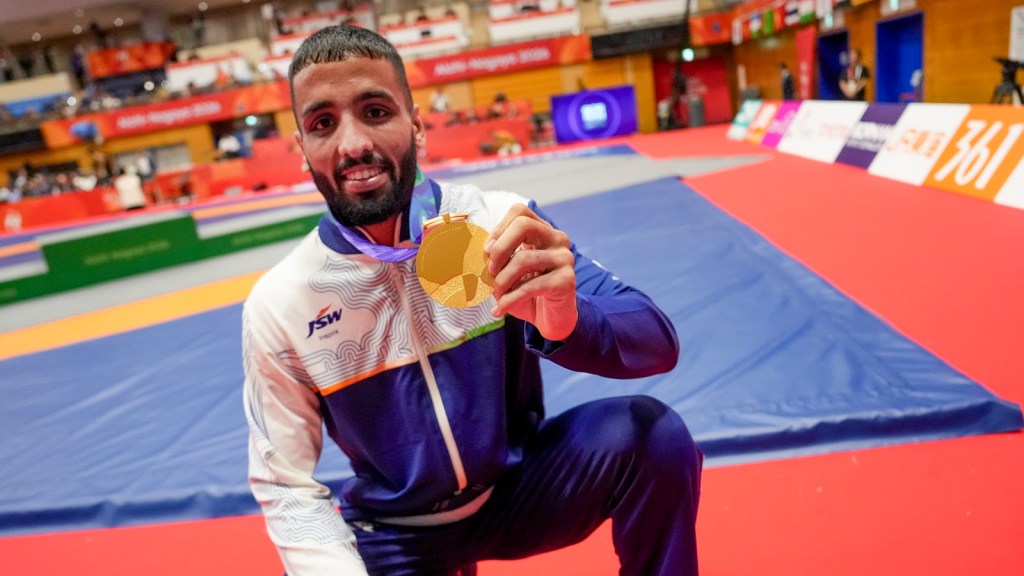
 Sujeet Kalkal poses with his Asian Games gold medal. (PTI Photo)
When Sujeet Kalkal left for Aichi Nagoya for the 2026 Asian Games, all eyes were on him; he was labelled as the brightest medal prospect with his medal chances being higher than Olympic bronze medallist Aman Sehrawat.
There were reasons behind the expectations. He is World no 2 in men’s 65 kg wrestling, unbeaten this season, and was fighting for a medal that had belonged to India in 2014 and 2018 before going to Mongolia in 2022.
Click here to read our Asian Games full coverage
As he effected a last minute takedown on his opponent Abdulmazhid Kudiev of Tajikistan to win the final bout 10-9, not only did he deliver on all the expectations but also ended India’s wait of an Asian Games gold after eight years bringing back the 65 kg gold to India continuing the legacy of Yogeshwar Dutt (2014 Gold) and Bajrang Punia (2018 Gold).
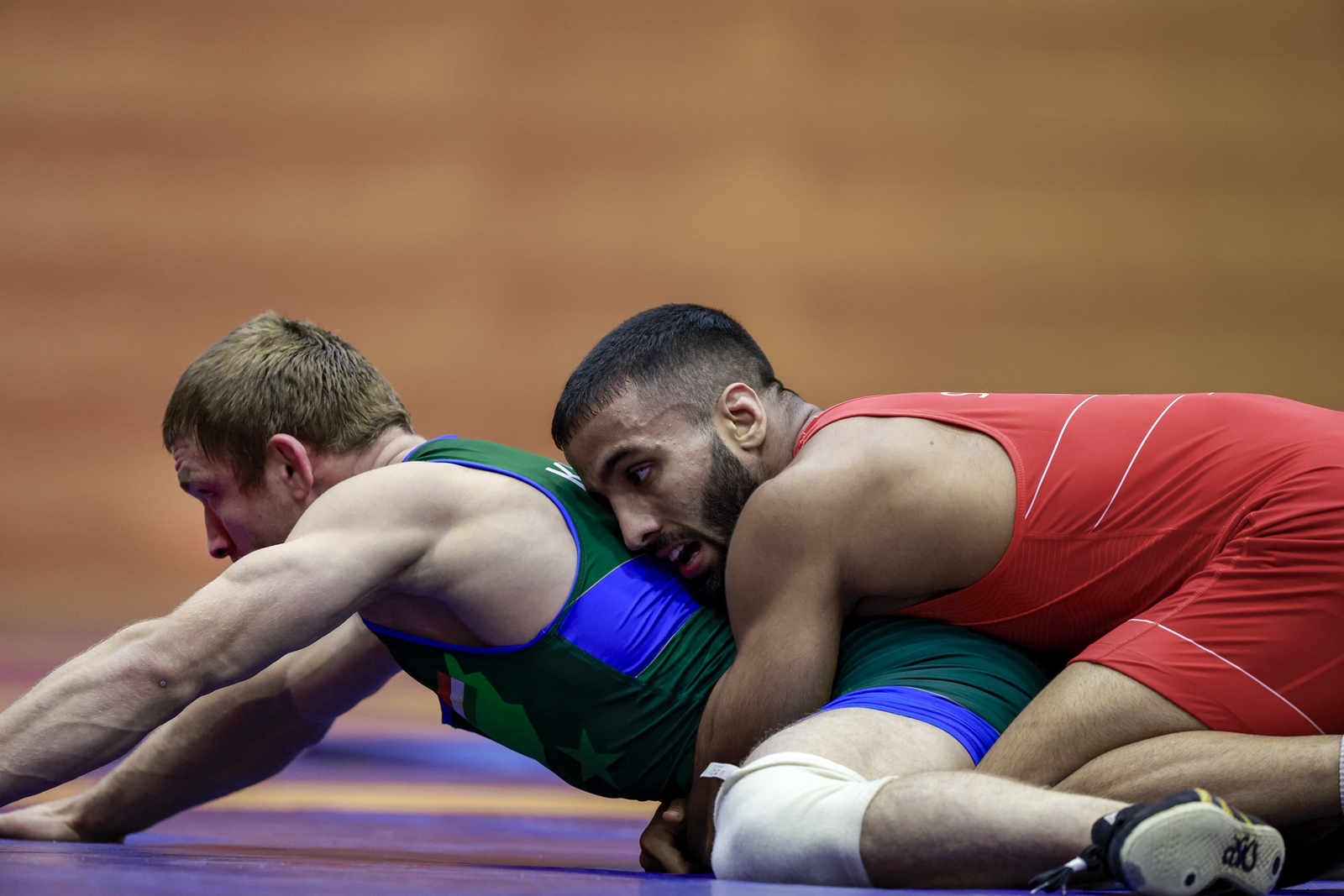 India’s Sujeet Kalkal, during the men’s freestyle 65 kg final against Tajikistan’s Abdulmazhid Kudiev (PTI Photo)
“I didn’t expect anything less than a gold. I had told him when he left for Japan and I told him today also, you are here to win a gold. He delivered on all the promise he has displayed over the last two years,” his coach Kuldeep Singh Sehrawat told The Indian Express.
Such pressure in a major event can do funny things to athletes but Sujeet remained ice cold in his wrestling and overturned a 2-9 deficit in the first half of the final to claim the gold medal.
Staring at 2-9, two men sitting miles apart were tense looking at the scoreline, as the Tajik used his superior ground wrestling and leg attacks to pick quick points. Coach Kuldeep was sitting behind him in the stands while his father Dayanand Kalkal was sitting in his home in Imlota, Haryana. Sujeet had time, but the Tajik was riding momentum – which the Indian flipped faster than a Phitle.
However, their tense faces soon started smiling as Sujeet launched four take-downs.
“For a moment, I was worried but it is okay. Wrestling is a sport like that where you can have those moments. The important thing is that he didn’t buckle under the pressure,” said Dayanand, who was a wrestler himself and early coach of Sujeet.
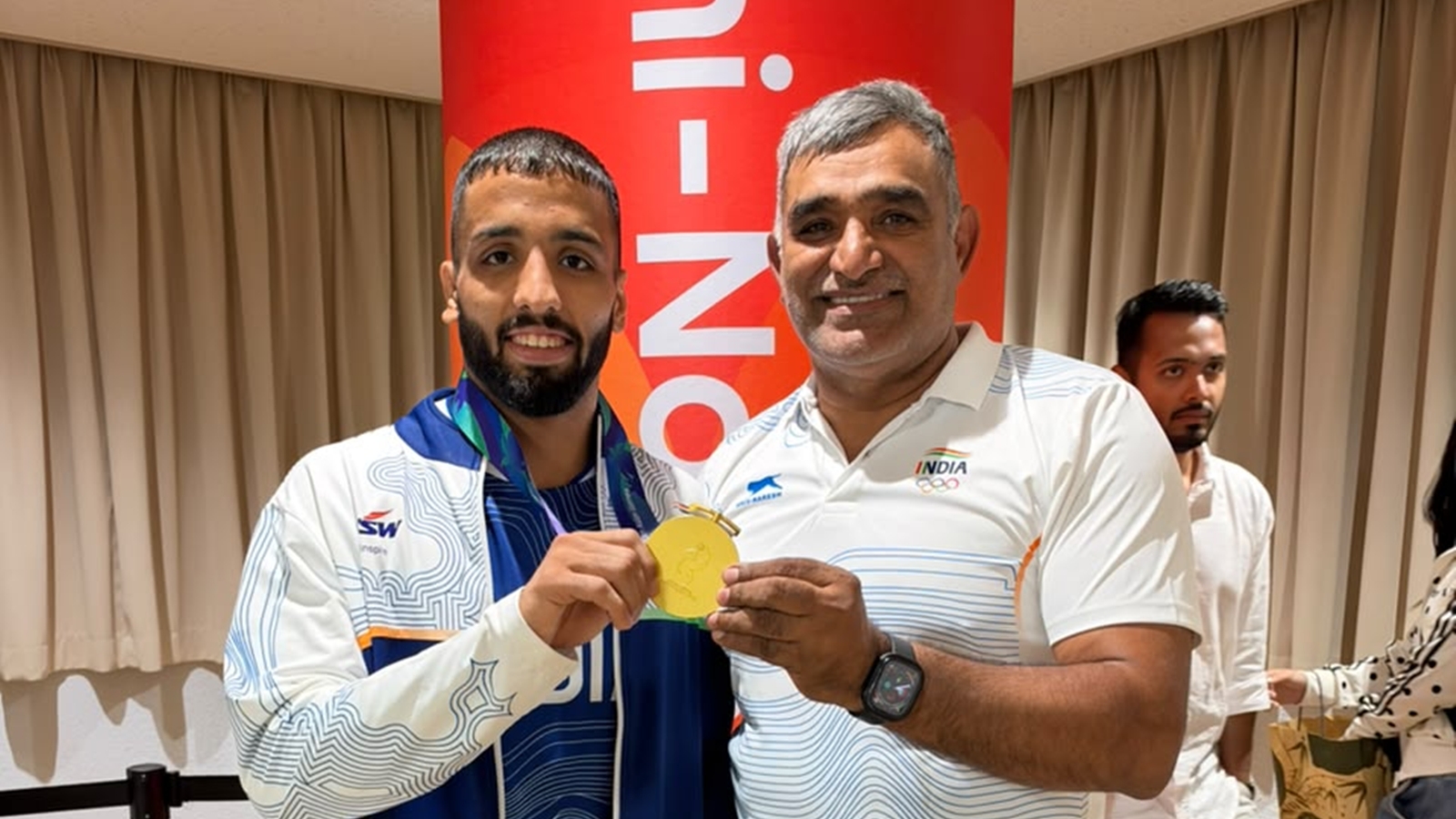 Sujeet and his coach Kuldeep Singh Sehrawat. (Image via special arrangement)
It will be fair to say that the final and Sujeet’s comeback was no less than dramatic.
He entered the mat to loud cheers from the Indian contingent. But the Indian fans and coaches were stunned alike as Kudiev countered Sujeet brilliantly, including scoring two points off a leg lace, to lead 9-2 after the first round.
“Sujeet made a few mistakes. Especially, once he lost the attacking position, the Tajik counter attacked him. The Tajik is a good ground wrestler and he executed his moves well,” said Kuldeep.
However, the second half was completely different. Sujeet came back determined and he effected four take downs to win the gold medal.
It was a mix of speed and smarts that allowed Sujeet to catch Kudiev by surprise on two occasions. He moved behind quickly to take him down in the second half before executing a right leg attack successfully. As Kudiev tired out, Sujeet used his speed to get hold of his legs and make it 8-9. With less than 30 seconds on the clock, came the last move where Sujeet got hold of Kudiev’s left leg and continued the attack to take him down and make it 10-9.
However, before even entering the final, Sujeet had made the headlines after defeating reigning Olympic champion Kotaro Kiyooka of Japan in front of the home fans in the semi-finals. It was a tactical bout fought between two of the best wrestlers in the business.
The bout ended on 3-3 with Sujeet winning on technical criteria.
“We knew that Kiyooka was going to be the biggest challenge. Incidentally, he came in the same half of the draw. Kiyooka’s main attacking move is that he goes for the right leg while attacking and we had planned to counter it that way,” explained Kuldeep. “When Kiyooka tried it for the first time, Sujeet defended and conceded only one point. However, when Kiyooka did it a second time, Sujeet was ready and he countered it to take two points and eventually won the bout.”
It was a momentous result for the 23-year-old who has his eyes firmly set on the World Championships 2026 and reaction from his coach Kuldeep summed up his gold medal run. “I had told everyone that he would defeat Iranian and Japanese wrestlers but had never thought that he would do that in a space of 27 minutes,” Kuldeep laughed.