5 min read
© The Indian Express Pvt Ltd



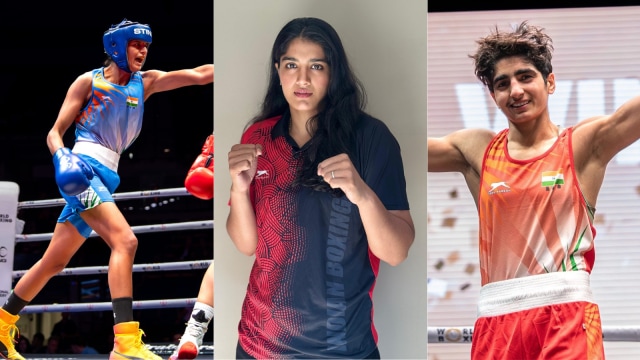 L-R: Indian boxers Jaismine Lamboriya, Nupur Singh Sheoran and Minakshi Hooda. (Photo: World Boxing)
Three out of the four Indian women who won medals at the Boxing World Championships all enjoyed one crucial advantage – their height. Minakshi Hooda, Jaismine Lamboriya and Nupur Singh Sheoran are all tall for their weight class and have long arms that keep their opponents at bay, and also help them score points from distance.
The crowning moment among the three came when Jaismine took down the Paris Olympics silver medallist in her weight category – becoming yet another world champion boxer from the country – a number that continues to increase after two World Championships were hosted in the country in the last 9 years. There have been 10 women world champions from India.
Jaismine’s coach Chhotelal Yadav, who also was MC Mary Kom’s coach until the six-time World Champion retired, says that whenever he sees a tall person interested in sports at the Army Sports Institute in Pune, he tries to get them into boxing. Yadav, who has worked with both Jaismine and Minakshi, also said that both of them benefitted from going down weight classes.
“Minakshi started out as a 54 kg boxer. Jaismine started out as a 60kg boxer. They didn’t get as much success at that weight so they cut weight and started fighting at a lower weight where their height advantage came through,” says Yadav.
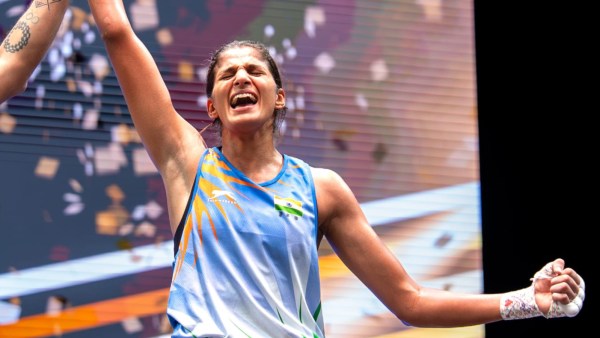 India’s Jaismine Lamboriya after winning the boxing World Championship in Liverpool. (Photo: World Boxing)
The uptick in taller boxers in the country is based on a few reasons. According to women’s head coach D Chandralal, taller boxers are effective because ‘they get maximum result with lesser efforts’.
“When Jaismine boxes, she always stays outside her opponent’s range, and always plays it safe. With that style of defence, it’s very tough to hit her. Then you add her leg movement, and suddenly she’s a target that’s far away and also keeps moving,” says Chandralal.
For a shorter boxer, the path to a win involves an overdrive of technique. It is why boxers like Nikhat Zareen, Amit Panghal and Shiva Thapa have excelled in their weight class – they don’t fight on the advantages of height but on the advantages of their skills.
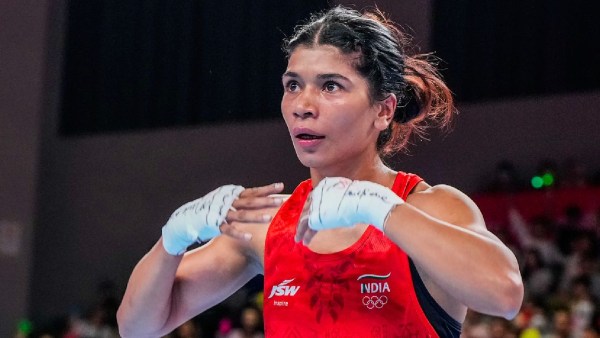 Nikhat Zareen returns empty-handed from Boxing World Championship after loss to familiar adversary in quarters. (File)
Another reason for the increase in taller boxers in India is a reason that plagues most Indian disciplines – poor grassroots education.
“If you acquire the technique at the right time and practice it, that particular boxer will go further. But even if you have many qualities and if your technique is poor, you cannot go further. Skill training has to be done at a younger age and the education has to be good,” says Chandralal.
When younger boxers turn up at elite levels sans these skills, Indian coaches often turn to taller body types for the women’s category. Men’s boxing, with its increased competition amongst a larger group of countries, operates on a different equation. India has only ever had one men’s boxer win an Olympic medal.
 Nupur (80+kg) celebrates her SF win with her coaches at World Boxing Championship 2025, Liverpool. (Photo Credit: World Boxing)
Chandrala cites the example of Haryana’s boxing and said that while the state was providing numbers, its quality was still not up to the mark. Cities like Bhiwani have been called ‘Mini Cuba’ in the past and have boxing academies that house 500-600 students – a number that is too high and not conducive to learn, according to Chandralal.
“It’s a business for them. And if you are training, you know, people in the mass, you cannot train the basics properly. The base needs that,” says Chandralal.
He also said that the influx of taller boxers was not because of their medal winning exploits but rather an answer to the boxing ecosystem throwing up overage boxers at the youth level and a decrease in Sports Authority of India’s regional centres housing sports like boxing. Chandralal believed that elite boxing coaching getting concentrated at the National Centres of Excellence, means that too few coaches are available for too many boxers.
“The talent is there all over the country. But smaller SAI centres should have boxing as a compulsory sport so that state coaches can continue working on boxers at the grassroots level,” says the Dronacharya awardee.