4 min read
© The Indian Express Pvt Ltd



 (From left) Racketlon men's world champion Leon Griffiths of UK playing badminton and squash.; Racketlon women's World No 2 Anna-Klara Ahlmer of Sweden, playing TT and tennis
 Leon Griffiths remembers the out-of-tune but joyous strains of ‘Happy Birthday’ at his sports club reaching his ears, while he spent his own big days shuffling from badminton’s honey-brown teak courts to tennis’ grass ones, as a racquet-sports obsessed introvert.
This weekend, as the Londoner was crowned champion at Racketlon’s World Tour Finals at the leafy Willingdon Sports Club in Mumbai, all those hours spent with just the thwack of a shuttle or ting of a ping pong or distinct click of finding the nick in squash, for company, seemed worth the silence. Racketlon involves four back to back games of TT, badminton, squash and tennis (in order of progressive higher racquet weight), played to 21 points each with 3-minute transitions. Leon, who won the World title beating brother Luke this August, wrapped up a fine 2025 for himself with the season-ending triple titles in India – including singles and mixed.
Racketlon is an extremely niche activity, needing top-tier facilities across all four racquet disciplines as pros hop from one court to next. Leon’s father played tennis, and badminton, his strong suit, came from his mother. His first World title at U13s however happened quite out of the blue. “Dad had a Swedish girlfriend earlier and we travelled to Stockholm on a whim along with my Uncle. I was entered in the U13 World’s at the last minute, and won the title,” he recalls.
 Racketlon men’s world champion Leon Griffiths of UK playing badminton and squash.
While he plays badminton at a fairly high level, the challenges to master all four sports can range from the short transition time to lugging around jelly feet in tennis so soon after squash has brutally inundated calves with lactic acid. “If you get into the TT groove because of the pace, you end up hitting shuttle late in badminton,” he laughs.
While the sport that started in Scandinavian countries in 70s, hasn’t attracted top names of individual sport, it’s a genuine outlet for the likes of women’s World No 1 Anna-Klara Ahlmer of Sweden, who grew up in Gothenburg. “I started with tennis, played squash one day because the courts weren’t free and got started in the sport where it was me and 25 guys! I found Racketlon when I was starting to bore of tennis, and it was fun to improve in other 3. I’d have quit sport if I hadn’t branched out because pro tennis gets monotonous. Racketlon was a second wind,” she says.
French woman Pauline Cave would win the Women’s title. For Leon, it took him 2 years to get really comfortable with all different techniques of all four sports. “Technical skills are transferable really,” he says.
Those like Dutch World doubles champ Koen Hageraats, are TT specialists, while a lot of Danes come from badminton. “All these sports have a common thread – positional tactics, playing fast points and finding opponents’ weakness. It’s fitness chess,” Leon laughs. Over the weekend, Mumbai’s 85-year-old journalist Rahul Singh became the sport’s oldest player.
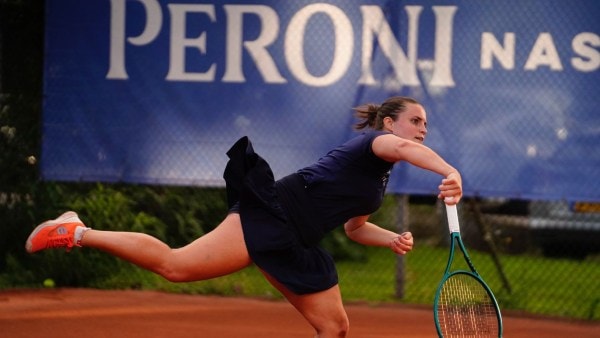 Racketlon women’s World No 2 Anna-Klara Ahlmer of Sweden, playing TT and tennis
Training can span 14-20 hours a week split between 4 sports for the top names, though building Racketlon’s identity almost sees many players not tune into watching individual events like Tennis Grand Slams or All England. “We play so much ourselves, I don’t watch a massive amount of sport. I’m really tall, like 6’4″ so I know I can’t play like Lee Chong Wei or Lin Dan or copy their style. Maybe Axelsen,” Leon jokes. “I watch football instead.”
Racketlon faced a bit-crisis when it started losing players to paddle briefly. “But paddle is really very simple, and too ‘easy’. Our players started returning because they craved the real intensity,” Leon ends.