


 India’s Seema holds the national flag as she celebrates after winning the bronze medal in the women's 10,000m final during the Asian Games 2026, in Nagoya, Japan, Thursday, Sept. 24, 2026. (PTI Photo)
Seema’s mother thinks she is in India.
She has no idea her daughter is in Japan, or that on Thursday night Seema was standing on the start line of the biggest race of her career, alongside Olympic champion Winfred Yavi and Japan’s Nozomi Tanaka. “I didn’t tell her because she is old and gets very tense,” Seema said after winning bronze in the women’s 10,000m. “So she still thinks I am in India. Maybe she will find out now.”
There was little time to think about home once the gun went.
The first 400m took 83 seconds. Then came the surges and slowdowns, the kind of stop-start rhythm that can turn a 10,000m into a test of patience as much as endurance. The field went through 1,000m in 3:18 and 5,000m in 16:52, still a remarkably slow pace for runners of this calibre. From the stands, Seema’s coach Scott Simmons realised the race wouldn’t be fast, also because Yavi had two more events to run and Tanaka another race to come.
Click here to read our Asian Games full coverage
On the track, Seema had seen the same thing. She led for only a couple of laps before realising nobody wanted to take responsibility for the race. “I came to know that no one will lead the race,” she said. “Because the best runners will wait for the final stretch. So I also changed my strategy.” Simmons adds: “You just have to be fit to begin with, so then you can handle whatever happens.”
Seema stopped chasing every move and stayed with the pack. One runner would accelerate, another would ease off. The field would stretch, then come back together. It was less about running at a steady pace than surviving everyone else’s changes. “Players do that so that we get tired and no one can finish the race,” Seema said. “So we have to work out with that strategy. So we did that. That was more beneficial.”
By 8,000m, the group had begun to shrink. Seema was fifth with three laps left, and moved up a notch. She went past Ruth Jebet, the Bahraini great, and Daisy Jepkemei of Kazakhstan. Three women were left in the medal fight, and Seema was one of them. For a moment, she thought she could win it.
Then Yavi and Tanaka, backed by the sparse crowd, found another gear. “I felt that I couldn’t win the race,” Seema said. “I also pushed. But I couldn’t push as much as they did.”
She did not need to win it. She stayed with them as long as she could, then held on to third as the two leaders pulled away.
That bronze-medal smile 🥉😊🇮🇳
Seema thanks the Indian fans in Nagoya after winning bronze in the Women’s 10,000m, 32:50.05 🔥
A wave, a clap and a flying kiss for everyone cheering her on 👋💙#AsianGames2026 #TeamIndia #IndianAthletics #Nagoya2026 pic.twitter.com/JRmGccqrXd
— Athletics Federation of India (@afiindia) September 24, 2026
Her time was 32:50.05, nearly 48 seconds slower than the personal best she had set in March. Yavi kicked into an incredible pace in the final lap to take gold in 32:39.18. But this race was never really about the clock. It was about reading the race, surviving its swings and being there when the medals were decided. Seema was.
She became India’s first women’s 10,000m medallist at the Asian Games since 2010. Simmons, she suspects, will be happier than she is. For three years, he has trained her at Colorado Springs, where she works in tough conditions alongside Olympic champions.
“He has always told me, ‘Seema, you are the best. You are the fighter,'” she said. “So today I thought that I will fight very well. And I did it till the end.”
The location has another significance. Los Angeles will host the 2028 Olympics, giving Seema a daily reminder of where she wants to be. “We train with Olympic champions. So our mindset is also the same. To compete.”
Her mother still thinks she is in India. Maybe now, finally, Kesari Devi will know she was in Japan all along.
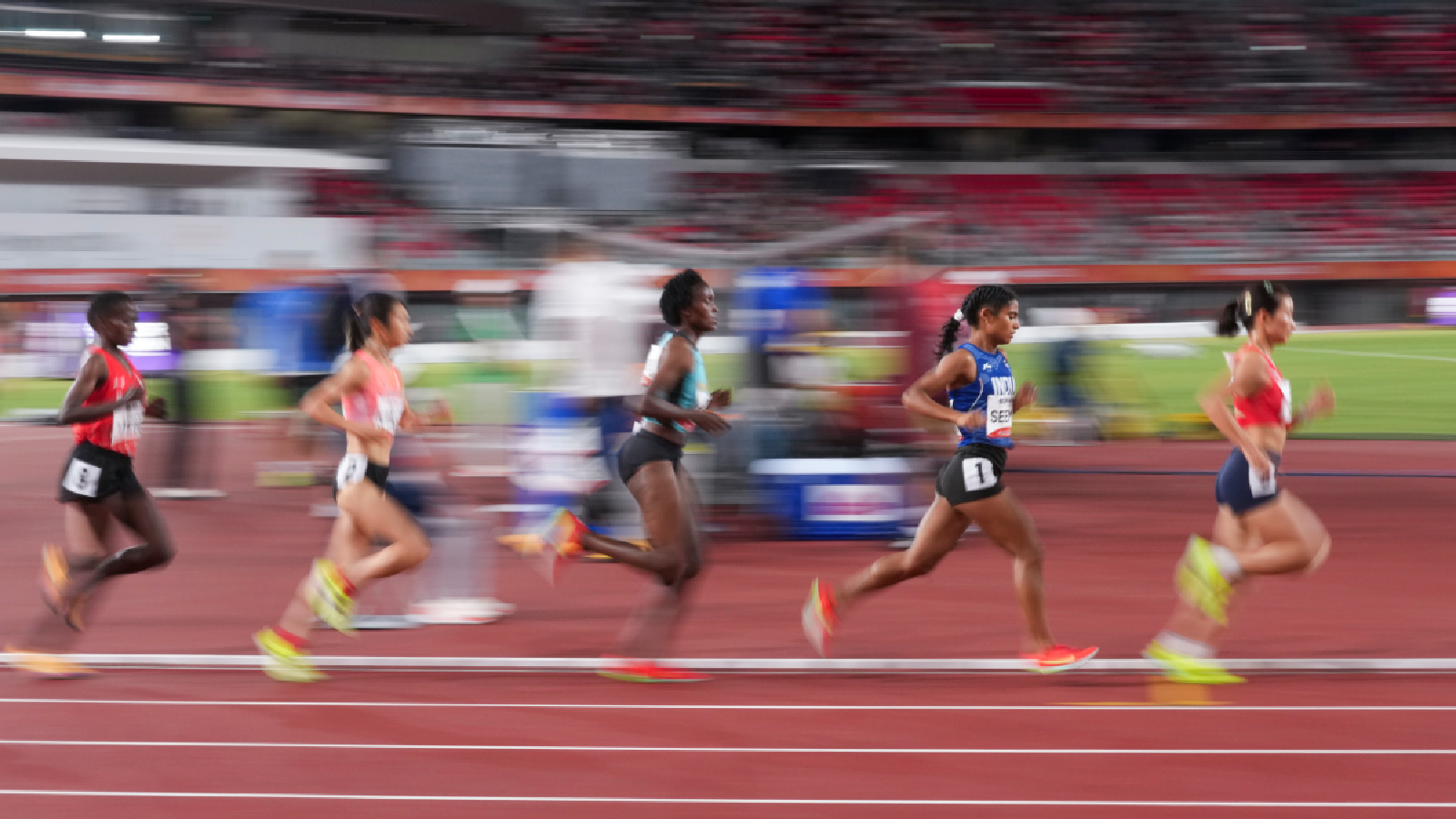 India’s Seema and others run in the women’s 10,000m final during the Asian Games 2026, in Nagoya, Japan, Thursday, Sept. 24, 2026. (PTI Photo)
*******
Devi was watching the telecast on the TV in their home — half of which has mud walls and the rest made from cement — in Retta village in Himachal Pradesh. Three of her brothers work for a daily wage. Her father, who once sold a goat to buy Seema running shoes, died of a snakebite in 2012.
“Seema was fond of running and would practice with her elder brother Surinder in the village. My husband used to work as a labourer, apart from managing the livestock. Before he died in 2012 due to a snakebite, he sold a goat to get Seema shoes. Post his death, when she was to appear for the SAI (Sports Authority of India) trials in Dharamshala in 2015, her brothers sold another goat to get her new shoes. Jhoote kharidne ke paise nahi hote the hamare pass aur aaj dekho Seema ne India ke liye medal jita hai Japan main (We did not have money to get her shoes, but today my daughter has won the medal for India in Japan),” an emotional Kesari Devi told The Indian Express.
Youngest of six siblings, Seema’s talent of running was spotted by PT teacher Hansraj in 2010 at the Government Senior Secondary School at Bhatka, which is a 45-minute uphill walk from her village. “While another brother Tej Singh and I work as labourers, my younger brother Surinder Kumar manages livestock,” 51-year-old Raj Kumar, the eldest of the six siblings, said.
Seema would begin formal training under coach Kehar Singh Patial at Dharmshala. Within six months, she would win the gold in 2000m in the junior Under-16 championships in Ranchi. “When I first saw Seema in the talent hunt, I was impressed by her stamina and endurance level to compete in longer distance races. When we carried out the physical tests, her speed was also good for long distance and we worked on her running style as well body mechanics and strength,” said Patial said.
Seema made progress at the national level over the past few years. A gold in the 10,000 metres at the 2022 National Games and bronze medals in the 5,000m and 10,000m at the Federation Cup the next year.
In 2024, she also won a silver in 5,000m at the World University Games in Germany with a timing of 15 minutes and 35,86 seconds, her second-quickest time in 5,000m. “Whenever she breaks a record or wins a medal, she makes sure to send me a picture and tells me to show it to the young athletes to motivate them,” Patial said. He expects a ping on his phone soon. This time from Seema, an Asian Games medallist.