


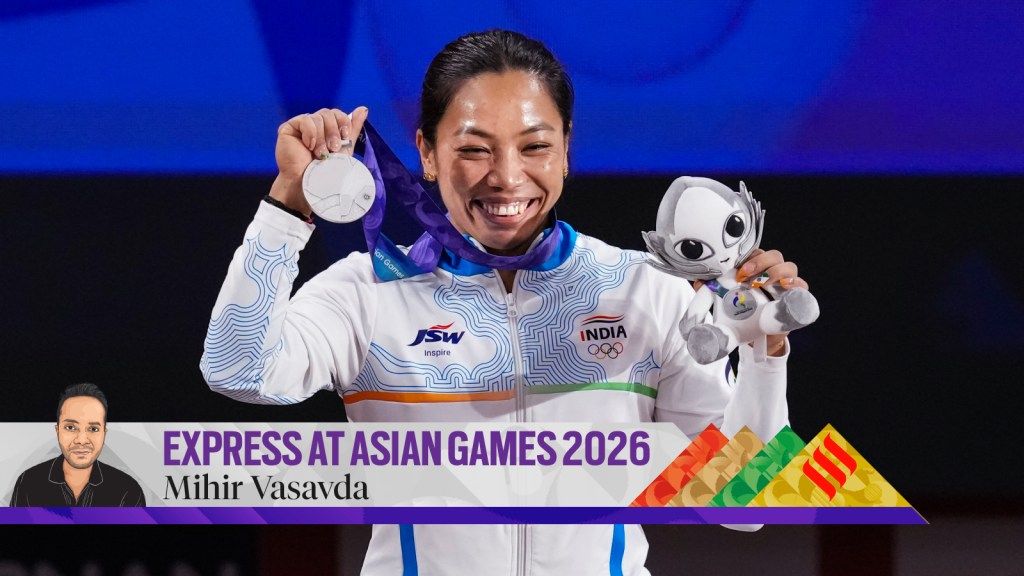
 India’s Mirabai Chanu holds a silver medal after competing in the Women’s 49kg Group A weightlifting final match during the 20th Asian Games, in Nagoya, Japan, Wednesday, Sept. 23, 2026. (PTI Photo)
Mirabai Chanu arrived in the mixed zone dancing.
There was a wide smile on her face, an Indian tricolour ribbon holding her hair together, Olympic rings dangling from her ears and the Indian flag painted on one of her nails. Around her neck hung the silver medal she had spent 12 years chasing at the Asian Games. She never took it off.
She smiled through almost every answer, occasionally breaking into a laugh, as if the weight of the medal around her neck had somehow made everything else feel lighter. “The pressure is gone. I feel very light,” she said. “This was the only thing missing. In a way, my life is complete now.”
For all that Chanu has achieved — an Olympic silver, a world title and three Commonwealth Games gold medals — there had always been one conspicuous gap. The Asian Games medal just refused to come.
She first competed at the continental event in 2014, when she did not produce the performance she wanted. In 2018, a back injury kept her out. In 2023, another injury cost her a medal. Each time, she left with the same question. “I asked myself, what happened? What is happening to me in every Asian Games?” she said. “I have everything. I have a gold medal. I am a world champion. I have an Olympic medal. I have three gold medals in the Commonwealth Games. Why am I losing the Asian Games medal?”
Mirabai Chanu nails all her three Snatch attempts, successfully lifting 83kg, 85kg and 87kg in a perfect start to her Asian Games campaign! 🔥
Watch the 20th Asian Games Aichi-Nagoya LIVE on Sony Sports Network TV channels & Sony LIV.#SonySportsNetwork #SonyLIV #AsianGames… pic.twitter.com/E1DnrjOhuB
— Sony Sports Network (@SonySportsNetwk) September 23, 2026
An overcast Wednesday in Nagoya was a ‘do or die’ situation for her to win a medal, which Chanu says was her dream since stepping into the elite ranks. While the Olympics may be considered the pinnacle of sport, Chanu has always viewed the Asian Games differently because of the depth of weightlifting in the continent. “In Asian Games, weightlifting is more strong in Asia, as you have North Korea, China, etc. I believe that medals in Asian Games are equal to medals in Olympics,” she said. “In the Olympics, it is less, and at the Asian Games, I feel it is more difficult.”
The difficulty was not just in the field. It was in getting herself to the start line. After the Commonwealth Games, there was little time to prepare. She had to keep her body weight within the 49kg category, while recovering from the injuries that have punctuated the latter part of her career. She spoke of the challenge almost matter-of-factly, but there was little doubt about the effort involved.
“It was very difficult for me to control my weight. It was very difficult for me to maintain 48. It was very difficult for me to maintain 49,” she said. In training, she would stay around 50.5kg, about 1.5kg above her competition category. That meant managing the demands of heavy training while keeping her weight under control. It was another balancing act for a body that had already endured years of elite competition and injury.
And perhaps that is what made this medal feel like the end of a chapter. The 49kg category, which has been part of Chanu’s competitive life for years, is disappearing from her Olympic horizon. Los Angeles, in a couple of years, begins at 53kg.
That means the next challenge will not simply be to compete at another Games, but also to build a different body for it. Chanu is already thinking about that transition, with the primary focus being on adding the right kind of weight without sacrificing the strength that has carried her through a long career.
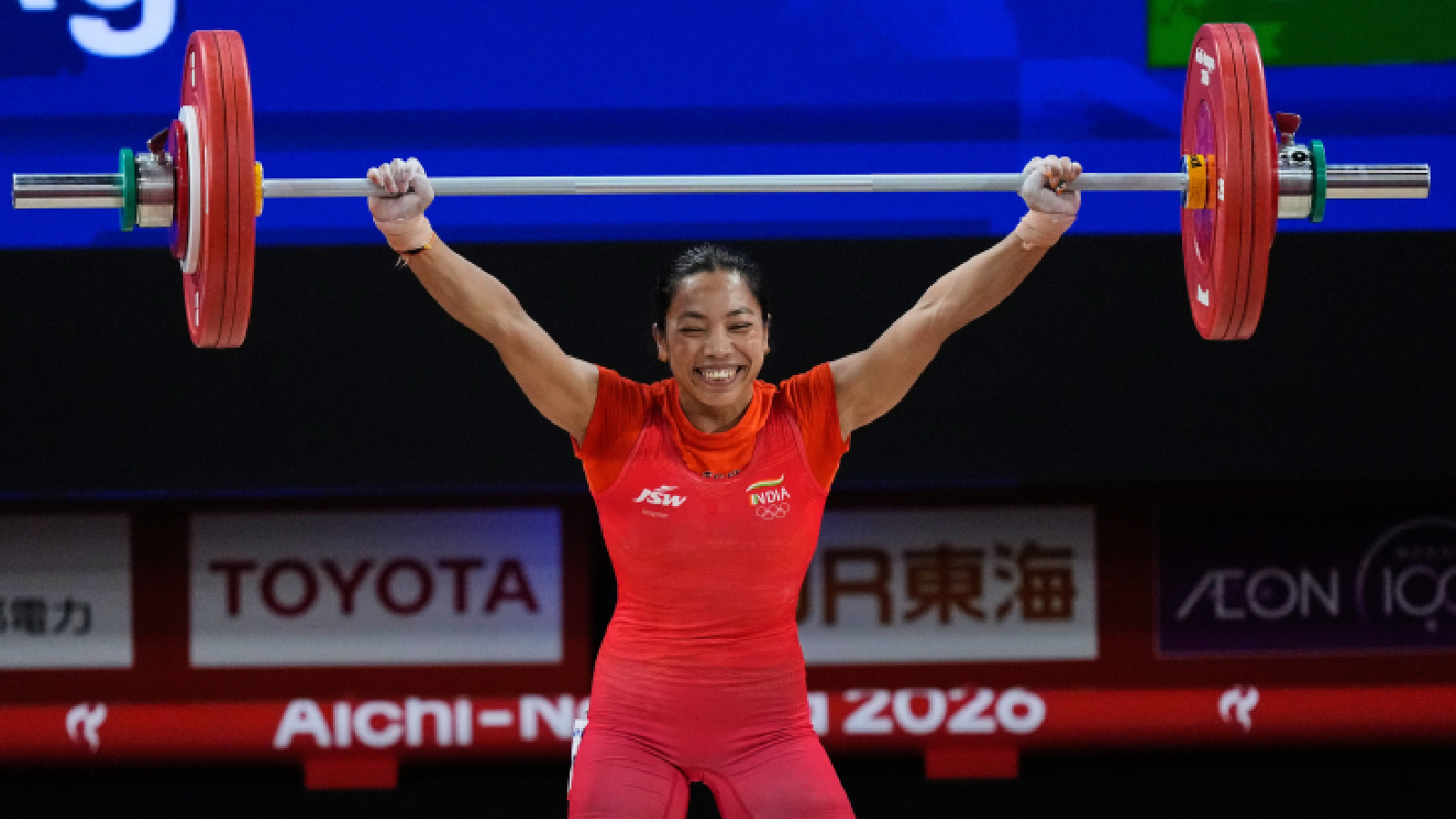 Mirabai Chanu Saikhom of India competes during the women’s 49kg weightlifting final at the Asian Games in Nagoya, Japan, Wednesday, Sept. 23, 2026. (AP Photo/Dita Alangkara)
“We don’t have to gain weight to compete in 53. We have to get the muscle ready first,” she said. “If I suddenly gain weight, my performance could go down and I could also lose strength.”
The plan, she explained, is to increase her weight while protecting her strength — more muscle, less unnecessary fat, and a carefully managed diet. “What to eat? What else do I have to change in my diet?” Chanu, who has already consulted a nutritionist, said. “If we get 53, then our strength can go. We have to control our weight with strength.”
But for the first time in years, she can make those plans without an unfinished Asian Games chapter hanging over her. “Qualifying (for Olympics) starts in December,” she said. “We haven’t decided anything yet. But for now, I will enjoy.”
And she did.
For once at the Asian Games, Chanu was not answering questions about a podium missed, or the injury that had cost her a medal.
She was simply wearing it, and smiling.