THE night would never end for Morocco.
The night of December 10, 2022, will remain etched in the country’s history. That night they beat Portugal, Portugal of Cristiano Ronaldo and Bruno Fernandes, of Bernardo Silva and Ruben Dias, to reach the semi-finals of the World Cup.
A country would celebrate for as long as they could; a continent was making its first big imprint, as Morocco were the first African country to reach the last four of a World Cup. En route they had overwhelmed the most European of European teams — Belgium, Spain and Portugal.
The celebrations had begun even before the game. There was a draining buoyancy among the fans that they would see this night through without pain. The volume they raised was head-splitting, like two amplified loudspeakers fitted into your ears. They ended the game with 10 men but it barely mattered because it seemed like Portugal were playing 11 versus 11,000 perhaps more.
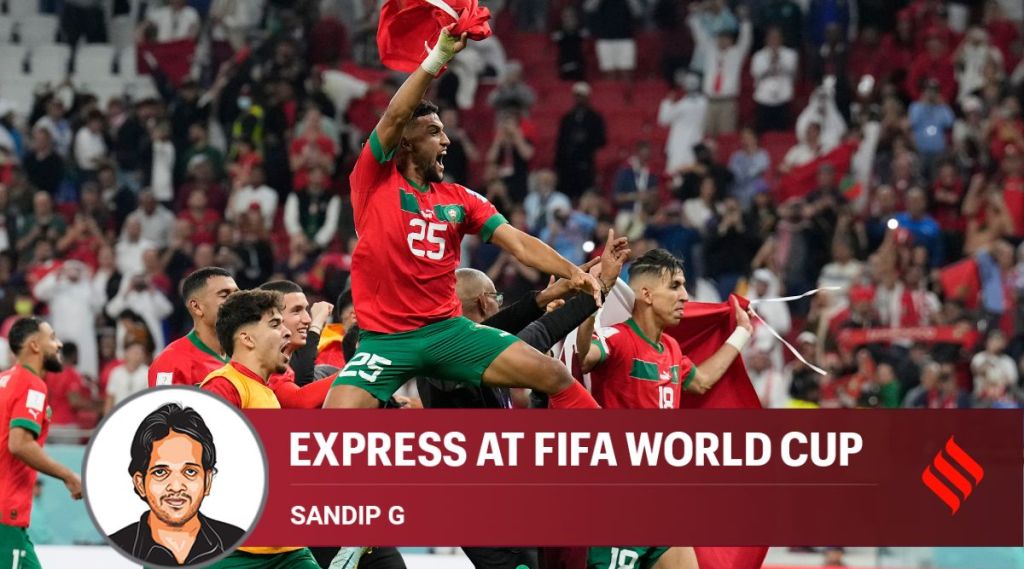
The stadium transformed into an amphitheatre of red. It seemed this was Rabat or Tangiers. And when the final whistle blew, after eight agonising stoppage minutes, they sang and danced as though it were the Timitar Music Festival.
The celebrations on the field have a familiar pattern: the players would kneel down in a prayer, hug their parents, toss their coach Walid Regragui in the air a few times. Except, this night, everything was longer, faster, more energetic and emotional, seemingly endless. “The dream is not yet over,” said Regragui amid teary journalists from Morocco. Almost all of them thanked him for what one reporter called “the most unbelievable night in my life.”
Remarkably, this was a dream run that came without caveats and asterisks. There was little favour or fortune; this was a win of sweat, belief, bravado. The sparkle of fandom and stardom didn’t dazzle their eyes and yet Morocco nursed not an iota of insecurity.
When their adversaries stared at them, they stared back. When they attacked them relentlessly, they didn’t wither. In their journey to the semi-final, they have conceded just a goal — that too an own-goal.
That is one goal in 480-odd hours.
They are unlike Greece of Euro 2004, more like Italy of World Cup 2006. Romain Saiss is no Fabio Cannavaro. Yet, their defence has been rock-solid yet elegant, impregnable yet classy.
An unflinching streak of ambition runs through them, coach Regragui is hardly fazed by the sudden attention. When asked about the possibility of an African team winning the World Cup, he said: “Why can’t we? Why can’t our players dream? You have to dare to dream. You have to have that ambition.”
The height of Morocco’s ambition could be measured in the leap of Youssef en-Neysri for their game-defining goal.
The forward sensed the fleeting confusion between Diogo Jota and Portuguese goalkeeper Diogo Costa over snuffing out a floaty cross. Jota was in two minds and froze; Costa presumed Jota would clear. No one did, laying the path for Neysri to storm in, out-jump Costa and plant a rip-roaring header to send their passionate fans into delirium.
Neysri craned every cell of his neck, strained every muscle of his face, reached as far as he could, and hung for a split second in the air to find the perfect placement. It was the kind of jump and goal Ronaldo is famous for scoring. But the 37-year-old aging super star was on the bench. It was the night of heroes, newer and younger.
As Neysri, 25, collected the ball from the nets still shaking with the power of his header and kicked the ball into ether, the fans, a sea of red, flowed out of their seats.
The goal itself was an aberration in a hitherto scruffy game when neither side struck any fluency or rhythm. Possession kept exchanging every second, managers kept gesturing at their players, screaming, to narrow down the space, press harder, man-mark more vigorously, scowling at a player not keeping the team’s shape.
The match suddenly swung open, as if a nudge was all it required, not the knocking and hammering. In the next three minutes, the Portuguese looked more vibrant than they ever had been in the game. Bruno Fernandes came up with an outrageous angled volley but it struck the crossbar. Shortly, he had a vocal penalty plea turned down.
How the game would unfold became predictable: Portugal would unleash the heavy artillery, wink changes, open up and make the game more direct. In the direst of moments, their semi-final dreams hanging by the slimmest of threads, Portugal’s coach Fernando Santos introduced Cristiano Ronaldo in the 51st minute. He immediately sent in a cross from the left, which posed a threat but the goal didn’t materialise.
Suddenly, Portugal’s game found sharpness, a sense of purposeful desperation, a fillip of hope.
Fernandes was at the heart of the revival, threading passes, laying through balls, and at times having a shot at the goal himself. Morocco clung on defiantly, blocking, scraping, shovelling, performing every trick to keep the lead intact. There was always a man, somewhere, somehow, denying the star-studded Portuguese forward-line.
Often, it was keeper Yassine Bounou, aka Bono, the impenetrable, unbreakable rock of Morocco. Six minutes from normal time, Joao Felix curled in a ferocious shot from just inside the box. The ball was wickedly bending in and devilishly dipping.
Bono was unsighted, but still managed to tip the ball over the crossbar into the tier behind him, where the Moroccan fans kissed the ball and threw it back at him.
His anticipation in stubbing potentially dangerous crosses or moves remained immaculate all through the game. Fittingly, the teammates carried him on their shoulders into the Moroccan night — endless and sleepless.


 Share


