In 2021, like many previous years, when the people of France voted for their favourite dish, they picked something that didn’t seem French enough – the humble couscous. A staple of Maghrebi cuisine, it was seen as another sign of the increasing Moroccan influence on French culture, from food to literature.
Around the same time, as the locals dug into their favourite comfort food, another prickly issue cropped up – visas. The French government decided to reduce the number of visas issued to Moroccans by up to 50 per cent, triggering a major dispute.
These two incidents capture the complex relationship between Morocco and France. Quite naturally then, Wednesday’s World Cup semifinal between the two countries feels like much more than a game of football: it’ll pit one friend against another; individuals representing their roots, facing the country of their birth.
The match also has a wider historical and political context. On its path-breaking run to the last four of the World Cup, Morocco have knocked out one former colonial power, Spain, who ruled over a part of the country in the 20th century. In France, they take on another country that once colonised them – until 1956.
The colonial past is seen as one of the reasons for Morocco having a huge diaspora in France. Compared to the North African country’s population of close to 38 million, roughly five million Moroccans have made France their home. As of 2019, they formed the second-largest non-European Union immigrant population in France, roughly 18.4 per cent of the total figure.
It reflects in the make-up of this Moroccan side, which became the first African country to reach the semifinals of the World Cup. Three members of this unit – coach Walid Regragui, captain Roman Saiss and Sofiane Boufal, one of their standout performers – were born in France.
“I am a dual national. It is an honour and pleasure to play against France but it is just football… When we play for Morocco, we are Moroccan,” Regragui, dubbed as the ‘Moroccan Guardiola’, said on the eve of the match.
Regragui is tasked with the seemingly-impossible job of halting the French juggernaut. One would guess, though, he might be better placed than many to get the job done. Regragui played alongside Olivier Giroud, France’s all-time top-scorer, for Grenoble in 2008. And one of his key lieutenants, Achraf Hakimi (among the five Moroccans plying their trade in France), is a good friend and a teammate of Kylian Mbappe, by far their biggest threat, at French giants Paris St-Germain.
‘Test of loyalty’
Hakimi and Mbappe have been exchanging pleasantries on social media ahead of this tie that has split the sporting allegiance of French-Moroccans. Rim-Sarah Alouane, a legal researcher on discrimination and civil liberties at the University of Toulouse, was quoted as saying by Reuters that the match will be a ‘test of loyalty for French citizens of immigrant origin’.
French far-right politician Eric Zemmour, an ex-candidate for the French presidency, said in an interview on BFM TV: “I find it weird that there are more people, who are supposed to be French, and who celebrate Morocco’s victory on the day France wins. You can’t be for one or the other.”
His statement came after nearly 20,000 people poured onto Paris’ Champs-Élysées after Morocco defeated Portugal in the quarterfinals. They celebrated all night, but it turned sour after clashes with police were reported. As per Le Figaro, Paris police arrested 108 people while 70 more were arrested in other parts of France.
On paper, on form and fitness, battle-ravaged Morocco have little chance of defeating high-flying France. But after seeing the fate Belgium, Spain and Portugal met, France will underestimate Regragui’s football revolutionaries at their own risk.

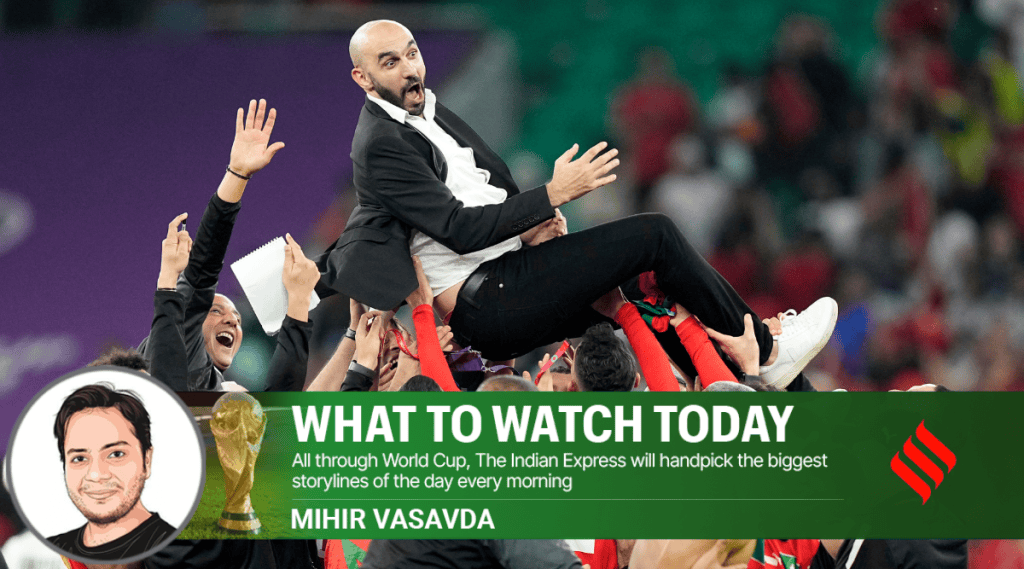 Morocco coach Walid Regragui. along with captain Roamin Saiss and Sofiane Boufal, was born in France. (AP)


 Share


