
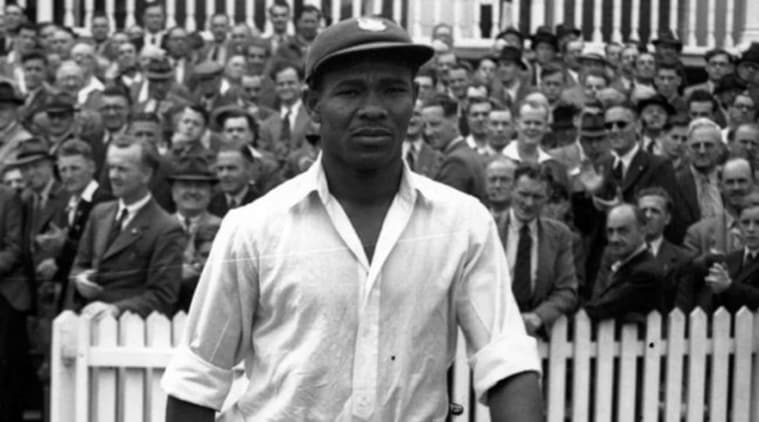
 Worrell became the first Black captain of the West Indies in 1960. (Source: Twitter/@ivivianrichards)
Everton Weekes, one of the famous three ‘Ws’ of West Indian cricket, passed away at the age of 95.
The Three Ws – Frank Worrell, Clyde Walcott and Weekes – were all Barbadians born within 18 months of each other, not too far apart in distance and made their debuts for the West Indies at around the same time. Their time together coincided with the period when teams from the Caribbean were making their initial mark in the game – they even won a series in England in 1950 – but were still led by Whites.

Everton Weekes (on right in pic) passes away aged 95. In 1948-49 he scored 5 consecutive Test centuries, a record that still stands. The 3 Ws including Frank Worrell (left) & Clyde Walcott (centre) who enthralled the cricket world reunited again, now in the Elysian fields. RIP pic.twitter.com/CubJMmSOBm
— Cricketwallah (@cricketwallah) July 2, 2020
Worrell became the first Black captain of the West Indies in 1960 and Garfield Sobers came to the height of his powers in the subsequent decade. Walcott was the first Black captain of British Guiana in 1956, and Weekes likewise for Barbados in 1960.
Worrell, Weekes, and Walcott batted at three, four and five during that landmark series in England, and along with the guile and skill of spinners Alf Valentine and Sonny Ramadhin, were key to the come-from-behind 3-1 victory.
Weekes, who passed away in his native land on Wednesday at the ripe age of 95, was the last survivor of the famous triumvirate and one of the most prominent links with the early years of West Indian cricket at the top level. By several accounts, he was the best batsman of the three.
Arriving in style
All three Ws made their Test debuts against England in 1948. Weekes scored his maiden hundred in the final match of that series in Jamaica, and then went on to rewrite the history books during the subsequent tour of India.
Hundreds in Delhi and Bombay were followed by tons in each innings in Calcutta as the Barbadian became the first – and till date only – batsman to hit centuries in five successive Test innings. It could have been six on the trot had Weekes not been adjudged run out for 90 in Madras, a decision, he later told cricket commentator Tony Cozier, was “rather doubtful.”
Weekes’ record of reaching 1,000 Test runs in only 12 innings is matched only by Herbert Sutcliffe. His powerful, aggressive batting style won him many admirers.
Everton Weekes the first & only batsman to score 5 Test Hundreds in 5 consecutive inngs – passed away at the age of 95.
141 v England, Kingston 1948
128 v India, Delhi 1948
194 v India, Mumbai 1948
162 & 101 v India, Kolkata 1949Scored a 90 in next test inngs.#RIP pic.twitter.com/YwDiaJNeJY
— Cricketopia (@CricketopiaCom) July 1, 2020
“He set out to hammer bowlers. He was a fierce hooker, puller and square-cutter, but at the same time, a terrific driver,” is how Richie Benaud remembered him, according to Cozier.
Weekes compiled 4,455 runs in 48 Tests with 15 hundreds before a thigh injury prompted a premature international retirement in 1958 when still only in his early 30s. His batting average of 58.61 is the second highest for the West Indies after George Headley – and the 10th highest overall among those who played at least 20 innings. He displayed his fondness for Indian bowling once again in the home series of 1953 with another three hundreds. On the trip to New Zealand in 1956, Weekes had another three on the trot.
Rising from penury
But Weekes’ story would be incomplete without a mention of the deprivation and discrimination he suffered in his initial years. Blacks were barred from watching cricket at Bridgetown’s Kensington Oval, and it was only on account of being on the ground staff that the young man could see the likes of Headley and Wally Hammond in person in 1935.
READ | Everton Weekes to feature in CAB’s Cricket Museum at Eden Gardens
“I was 10 years old and stayed on after helping the ground staff, otherwise I couldn’t have paid the entrance fee,” he told Cozier several decades later.
His batting style was formed by rough neighbourhood cricket on ill-prepared pitches. But he rose through the ranks on the basis of sheer talent and determination to be one of the leading lights of West Indian, and world cricket, and reached very close to a century in life, a landmark he had made a habit of attaining on the cricket field.


 Share


