7 min read
Stay updated with the latest sports news across Cricket, Football, Chess, and more. Catch all the action with real-time live cricket score updates and in-depth coverage of ongoing matches.

Journalism of Courage



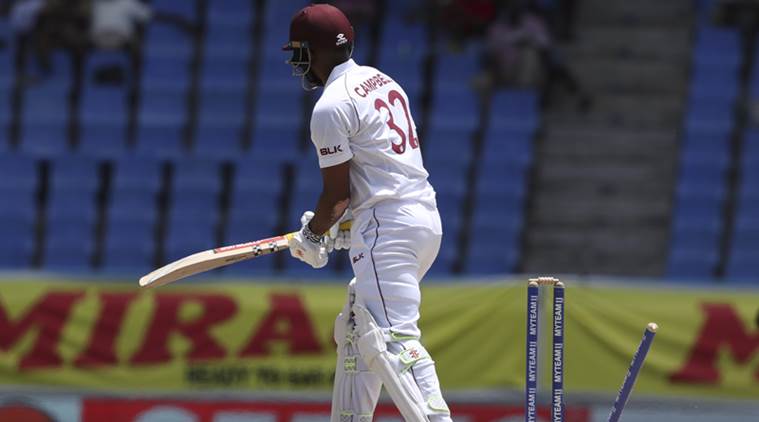 West Indies’ John Campbell is bowled by India’s Mohammed Shami during day two of the first Test cricket match at the Sir Vivian Richards cricket ground in North Sound, Antigua and Barbuda. (AP)
As Kemar Roach and Miguel Cummins freewheeled to an entertaining last-wicket stand, the highest of the West Indies second innings, providing comic relief, the crowd began chanting: “Roach, Roach, Roach, he’s our best bowler. Roach, Roach, Roach, he’s our best batsman. Roach, Roach, Roach, he takes the new ball. Roach, Roach, Roach, he’s our opener.”
Though West Indies wouldn’t embrace such outlandish measures — Roach once hung around with Shivnarine Chanderpaul for a famous win against New Zealand in Kingston, his Test best — their batting line-up prompts as much investigation as revision. Though the skipper and all those associated with their cricket swear by the potential of their young batsmen, some of their choices have been questionable.
For instance, debutant Shamarh Brooks at No 3. Though the 30-year-old is a seasoned domestic hand, having collected 73 caps for Barbados, he seemed utterly out of sorts against India’s new-ball fury. It was, to an extent, understandable in the first innings, but in the second when Jasprit Bumrah and Ishant Sharma had provided ample proof that they were raging hot, the hapless Brooks was again thrust into the middle. There were others, like Roston Chase and Shai Hope, more experienced and in better touch. Brooks made 11 and 2, and probably had his confidence shattered.
The case of Chase and Hope is even more baffling. The pair, who famously battled out a draw against India in Jamaica in 2016, is considered their best Test players, alongside opener Kraigg Brathwaite. Both are technically organised batsmen who can dig in, see off attacks and lay the foundation for a competitive total.
READ | Watching Bumrah with Roberts: ‘Wish we had him’
Instead, Chase batted at Nos. 5 and No 6, Hope came in at 6 and 7. Too low to influence a Test match. It could be that Chase had bowled a combined 54 overs in the match and Hope kept wickets for nearly 210 overs. But to protect the batsmen best equipped to deal with the demands of a Test match, and push a debutant with a first-class average of 32 is as suicidal as it is farcical.
Then the case of skipper Jason Holder, West Indies’s last double centurion. He peeled it out on his home ground of Kensington Oval against England early this year, and soon after the match, announced that he would like to bat higher up the order. And in this West Indies team, sans the Laras and Chanderpauls and Sarwans, he has looked more assured and adequate than most of their top-order batsmen. But is he, like Chase and Hope, too exhausted from the toils on the field and the unenviable demands of leading his side? Tough as leading a bunch of islands with different cultures and dialects is, and he has led them admirably, self-promotion in the batting line-up wouldn’t have been considered selfish, rather it could have magnified his aura and lent more stability to the side.
The top order could not escape blame either, and Holder did point a finger in their direction after the first-innings capitulation. “Extremely disappointed. It’s been a common thing for our batsmen now. We have not been able to step up as a top order, the middle and lower order have done an exceptional job,” he had said. If the top order is flaky, barring Brathwaite, blaming them is deflecting attention from the real issues plaguing West Indies cricket.
What then is at the bottom of the batting collapses? Is it technical or temperamental? Is it a question of will or motivation? Is it a question of talent? Are their techniques conditioned by T20 cricket (any discussion on batting anywhere in the world, and this thread will pop up). Most of the former players, including batting consultant Ramnaresh Sarwan, swear by their potential. “Talent has never been an issue with West Indies cricket. We keep producing them. It’s a case of applying themselves out in the middle,” he had told this newspaper before the start of the series.
READ | ‘Endless blues’: Virat Kohli and teammates enjoy yacht party with Anushka Sharma
But West Indies churning out good batsmen in bounty has always been a myth. Barring their glorious years of the 3Ws and the Lloydean bunch of Desmond Haynes, Gordon Greenidge, Viv Richards and Richie Richardson, their bating had revolved around the feats of a few great batsmen. Rohan Kanhai, Alvin Kallicharan and Roy Fredericks during different phases in the 70s, and then largely Brian Lara, Shivnarine Chanderpaul and Ramnaresh Sarwan, lending respectability and sometimes conjuring the magical to amplify the batting riches in the Caribbean.
In between, there were a lot of mediocre batsmen or those who failed to maximise their potential, Marlon Samuels, Wavell Hinds and even Chris Gayle, in this format. There have been eye-catchy batsmen, no doubt, but few of genuine Test mettle. The incumbent batting line-up betrays a lack of quality at this level, even first-class level, on surfaces that have supposedly slowed down.
Just look at some of their first-class figures: John Campbell, their opener, averages 29. 42 with just three hundreds in 114 innings, Brathwaite’s is a notch better, 38.72 with 21 centuries in 256 innings; Brooks has just five hundreds from 125 innings, his runs coming at 32.90. Just for perspective, compare them to India’s top three: KL Rahul averages 47; Mayank Agarwal 49 and Cheteshwar Pujara 54.2. This illustrated not just the gulf in batting quality between the sides but also the reality that West Indies batting, even at first-class level, is modest.
Watch IE Video:
Even Chase and Hope don’t have numbers that flatter them: Chase scores 39 runs an innings; Hope 38. The profusely talented Shimron Hetmyer belts it at 33. Observes former wicketkeeper Jeffrey Dujon: “When we were playing, there were a lot of them who averaged in the mid-40s who had to sit out because the national side was full. There was competition, but it’s no longer the case now,” he says.
The regional four-day competition’s run-chart only validates his observation on the talent drought. In the most recent edition, only one batsman managed a 50-plus average among the top-10 run-getters, Anthony Bramble of Guyana. Four others managed 40 or thereabouts. And when you delve a bit deeper, it was more a case of one breakout season than sustained run-making. Bramble, for instance, averages 31. So rather than shoving the blame around, the powers that be need to install a system to spot and groom talent, and ensure they don’t drift. Then crash batting-clinics, pep talks and batting order shuffles can be organised.
But as it is now such a middling bunch, expecting them to negotiate the versatile Indian bowling is merely wishful thinking. It’s not to tarnish them — they showed lot of courage and stickability against England early this year. They are not entirely bereft of talent — in Hetmyer, Chase, Hope and Holder, they have promise — but there’s a genuine paucity of batting talent in the Caribbean. It has been blowing in the wind for ages, only that they have yet to fully comprehend it. Or rather, they have let romance blur the reality and find little joys in a No. 9 freewheeling.
Stay updated with the latest sports news across Cricket, Football, Chess, and more. Catch all the action with real-time live cricket score updates and in-depth coverage of ongoing matches.