


- Tags:
- chess
- chess news
- Chess Olympiad
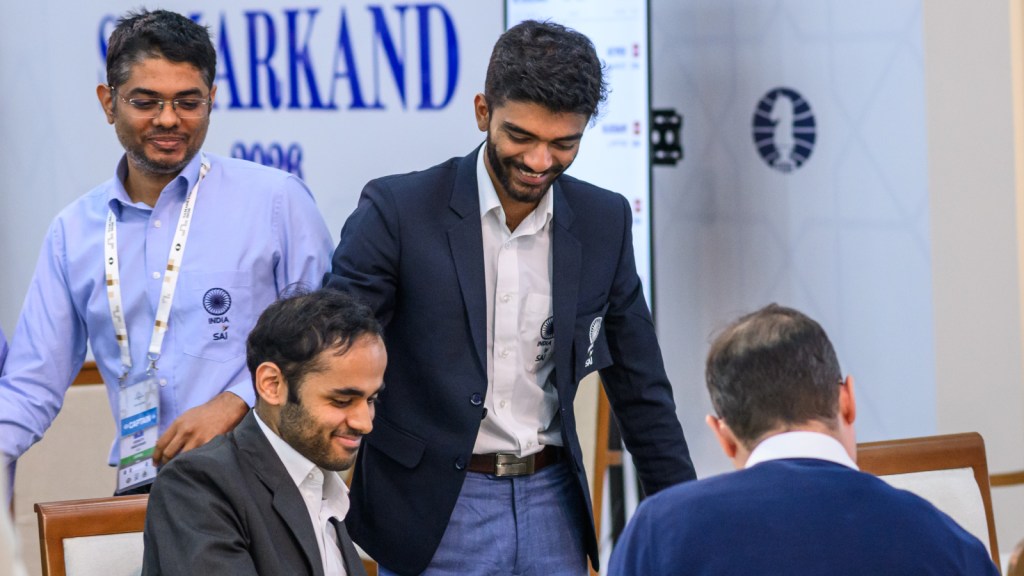 Arjun Erigaisi delivered a crucial win, helping India win a silver medal at 2026 Chess Olympiad. (Michal Walusza/FIDE)
It was an afternoon of stark irony. D Gukesh, the lynchpin of India’s campaign and seemingly unbreachable throughout the tournament, was being comprehensively outplayed on Board 4 by Hungary’s 2560-rated Gleb Dudin. A few feet away, Arjun Erigaisi, weathering days of scrutiny after a quiet tournament by his dizzying standards, pushed veteran Peter Leko into a corner to keep the final round match of the 2026 Chess Olympiad on a knife-edge.
Retaining their Budapest crown always required some miracle. A win against Hungary was non-negotiable, and even that depended on a ruthless Uzbekistan side somehow stumbling against Ukraine in the last round. Neither happened. When Gukesh finally extended his hand in resignation, suffering his first Olympiad loss since that heartbreaking encounter against Nodirbek Abdusattorov in 2022, there was somehow little outward despair on his face.
The maths had already settled the matter. Uzbekistan cruised to victory against Ukraine, meaning that regardless of how Gukesh’s board unfolded, even a flawless Indian sweep on the day would not have stopped the gold from slipping away. But with millions of heartbeats racing back home, Arjun calmly converted his endgame to rescue a 2–2 draw, locking down a hard-earned silver for an Indian side that simply refused to leave Samarkand empty-handed.
For hosts Uzbekistan, this gold is another marker of their rapid rise in world chess, an Olympiad title won in front of a home crowd. The favourites lived up to the billing, finishing with 20 match points, two clear of India and Germany, to crown themselves deserved champions.
The triumph repeats Uzbekistan’s historic 2022 gold and reaffirms their status as India’s biggest challenger. Between them, the two nations have now swept the last four Olympiad titles, including the online edition of 2020.
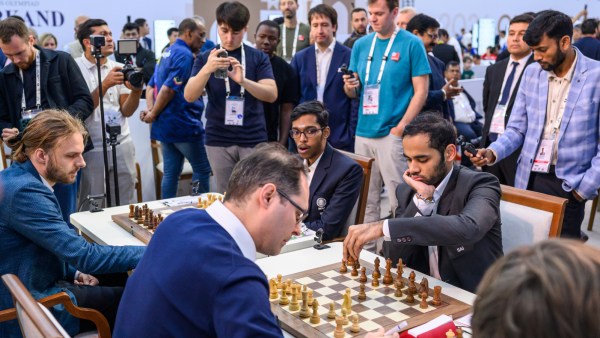 India were held to a 2-2 draw by Hungary in the final round of 2026 Chess Olympiad. (Michal Walusza/FIDE)
India ended their campaign with 18 match points and 28.5 game points, tied with Germany on both counts. But the defending champions took silver on a superior tiebreak (TB2), having won the head-to-head clash. Germany, the giant-slayers who toppled top-seeds USA and were the only side to beat Uzbekistan, had to settle for bronze.
Hungary, meanwhile, punched well above their weight to nearly trip the Indian giants. The same side that had been thrashed 4-0 by Uzbekistan came hard at India, with Richard Rapport and Benjamin Gledura closing out solid draws against R Praggnanandhaa and Nihal Sarin to give them nothing to play for. It took a much-needed win from Arjun, following Gukesh’s unfortunate loss, to keep India afloat.
India had kept themselves in contention for gold right up to the final day, but it was their loss to Uzbekistan that stung the most. From a winning position, a blunder from Nihal Sarin against Nodirbek Yakubboev cost India crucial points, and from that moment on, it became a chasing job.
For Indian captain Srinath Narayanan, however, the takeaway was the silver that was won, not the gold that was lost.
“We played stronger for most of that match and utilised the advantage. Even in Nihal’s game against Yakubboev, Nihal was clearly the one playing better. Uzbekistan probably realised that by winning that match, they had beaten the one team that could seriously push them,” Srinath told The Indian Express.
“It was a massive setback for us, like a final before the final. Uzbekistan winning that gave them a huge step forward… the confidence, the momentum, everything.”
“It was an Olympiad decided by fine margins. If that fixture had gone our way, we probably would have been favourites for gold. But with that match point against us, silver is a fair result,” said Srinath.
Grandmaster Vaibhav Suri, part of the Indian coaching contingent and trainer to R Praggnanandhaa, agreed with that assessment, preferring perspective over autopsy.
“The number of misses we had was still relatively small compared to the mistakes made by other teams,” Suri said. “Naturally, we focus on the Indian players, but across an entire tournament, no run is ever going to be completely clean.
“Budapest in 2024 was an anomaly; that is simply not how Olympiads unfold historically. We need to be slightly careful micro-analysing these mistakes and errors. At the end of the day, you need players to stay in the right headspace because there is always another round to play. You have to keep a steady, forward-looking attitude.”