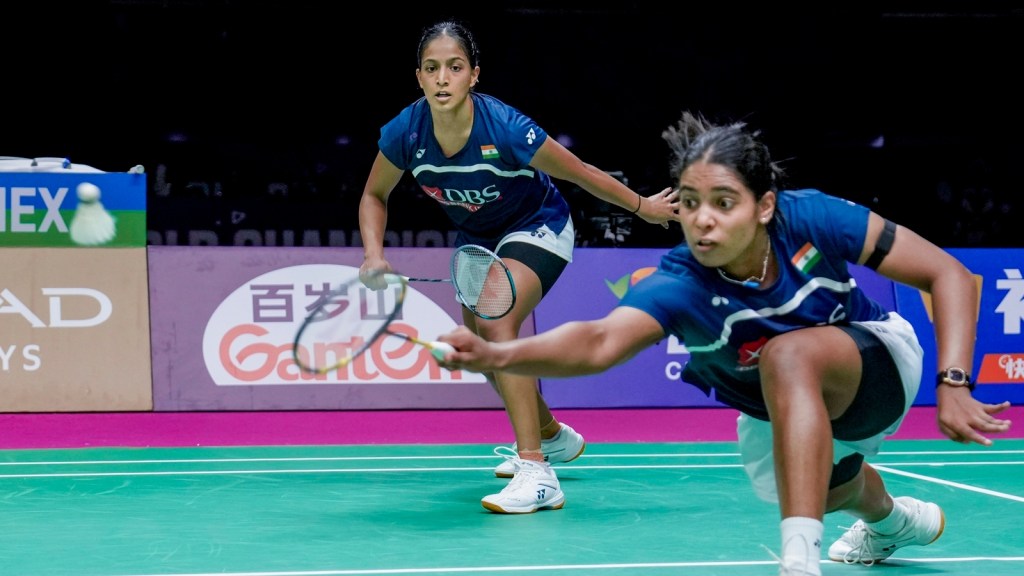
Treesa-Gayatri, Unnati beat higher-ranked opponents, reach Asian Games last 8

India’s doubles duo defeated World No 3 Japanese pairing Yuki Fukushima and Mayu Matsumoto 24-22, 21-18 and Hooda followed it up with a 21-19, 21-13 win over WR 6 Putri Kusuma Wardani

Treesa-Gayatri have gone about the Asian Games, doing the "needful." (PTI Photo)Treesa-Gayatri have gone about the Asian Games, doing the "needful." (PTI Photo)

Getting into the Asian Games team isn’t always easy. Though, once there, you might even reach the quarterfinals – last 8 – like Treesa Jolly-Gayatri Gopichand and Unnati Hooda did.

A fortnight before the World Championships, those in charge of firming up badminton entries were politely asked by those clearing the squads headed to Nagoya, if Treesa-Gayatri deserved to be on the Asiad team. Their ranking was down because Treesa was nursing an injury and hadn’t been on the circuit. Those asking, were politely told that the selection would hold.

Click here to read our Asian Games full coverage

The pair of 23-year-olds haven’t stopped creating one upset, after another, ever since. The World Championships at Delhi saw them claim India’s only bronze. And though the doubting-drama never reared its head again, Treesa-Gayatri have gone about the Asian Games, doing the “needful.”

In the space of a week, the duo has twice brought down the Japanese World No 3 pairing, first in the Team event, India’s only win in a 1-3 tie loss. And on Saturday, in the Round-of-16 of the individual event, as they defeated the hugely experienced Yuki Fukushima and Mayu Matsumoto, who have 7 World Championship medals between them, with a 24-22, 21-18 takedown, to reach quarterfinals.

This means they are in Asia’s best 8 at the moment, after being in the World’s best 4 at Delhi, a month ago. Treesa-Gayatri politely proved a point with wins — four top-ten scalps in a month. They won’t pretend former World runners up, Pearly Tan and Thinaah Muralitharan of Malaysia, will be easy to beat. But they will work hard on their plans, and execute them earnestly, and a shade impolitely – like Treesa’s wicked corner-net dribbles, that saw decorated Fukushima, literally pull her hair out in frustration.

These dribbles were practiced on days spent nursing the ankle – sometimes sitting on a bench because she could barely stand up. There were other tactics. Matsumoto and Fukushima might’ve learnt exactly what the Indians do to confuse them. Treesa reins in her titanic smash attack and turns it into a proper tease – sliced drops after a jump that plop like the first of raindrops on the front court. The Japanese, 31 and 33, were left pleading for the smash to arrive, for their defense could tackle it. Then there was Gayatri.

Her hand-speed is two clicks quicker so the reactions are lightning fast. She knows a smash is a drizzle, a tadkaa, a lime-squeeze or a garnish — not the main course. She kept alternating attacks on the body with the one on flanks, the tipples to the net with the clears to the back, keeping them constantly guessing. It’s creative, yet physically demanding. But opponents are struggling to know what Indians are up to. That said Indians themselves don’t overthink the rally. Coach Gopichand kept asking Treesa to not use the smash as a sledgehammer, but a syringe-prick. Hit one, then back off, float the next, then one more, and then sting with the smash again.

Story continues below this ad

The top Japanese pair, with home support, and two seasoned coaches, just couldn’t clear the maze. But for those who politely wondered if this pairing were good enough for India, these wins might momentarily suffice.

Unnati beats World No 6

Unnati Hooda, who has dared to enter the Top 30 realm to line up behind PV Sindhu, has faced edgeways-questions too. Does she deserve to play India’s second singles? Why doesn’t she join up with a known academy? And the most laughable of all: Why is her footwork so poor?

After she defeated World No 6 Putri Kusuma Wardani, 21-19, 21-13, court-side coach Guru Saidutt sitting for her match, guffawed. “Both her opponents were technically solid, had great footwork. She still beat them! She has something else – the ability to keep the shuttle in play. Grit. Even when she is tired, she just doesn’t leave the shuttle. And that wins you matches. Footwork is alright,” he chuckled.

Unnati had played an arduous, sapping 80-minute match against Malaysian Wong Chin Lin, winning 21-14, 20-22, 21-19. The Asian Games schedule demanded she show up within three hours, to play the World No 6.

Story continues below this ad

After Wardani went from 11-15 to 17-15, Unnati dragged it back on sheer persistence, going on in long rallies, undeterred in the first set. That patience ate into Wardani’s resolve and with desperation came the errors.

Not giving up when tired is what wins you matches. And Unnati used her discipline and blinkers to simply do everything to keep the shuttle in play. Wardani started cracking and went into survival-mode, stopping to hit her smashes altogether.

“Wardani could’ve come back. But Unnati didn’t make errors that top players like pouncing on. Our girl held on; she didn’t leave a single shuttle despite being tired,” Guru said. “You have to give it to her mental strength. She was just not leaving the shuttle even when physically exhausted. This grit is rare, I’ve seen it only in Saina,” Guru added.

Shivani Naik is a senior sports journalist and Assistant Editor at The Indian Express. She is widely considered one of the leading voices in Indian Olympic sports journalism, particularly known for her deep expertise in badminton, wrestling, and basketball. Professional Profile Role: Assistant Editor and Columnist at The Indian Express. Specialization: While she covers a variety of sports, she is the primary authority on badminton for the publication. She also writes extensively about tennis, track and field, wrestling, and gymnastics. Writing Style: Her work is characterized by "technical storytelling"—breaking down the biomechanics, tactics, and psychological grit of athletes. She often provides "long reads" that explore the personal journeys of athletes beyond the podium. Key Topics & Recent Coverage (Late 2025) Shivani Naik’s recent articles (as of December 2025) focus on the evolving landscape of Indian sports as athletes prepare for the 2026 Asian Games and beyond: Indian Badminton's "Hulks": She has recently written about a new generation of Indian shuttlers characterized by power and physicality, such as Ayush Shetty and Sathish Karunakaran, marking a shift from the traditionally finesse-based Indian style. PV Sindhu’s Resurgence: A significant portion of her late-2025 work tracks PV Sindhu’s tactical shifts under new coaching, focusing on her "sparkle" and technical tweaks to break out of career slumps. The "Group of Death": In December 2025, she provided detailed tactical previews for Satwiksairaj Rankireddy and Chirag Shetty’s campaign in the BWF World Tour Finals. Tactical Deep Dives: She frequently explores technical trends, such as the rise of "backhand deception" in modern badminton and the importance of court drift management in international arenas. Legacy and History: She often revisits the careers of legends like Saina Nehwal and Syed Modi, providing historical context to current Indian successes. Notable Recent Articles BWF World Tour Finals: Satwik-Chirag have it all to do to get through proverbial Group of Death. (Dec 2025) The age of Hulks in Indian badminton is here. (Dec 2025) Treadmill, Yoganidra and building endurance: The themes that defined the resurgence of Gayatri and Treesa. (Dec 2025) Ayush Shetty beats Kodai Naraoka: Will 20-year-old be the headline act in 2026? (Nov 2025) Modern Cinderella tale – featuring An Se-young and a shoe that fits snugly. (Nov 2025) Other Sports Interests Beyond the court, Shivani is a passionate follower of South African cricket, sometimes writing emotional columns about her irrational support for the Proteas, which started because of love for Graeme Smith's dour and doughty Test playing style despite being a left-hander, and sustained over curiosity over their heartbreaking habit of losing ICC knockouts. You can follow her detailed analysis and columns on her official Indian Express profile page. ... Read More


Advertisement
Loading Recommendations...
Advertisement
Advertisement
Latest Comment
Post Comment
Read Comments