India’s depth in the 10m air rifle, an event made famous by Messrs Bindra and Narang, with three strong shooters capable of making the 8-man final, yielded the country its first gold medal at the Hangzhou Asian Games. It took the collective might of Aishwary Pratap Singh Tomar, Rudranksh Patil and Divyansh Panwar with a world record aggregate of qualification scores, to ensure that the Chinese shooting phenomenon Sheng Lihao would settle for bronze in the team event.
Lihao shot a Games record in qualification, but didn’t have two others flanking him with equal capability. For India, the trio’s medal was significant as they were still searching for a gold after the first day of competition returned none. Shooting delivered, thanks to three young men, one in his teens and two others in their early 20s.

But the magnitude of their achievement was lost on the Tomar, Patil and Panwar. “I was packing my stuff after the qualification round when my coach came and told me we’d set the team world record,” Patil, the youngest of the three at 19, said. “So, I assumed if we’ve broken the world record, it must be a gold medal as well.”
Tomar had already trained his guns on the final. “My focus was totally on that, I didn’t even notice the team score,” said the shooter who ended up with individual bronze.
For Panwar, the half hour after the qualification got over was an emotional rollercoaster. He first rejoiced believing he’d snuck into the final comprising top-8 shooters, was then informed that he in fact couldn’t compete for medals since only two shooters from each were allowed in the final, and later got to know that he’d won the team gold.
“It was so disappointing,” Panwar said about his qualification saga. “For almost 30 minutes after the qualification, I was under the impression that I had qualified for the final.”
Hangzhou: Indian shooters Rudrankksh Patil (right), Aishwary Pratap Singh Tomar (centre) and Divyansh Singh Panwar pose for photos after winning gold in the Men’s 10m Air Rifle team event at the 19th Asian Games, in Hangzhou, China, Monday, Sept. 25, 2023. (PTI Photo/Shailendra Bhojak)(PTI09_25_2023_000074A)
The day that witnessed unbelievable quality of shooting began with India eclipsing the team world record that China set just last month with a combined total of 1893.7, 0.4 more than their rivals. And it ended with China’s Sheng Lihao breaking his compatriot’s four-year world record in the 10m air rifle final, in addition to the qualification round mark.
Unlike other team sports, shooters can’t communicate with their teammates and aren’t even aware of the scores the other person is shooting.
Countries with three shooters in qualifying are in contention for a medal and the individual qualification round scores of each shooter are tallied, with the top three finishing on the podium, without having to play a separate final.
As a team, India were better than 12 other countries that were in the fray. But that was incidental. The bigger picture lay in the individual performances of the three shooters in an event tipped to end India’s medal drought at the Olympics.
Immediately after the event, the coaching staff held a debrief with all players, making sharp observations for each of them. Tomar was over the moon after winning the team gold and an individual bronze. But the consistency of his shots, which sprayed all over the 10-ring of the target, would concern rifle coach Suma Shirur.
The 20-year-old would shoot a high 10 and follow it up with a relatively mediocre shot; the fluctuating form eventually cost him a silver that looked firmly within his grasp in the beginning. “With him, we need more preparation time after the final to get these little things right,” Shirur said.
Tomar, however, wasn’t too fixated. “To win a gold and a bronze at the Asian Games in one day, it’s huge.”
While Tomar was elated, Patil went straight into introspection mode. The former world champion and world number 1’s fourth-place finish after a tense shoot-off with his compatriot was a rare medalless show in a major event.
“Sometimes, you learn from more losses,” he said. “I had been a little up-and-down in the last couple of months so I needed a match like this before the Olympics. To be honest, I have learnt as much from this fourth-place finish as I have from the medals, perhaps even more.”
One big learning, Shirur said, was the elevation of his rifle. “If he brings the rifle a little higher, his head will be more comfortable and he might be able to shoot even better,” Shirur said. “These are the kind of minute observations we have made so we can fix it in time for the Olympics.”
Shirur had a busy morning monitoring all three shooters. At one point, after the 25th shot in the qualifying phase, she called Panwar to one side and had a brief conversation with him. Panwar until then was behind the rest of the pack but he switched gears after the chat, which helped India clinch the team gold.
“Divyansh, I called him out during the match because I felt he needed a little bit of pep talk after the 25th shot. He got back into the game and got us the team world record,” Shirur said.
Visibly distraught at missing out on the final due to the tournament regulations, the gold, Panwar said, at least was a consolation. “Something’s better than nothing,” he said.
India’s first gold medallists of these Games, Tomar, Patil and Panwar stepped on the podium beaming and flashing their medals to the cameras. Behind the three smiling faces, though, were stories of happiness, hope and heartbreak.

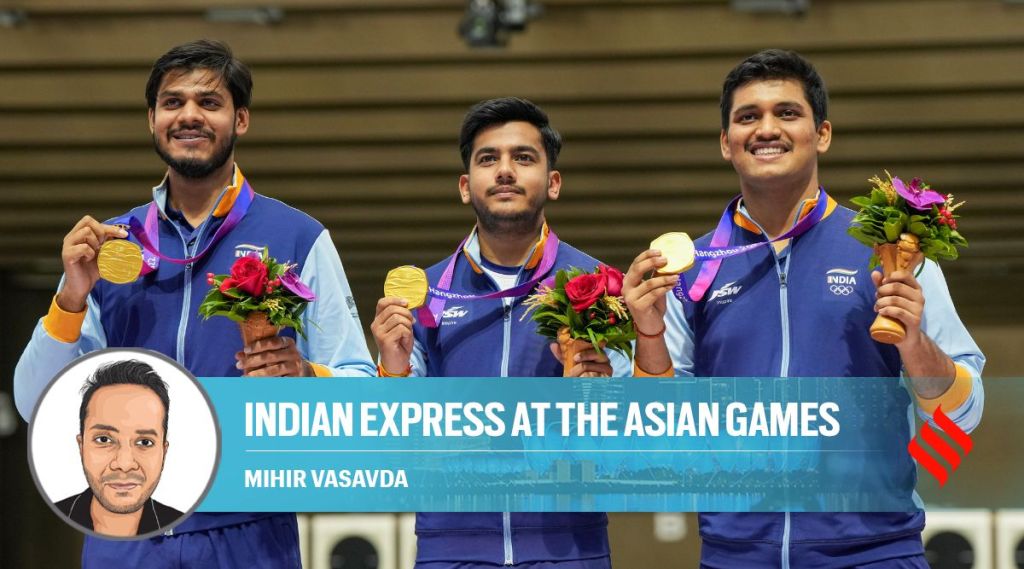 Indian shooters Rudrankksh Patil (right), Aishwary Pratap Singh Tomar (centre) and Divyansh Singh Panwar pose for photos with their gold medals during the presentation ceremony of Men's 10m Air Rifle team event at the 19th Asian Games, in Hangzhou, China, Monday, Sept. 25, 2023. (PTI)

 Hangzhou: Indian shooters Rudrankksh Patil (right), Aishwary Pratap Singh Tomar (centre) and Divyansh Singh Panwar pose for photos after winning gold in the Men’s 10m Air Rifle team event at the 19th Asian Games, in Hangzhou, China, Monday, Sept. 25, 2023. (PTI Photo/Shailendra Bhojak)(PTI09_25_2023_000074A)


 Share


