Why the table matters: India’s TT stars face a different game at Asian Games

Indian tables are grainy, faster and spinnier. In hotter conditions, the ball comes on faster. In Europe, it's a little slower. In China and Japan, the spin quotient often comes down

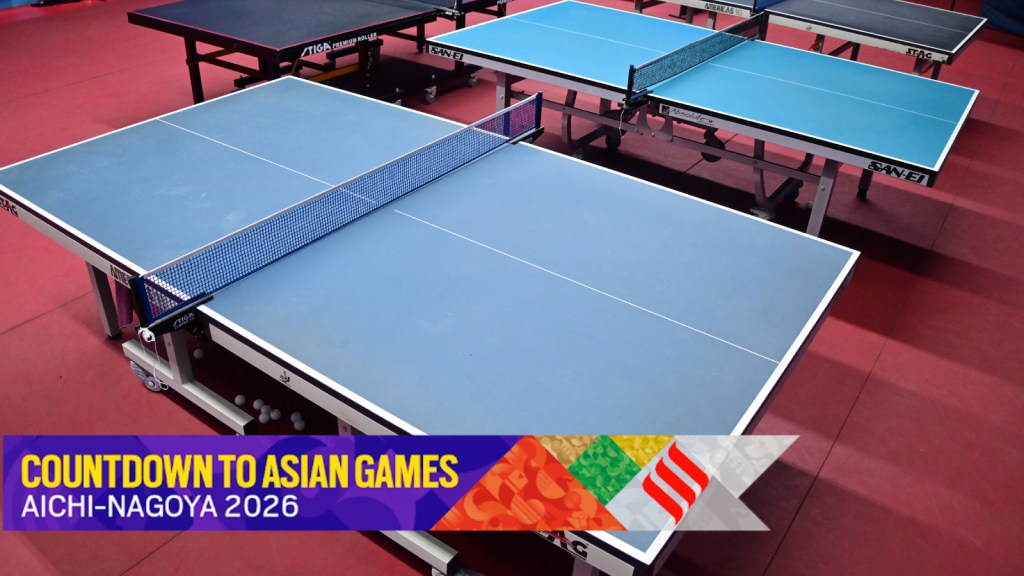
At the Aichi-Nagoya Asian Games, the tables will play much slower and Indians will need to be in their best physical shape. (Express Photo by Pichumani Krishnan)At the Aichi-Nagoya Asian Games, the tables will play much slower and Indians will need to be in their best physical shape. (Express Photo by Pichumani Krishnan)

In table tennis, it’s not always what the paddler brings to the table. But what the table might bring to the player.

Every competition table might look just the same, but they could be every bit as finicky and whimsical as cricket pitches or badminton shuttles. At the Aichi-Nagoya Asian Games, the tables will play much slower and Indians will need to be in their best physical shape.

“There’s a huge difference in tables, as much as grass and clay in tennis,” explains G Sathiyan, before Indians embark to Higashiyama Park with hope to improve upon the performance at the last edition where Sutirtha Mukherjee and Ayhika Mukherjee won a gutsy bronze.

“But there are no demarcated seasons for us. The segregation in TT is like first week clay, second grass and then clay again in a different country,” Sathiyan says.

In India, tables are grainy, faster and spinnier. In hotter conditions, the ball comes on faster. In Europe, it’s a little slower. Slowest are the DHS (Double Happiness) tables in China and Japan where the spin quotient comes down.

Sathiyan’s longtime coach S Raman runs an academy in Chennai, which brought in 2-3 different varieties of tables to help its players.

ALSO READ | Asian Games 2026: The force behind 400 metre national record holder Vishal

Story continues below this ad

“There’s three variables to TT conditions – vertical bounce, the amount of spin depending on the friction of the table and linear speed,” Raman says.

“You have to constantly keep recalibrating your playing style. Also, the same table brand can play differently in Conditions A, B or E. This makes it tough to get consistent results,” he adds.

Especially when Indian tables are grippier and the ball dances around wickedly at pace.

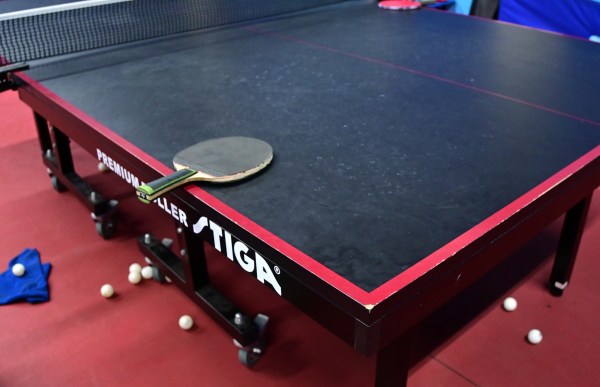
TT tables differ in bounce, linear speed, and spin depending on the friction of surface. (Express Photo by Pichumani Krishnan) TT tables differ in bounce, linear speed, and spin depending on the friction of surface. (Express Photo by Pichumani Krishnan)

Manush Shah, on whom many hopes rest due to his partnership with Manav Thakkar that’s No.3 in the world, explains the granular behaviour of tables.

Story continues below this ad

“We need to wait more, produce more power from the lower body in order to not get injured in the upper body. Also, we tend to stay closer to the table to be prepared for shorter balls inside the table.”

Slower balls means there are fewer opportunities to attack. “So, we focus on defence and then bring attack into the rally,” he added.

One could be training all year in India, where the ball is whizzing; and stand a foot behind. When they play abroad, slow balls demand more power, which the top Chinese and Japanese have trained for. Indians like the Mukherjeas, Manika Batra, Sreeja Akula besides Ankur Bhattacharya, Sathiyan and the MnMs have been confronting this challenge over the years.

Crash course

New sensation Syndrella Das is learning to adapt.

Story continues below this ad

“We have to adjust to different conditions all the time. As soon as you get a good feel of one set of conditions, the next one is completely different,” she says.

Sathiyan says his mind zones in on what to expect the moment he clears immigration. For Sutirtha, adapting to tables has become a part of life, though a webpage all paddlers visit ahead of a tournament is the tournament prospectus which mentions the type of table to be used.

“You just have to acclimatise within a short time on the practice day. They declare on the prospectus. You can’t buy so many tables for training, can you?” she remarks.

You can – if you are in China or Korea.

“I’ve seen Korean training halls and in China, where they train with 12-13 types of tables, while India will have at most 3-4. In Chennai, we have 2-3 variations including a DHS table,” Sathiyan says. “DHS tables in China and Japan result in the spin quotient reducing. It puts more pressure on the legs because the ball comes slowly a lot of times. It changes strokemaking. When it’s slow, the body movement changes since you are used to play from much behind in India.”

Story continues below this ad

“When the ball moves at speed, less effort is extracted from the body,” says fellow international Snehit Suravajjula. “It gets difficult when competing abroad because of the tables.”

Coach Raman, though, cuts through the table-babble and benefits of simulation.

“It’s ultimately down to the player. As long as you know that a table is neither your best friend nor your worst enemy, you are OK,” he says.

He says the talk about the ‘latest table’ often tends to be a “manufacturing gimmick.”

Story continues below this ad

“Like iPhones,” he laughs. “It’ll just be a little tampering with the top surface of the table.”

(With inputs from Bhuvan Gupta)

Shivani Naik is a senior sports journalist and Assistant Editor at The Indian Express. She is widely considered one of the leading voices in Indian Olympic sports journalism, particularly known for her deep expertise in badminton, wrestling, and basketball. Professional Profile Role: Assistant Editor and Columnist at The Indian Express. Specialization: While she covers a variety of sports, she is the primary authority on badminton for the publication. She also writes extensively about tennis, track and field, wrestling, and gymnastics. Writing Style: Her work is characterized by "technical storytelling"—breaking down the biomechanics, tactics, and psychological grit of athletes. She often provides "long reads" that explore the personal journeys of athletes beyond the podium. Key Topics & Recent Coverage (Late 2025) Shivani Naik’s recent articles (as of December 2025) focus on the evolving landscape of Indian sports as athletes prepare for the 2026 Asian Games and beyond: Indian Badminton's "Hulks": She has recently written about a new generation of Indian shuttlers characterized by power and physicality, such as Ayush Shetty and Sathish Karunakaran, marking a shift from the traditionally finesse-based Indian style. PV Sindhu’s Resurgence: A significant portion of her late-2025 work tracks PV Sindhu’s tactical shifts under new coaching, focusing on her "sparkle" and technical tweaks to break out of career slumps. The "Group of Death": In December 2025, she provided detailed tactical previews for Satwiksairaj Rankireddy and Chirag Shetty’s campaign in the BWF World Tour Finals. Tactical Deep Dives: She frequently explores technical trends, such as the rise of "backhand deception" in modern badminton and the importance of court drift management in international arenas. Legacy and History: She often revisits the careers of legends like Saina Nehwal and Syed Modi, providing historical context to current Indian successes. Notable Recent Articles BWF World Tour Finals: Satwik-Chirag have it all to do to get through proverbial Group of Death. (Dec 2025) The age of Hulks in Indian badminton is here. (Dec 2025) Treadmill, Yoganidra and building endurance: The themes that defined the resurgence of Gayatri and Treesa. (Dec 2025) Ayush Shetty beats Kodai Naraoka: Will 20-year-old be the headline act in 2026? (Nov 2025) Modern Cinderella tale – featuring An Se-young and a shoe that fits snugly. (Nov 2025) Other Sports Interests Beyond the court, Shivani is a passionate follower of South African cricket, sometimes writing emotional columns about her irrational support for the Proteas, which started because of love for Graeme Smith's dour and doughty Test playing style despite being a left-hander, and sustained over curiosity over their heartbreaking habit of losing ICC knockouts. You can follow her detailed analysis and columns on her official Indian Express profile page. ... Read More


Advertisement
Loading Recommendations...
Advertisement
Advertisement
Latest Comment
Post Comment
Read Comments