
Rolex Rings: Can Europe drive its next phase of growth?
Rolex Rings' European business grew 25% in FY26, even as US exports fell 30% amid tariffs. With an India-EU trade deal on the horizon and new orders in the pipeline, can the company turn these opportunities into sustained growth?
 Rolex Rings operates in a part of the manufacturing world that most people never see. (File photo)
In FY26, Rolex Rings was a tale of two export markets.
US tariffs on Rolex Rings’ auto components peaked at 53% in FY26, leading to a fall in exports to the US by roughly 30% from the previous year. US exports fell roughly 30% from the previous year.

In Europe, the business grew about 25%. More importantly, Europe accounted for more than 60% of all new business nominations the company won during the year. Nominations are supplier awards for future vehicle and industrial programmes, and they turn into revenue over the following years.
The timing is not a coincidence. SKF is separating its lower-margin automotive business into a separately listed company, SKF Vertevo, to be listed on Nasdaq Stockholm in the fourth quarter of 2026. In January, India and the European Union concluded negotiations on a free trade agreement which will officially be signed by the end of 2026.
For a Rajkot-based company that forges and machines bearing rings and automotive components for global customers, these shifts are directly relevant.
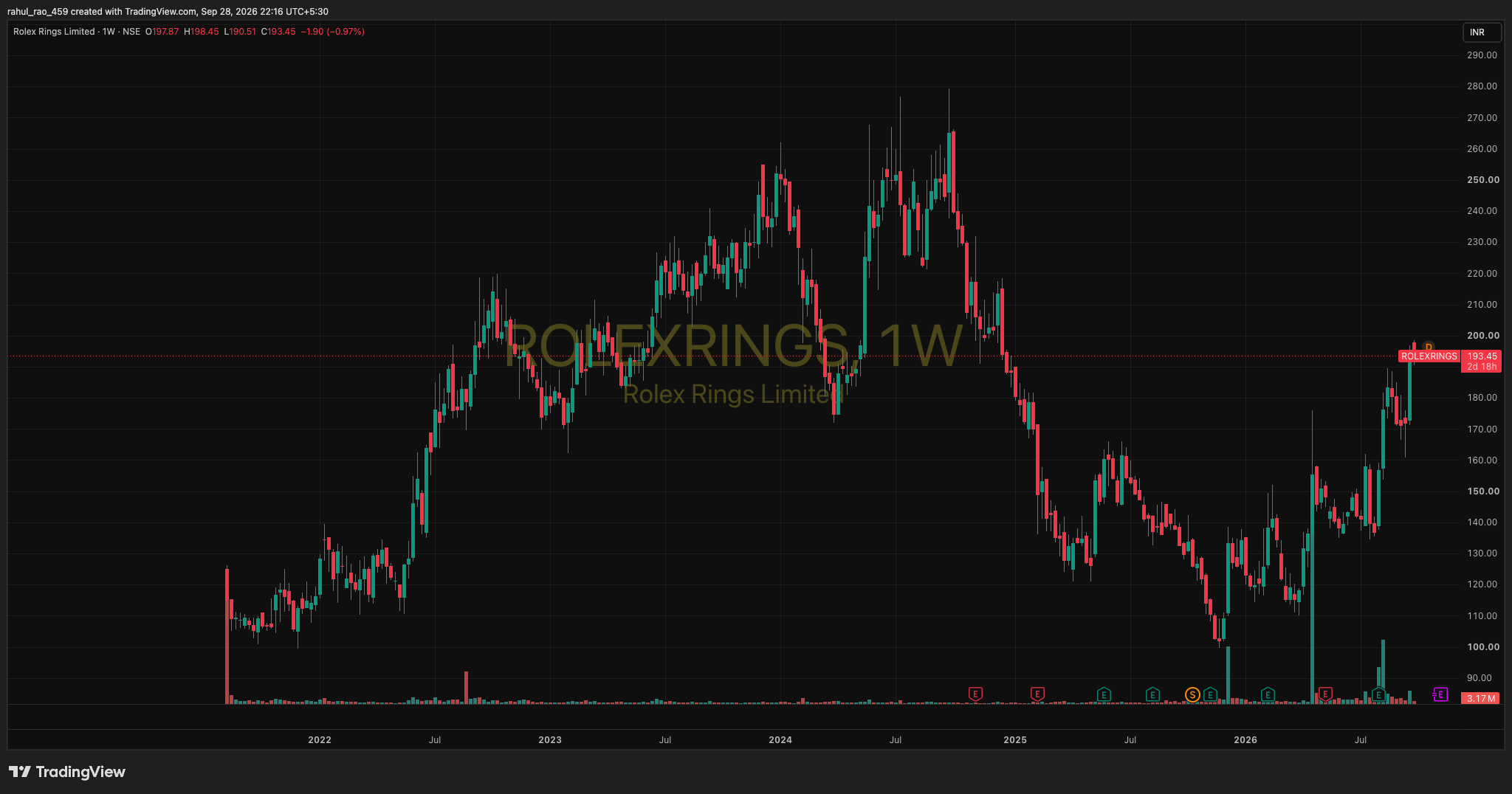
The catch is that none of this has shown up in the headline numbers yet. Rolex Rings’ FY26 revenue of Rs 1,144 crore was lower than FY23’s Rs 1,179 crore. Revenue grew just 4% in the June 2026 quarter. The stock, meanwhile, has risen from a 52-week low of about Rs 99 to around Rs 193, a market capitalisation of roughly Rs 5,050 crore.
Rolex Rings: 1-Year Stock Price Movement
Source: http://www.tradingview.com
So the question for investors is whether the European opportunity, the US recovery, and the unused capacity can deliver the 15-17% growth management is guiding for FY27, and how much of that the 80%+ rally has already priced in.
Let’s dive in.
Understanding the business
Rolex Rings operates in a part of the manufacturing world that most people never see.
Anything that rotates, whether it’s a car wheel, a gearbox shaft, an electric motor, a wind turbine or a railway axle, turns on a bearing. At its simplest, a bearing is two hardened steel rings with balls or rollers between them. The rings carry the load. If they fail, the machine fails.
Global bearing companies design, assemble and sell finished bearings under their own brands. Many of them, however, outsource the most capital-intensive and metallurgically unforgiving step, which is forging and machining the rings, to specialists. Rolex Rings is one of those specialists. It heats steel bars, forges and rolls them into rings weighing anything from 10 grams to over 160 kg, and machines them to the tolerances the bearing maker specifies.
Its second business is automotive components: transmission gear blanks, ring gears, sun and pinion gears, wheel hubs, hub bearing units and output shafts, supplied to global Tier-1 suppliers and vehicle makers. These parts weigh between 200 grams and 125 kg.
The scale is substantial for a company of its size. Rolex operates three plants in Rajkot with 26 forging lines, 625 machining spindles and 1,65,000 tonnes a year of forging capacity, which it says makes it the fifth-largest forging capacity holder in India. It serves 57 customers, and seven of its top ten customers have been with it for more than 15 years.
That stickiness is structural. A bearing ring or a hub is a safety-critical part. Qualifying a new supplier means months of trials, audits and validation, so customers rarely switch once a supplier is approved.
Two businesses under one roof
The easiest way to understand Rolex Rings’ recent numbers is to recognise that its two segments are driven by quite different forces.
Bearing rings (Rs 539 crore, 47% of FY26 revenue) are mostly a domestic business. Around 71% of this revenue comes from Indian customers, and India’s bearing industry is highly concentrated: at the time of Rolex’s IPO, five players (SKF, Schaeffler, Timken, NEI and NRB) accounted for about 81% of the market. This segment tracks Indian auto and industrial production. It grew 11% in FY26.
Automotive components (Rs 520 crore, 45%) are largely an export business. About 67% goes overseas, mainly to vehicle programmes in the US and Europe. This segment tracks global vehicle production and US trade policy. It fell 10% in FY26.
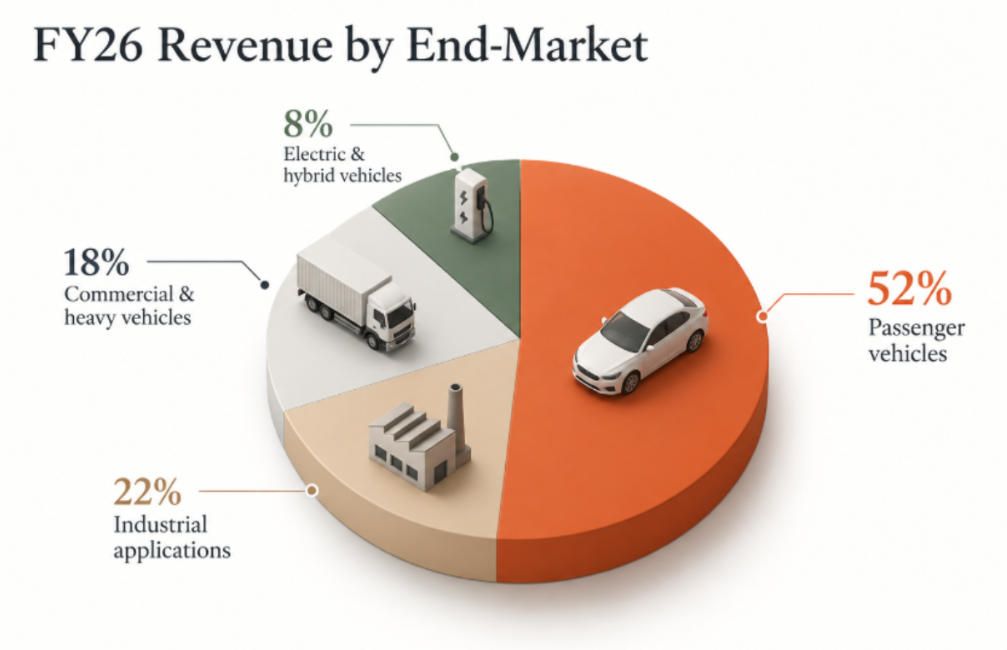
Source : Q1 FY27 investor presentation
That EV number matters less for its size and more for what it says about the business.
A wheel hub, gearbox bearing, or differential gear is needed whether the vehicle runs on petrol, diesel, or a battery. Unlike manufacturers of pistons or fuel-injection components, Rolex Rings doesn’t inherently lose content as the powertrain electrifies. If anything, hybrids can add content because they combine a mechanical driveline with electric motors, and every electric motor needs bearings.
The European opportunity for Rolex Rings
Rolex’s European momentum rests on three things.
- European bearing majors are under cost pressure
Schaeffler announced up to 4,700 job cuts in Europe in 2024, including 2,800 in Germany, citing weaker combustion-engine volumes and slower EV programmes. SKF’s automotive business, which is being spun off as SKF Vertevo, generated SEK 25.9 billion of revenue in 2025 at an adjusted EBITDA margin of only about 6%.
A standalone automotive bearing business earning single-digit margins has every reason to scrutinise its cost base. Forging and machining rings is energy- and labour-intensive, and European manufacturers have faced structurally higher energy costs since 2022. Sourcing more of these components from qualified, lower-cost suppliers is one of the most obvious levers. No company has announced such a shift to Rolex publicly, but the direction of the industry favours suppliers like it.
- Europe is a big market, and Rolex is gaining share
Source: Rolex Rings investor presentation Q1 FY26 , Author illustration
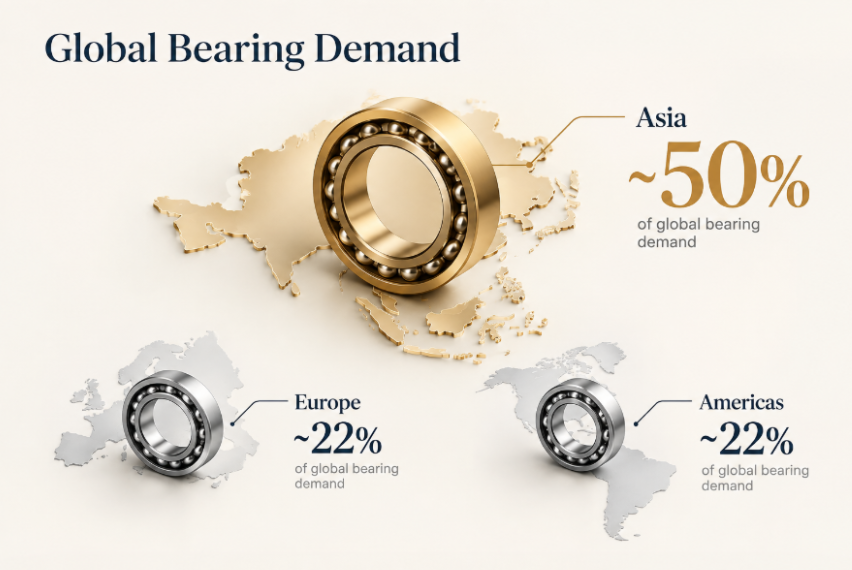
Europe accounts for roughly 22% of global bearing demand, about the same as the Americas. Rolex grew its European revenue by about 25% in FY26, a year in which European industrial and automotive demand was weak. That points to market share gains rather than a rising tide. Management has highlighted European commercial vehicle and industrial customers as particular sources of growth.
- The pipeline is already built
More than 60% of FY26’s new nominations came from Europe. New programmes typically take 1.5-3 years to ramp up to full volumes, so these wins are a leading indicator for FY27-FY29 revenue rather than something that showed up in FY26. That is also why the FTA’s timing matters: the deal is expected to take effect roughly as these programmes reach peak volumes.
The EU FTA: What actually changes for Rolex
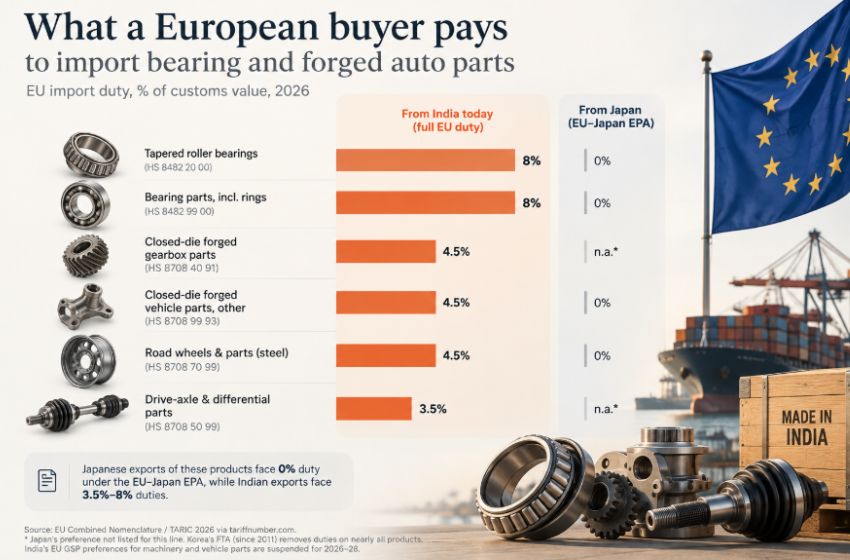
Source: EU Combined Nomenclature 2026 via http://www.tariffnumber.com, author illustrations
Indian machinery and vehicle parts currently pay the EU’s full standard MFN (Most Favoured Nation) duty. The EU’s Generalised Scheme of Preferences, which gives developing countries lower tariffs, is suspended for India on machinery and on vehicles and parts from January 2026 through 2028. So a European buyer pays 8% on bearings and bearing parts from India, and 3.5-4.5% on the gearbox, axle and wheel parts that make up much of Rolex’s auto component range.
Japan’s bearings and auto parts enter the EU duty-free under the EU-Japan agreement. South Korea has an FTA with the EU, and Turkey is in a customs union with it. Chinese suppliers pay the same MFN duty as India but face growing political and supply chain scrutiny in Europe.
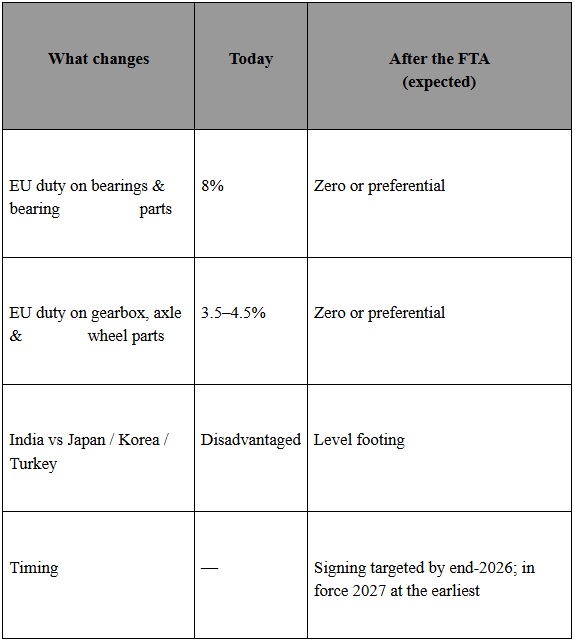
The FTA would put India on the same footing. According to the Indian government, the EU will give zero-duty or preferential access for over 99% of Indian exports by value, with engineering goods, which currently face tariffs as high as 22%, among the main beneficiaries.
Source: EU tariff schedule, Press Information Bureau, European Commission
So, is Rolex a beneficiary?
Three points put the benefit in perspective.
First, the customer pays the duty. Import duty is generally paid by the European buyer, not by Rolex. The FTA therefore won’t directly add to Rolex’s margins. What it does is that it makes Rolex’s parts 3.5-8% cheaper on a landed basis. In a request for quotation where a European buyer compares Rajkot with a Japanese, Korean, Turkish or Eastern European supplier, that is often enough to swing the decision. Part of that gain may be shared with customers through pricing, but the bigger prize is winning more programmes.
Second, it’s a positive move but not a game changer. EU duties of 3.5-8% are modest next to the 25% US tariff Rolex is dealing with today. The FTA makes a good European business better, but it doesn’t fix a weak one. The fact that Rolex grew 25% in Europe while paying full duty suggests the underlying competitiveness is already there.
Third, it is a FY28-FY30 story. The deal still needs to be signed, approved by the European Parliament, and ratified by India. Even if it takes effect in 2027, the benefit shows up gradually as it feeds into new sourcing decisions and programme nominations, which then take 1.5-3 years to ramp up.
There are two details to watch. The first is rules of origin: forged and machined parts made from Indian steel should comfortably qualify as Indian, but the final product-specific rules matter. The second is the tariff staging for each product line, which will be clear only once the full text is published.
The catch: Europe’s Carbon Border Tax
The FTA keeps the EU’s Carbon Border Adjustment Mechanism (CBAM) intact. CBAM charges importers for the carbon emitted in making certain goods. It currently covers iron and steel but not finished components. In December 2025, the European Commission proposed extending it from 2028 to about 180 downstream products, including gearboxes and wheels. Bearings were not among the categories highlighted. The proposal still has to be negotiated with the European Parliament and member states.
If adopted, some of Rolex’s European auto component exports could carry a carbon cost that partly offsets the FTA’s tariff benefit. Most of the embedded emissions in a forged part come from making the steel, so Rolex’s exposure will depend largely on its steel suppliers. Its own efforts help at the margin: it has 21.55 MW of installed solar and wind capacity, plans another 9 MW of solar, and targets 60% renewable energy consumption by 2030. European buyers are increasingly asking suppliers about exactly these numbers.
The rest of the picture: The US and India
Europe is the structural opportunity, but two other markets decide FY27.
The US is the near-term swing factor. Management says tariffs on its products have eased to around 25%, that customers who deferred decisions in FY26 are re-engaging, and that new customer programmes in Mexico and the US will add revenue from mid-FY27. Automotive components, the export-heavy segment, grew 13% in the June quarter.
India is the base. The domestic bearing ring business depends on the Indian subsidiaries of global bearing majors, which have been increasing local manufacturing and using India as an export base. Every bearing made in India, rather than imported, needs locally sourced rings. The business was hit in the June quarter by a shop-floor labour shortage from April to mid-June, which management says has since normalised.
Q1 FY27: The recovery starts, unevenly
Automotive components grew 13% to Rs 163 crore, including Rs 118 crore of exports. Bearing rings fell 6% to Rs 118 crore due to labour shortages and weaker industrial demand in India and Europe.
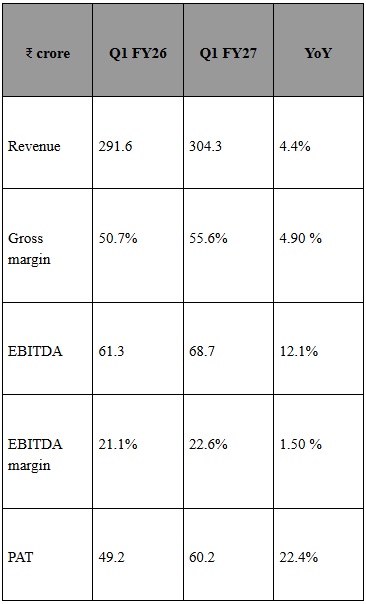
Source: Rolex Rings Q1 FY27 investor presentation
Freight costs are another headwind. Ocean shipping rates have risen 2.5-3x since mid-June 2026, increasing costs for Rolex as it ships heavy steel parts to Europe and the US. This is one reason management is being conservative and guiding for a 21-22% EBITDA margin in FY27.
The math that matters for FY27
Management has reiterated 15-17% revenue growth for FY27, which implies Rs 1,315-1,340 crore. Q1 delivered Rs 304 crore, leaving Rs 1,010-1,035 crore for the remaining three quarters against Rs 852 crore in the same period of FY26.
In other words, Rolex needs roughly 19-21% growth for the rest of the year to meet its guidance. The US and Mexico programmes and the European nominations have to show up in Q2 and Q3.
Capacity: Room To Grow Without A Capex Cycle
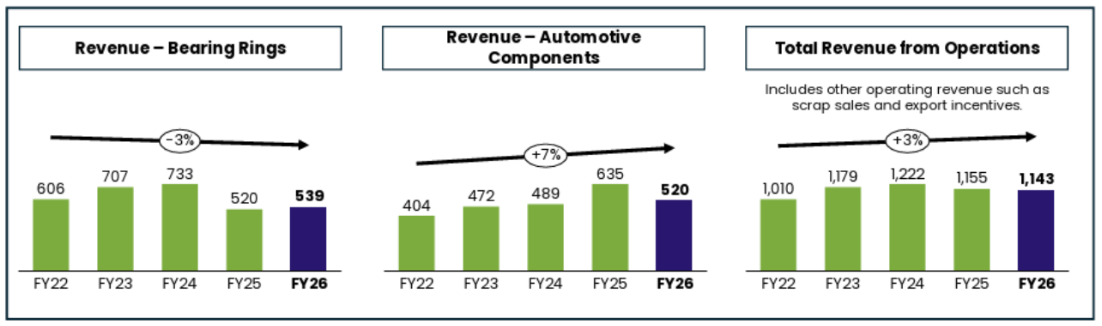
Source: Company investor presentation (May 2026), http://www.screener.in
Revenue has been stuck at Rs 1,150-1,220 crore since FY23, and EBITDA margins have drifted down from 22.7% in FY22 to 20.1% in FY26. As the utilisation picks up from current 62% levels, we could see an improvement in the EBITDA margins.
With utilisation currently around 63-65% and target to hit 70-72% by FY27 end, Rolex can comfortably absorb European and US growth without building new plants.
Additionally, the company has no debt. It also held Rs 367 crore of cash and investments at the end of FY26, before a Rs 180 crore buyback.
The catch is working capital, which rose to 195 days in March 2026. Exporting heavy parts across oceans ties up inventory and receivables, so faster export growth will absorb a meaningful part of the cash it generates.
Valuations
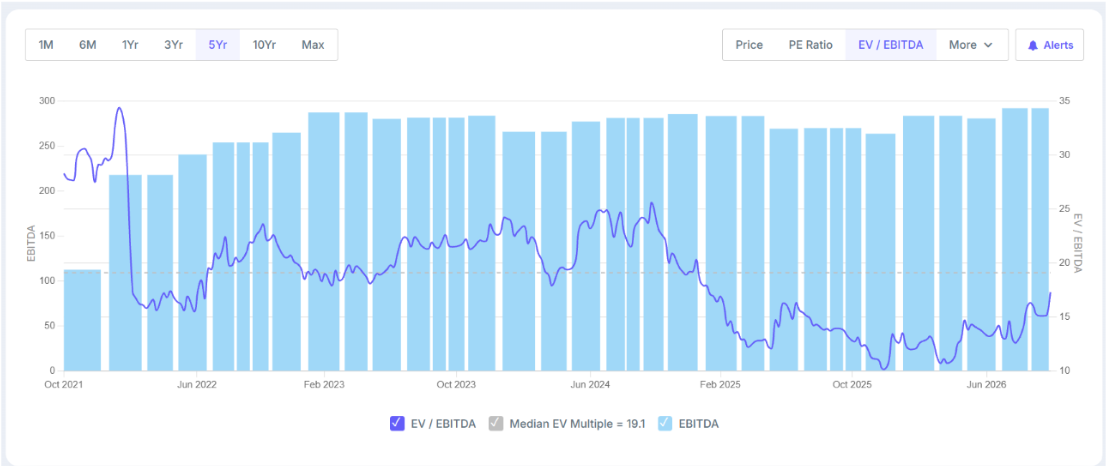
At around Rs 193, Rolex Rings has a market capitalisation of about Rs 5,050 crore and an enterprise value of about Rs 4,600 crore. On trailing numbers, that is about 23.5x adjusted earnings (excluding one-off exceptional charges) and about 19x EV/EBITDA.
Source: http://www.screener.in
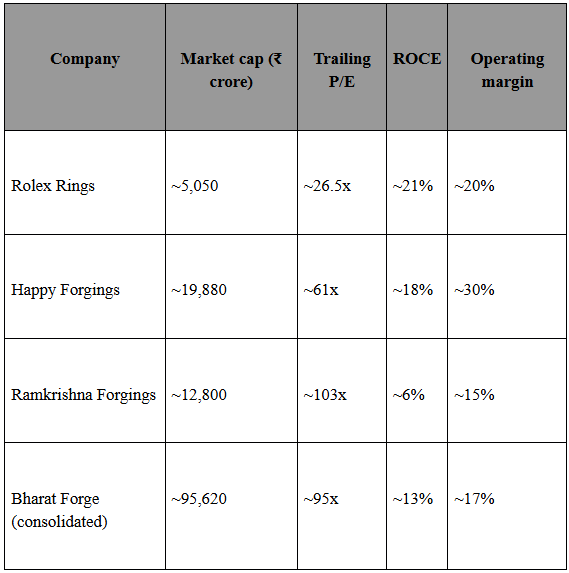
Compared to peers, Rolex has the highest return on capital in this group but the lowest multiple. The listed Indian bearing companies it supplies to, such as Schaeffler India, Timken India and SKF India, traded at roughly 38-56x earnings in August 2026.
Source: http://www.screener.in (late September 2026), author calculations
The discount reflects four years of no growth, heavy dependence on US trade policy, a working capital-heavy model, and a concentrated customer base. The stock is up more than 80% from its 52-week low and about 26% since the Q1 results on August 5, so a recovery to mid-teens growth is now largely priced in.
What the market isn’t obviously paying for is Europe becoming a multi-year growth engine with the FTA as an accelerant. That is where the upside lies, if the nominations convert.
Risks worth noting
- FTA delays: The deal still needs signature, European Parliament consent and Indian ratification. Any slippage pushes the benefit further out.
- CBAM: The proposed extension to downstream products from 2028 could add a carbon cost to some auto component exports to Europe.
- Weak European demand: Market share gains can be offset by a soft industrial and automotive cycle in Europe.
- US trade policy: Tariffs have eased but could escalate again.
- Freight: Ocean freight is up 2.5-3x since mid-June 2026, hitting a business that ships heavy parts across oceans.
- Customer concentration: The bearing industry is dominated by a handful of global players, which limits pricing power.
- Working capital: At 195 days, export growth will consume cash.
Note: We have relied on data from http://www.screener.in and http://www.tijorifinance.com throughout this article. Market price and market capitalisation data are from Thurro. Only in cases where the data was not available, have we used an alternate, but widely used and accepted source of information.
Rahul Rao has helped conduct financial literacy programmes for over 1,50,000 investors. He has also worked at an AIF, focusing on small and mid-cap opportunities.
Disclosure: The writer or his dependents do not hold shares in the securities/stocks/bonds discussed in the article.
The website managers, its employee(s), and contributors/writers/authors of articles have or may have an outstanding buy or sell position or holding in the securities, options on securities or other related investments of issuers and/or companies discussed therein. The content of the articles and the interpretation of data are solely the personal views of the contributors/writers/authors. Investors must make their own investment decisions based on their specific objectives, resources and only after consulting such independent advisors as may be necessary.

 Share


