Three hundred Ramayanas are known to exist around the world. Among them is a version revered by a Muslim Filipino ethnic group called the Maranaos. About two hundred years ago, the Maranaos were forced to migrate to the Sulu Aquapelago, a string of islands in southwestern Philippines, and reimagine themselves, both economically and culturally. What came in handy was a version of Valmiki’s Ramayana that was already popular among the existing Muslim ethnic groups living on the island.
Rhodora G Magan, associate professor of Literature and Communication at Cebu Technological University, Philippines, in a recently published research paper titled Perception and Visibility of the State: The Ramayan of the Maranao: Rethinking Aquapelagos in the Philippines’ Sulu Sea (Shima Journal, March 2025), unravels the complex ways in which the Maranaos adapted the Ramayana for their survival. The Maharadia Lawana, as the Ramayana is titled among the Maranaos, focuses on the character of Ravana, making him the hero of the epic. This creative adaptation of the epic, explains Magan, was done to align with the new cultural identities of the Maranaos.

In an interview with indianexpress.com, Magan speaks about the history of the Maranaos and the role the Ramayana played in the process of migration and resettlement they underwent. Edited excerpts:
Who are the Maranaos?
The Marano people are one of the major Mohammedan groups in the Philippines, alongside the Maguindanao, the Tausug, and the Yakan.
The Maranaos were recorded to have migrated some 200 years ago from the upland to the lowland area due to land competition and a volcanic eruption. They came to inhabit the Sulu Aquapelago. So, from being farmers, they had to become fishermen. They had to shapeshift and understand their new space, so they had to become confident, psychologically speaking, in the kind of role they had to act upon, which was very different from being farmers.
When they were inhabiting the coastal areas, they realised that they had to survive. And so, they retooled themselves. A lot of books authored by Europeans portrayed the Maranaos as ‘marauders’, who do everything to disrupt the peace in Southeast Asia. But, in fact, Maranaos were Eastern sea lords. They were fierce warriors and played a huge role in the economic dynamics. They became great traders. They play the role of the middlemen between two economic giants — Britain and China. As the middlemen, the Maranaos control the seas. They are known as pirates, but piracy is part of their survival strategy. And wanting to survive is a part of the Maranao psyche, which is also why they latch on to the Maharadia Lawana, the regional variant of the Ramayana.
You said that when Maranaos started reimagining their identity, Valmiki’s Ramayana played a key role. Why and how did the Ramayana come to this island?
The Maranaos deconstructed the Valmiki Ramayana upon their arrival in the aquapelago between the 17th and 19th centuries. The adaptation of Indic texts, transmitted through multiple pathways across Southeast Asia, contributed to the region’s culturally hybrid character during this period.
It’s important to highlight the alteration of Hindu cultural archetypes by folk Islam. As proof, we have the Valmiki Ramayana modified into Maharadia Lawana. In Ramayana, Rama is the hero. But in Maharadia Lawana, the counterpart of Ravana is the main character.
In what historical context did Hinduism reach the Sulu Aquapelago?
Based on my study, there is no specific date that can be confirmed for when the Hindus first arrived in the region. We have texts that say that prior to the 14th century, the Hindus were already present on the islands. That was also because the Sulu area was like a business hub of the time.
This explains why there’s already an entrenched Hinduistic value system that is being cultivated by the indigenous tribes, as the story of Maharadia Lawana exists within a larger framework of the Darangen, the Maranao epic.
It also shows how Maranaos accepted Hinduism because they modified it. They suited it to their own culture of an indigenous tribe. They could have absorbed the Valmiki Ramayana without changing anything. But they had to do it, and I call this, in the study, creative amplification (an earlier oral indigenisation of Ramayana themes by the Maranao), which is present in the whole of Southeast Asia.
Every Southeast Asian country has a Ramayana version. That’s why I began my study with how many Ramayana versions there are. There are nearly 300, and one of them is Maharadia Lawana.
You mentioned how the Valmiki Ramayana is indigenised. So, what exactly is different in this case?
If you look at the title, Rama should have been the main character in Maharadia Lawana. On the contrary, the villain, who in Valmiki Ramayana is Ravana, equivalent to Maharadia Lawana, was considered to be the most important character in this text.
So the question is, why do you revere the opponent and not the good guy? I associated that with the re-imagining of the Maranao people. To be able to resuscitate their psychological strength, they have to embody a certain character that would spell out the kind of masculinity. Because Radia Magandiri, the equivalent of Rama in Valmiki Ramayan, is not the kind of character whom they can emulate daily. Why? Because in the story, he was emasculated, and Maranaos, being newcomers in the island, could not have celebrated such a character. However, if you look at the character of Maharadia Lawana, who practices asceticism, which is resonant with both Hindu and Muslim cultures, that’s closer to who they are.
That’s the kind of image they want to project to the world. They want to ensure that even if they are few in the Philippines, they can contend with the Spaniards, because towards the end of the 17th century, there was heightened tension between the Spaniards and the settlers in the Philippines.
They came over in the 16th century, and in the 17th century, the skirmish was at the top. So, what do you do as a Mohammedan tribe to combat this very colossal Spanish force? You have to start by making your mind strong enough to contend with that.
And who is their clarion call for this? Or who gives them the strength to push forward? It is the character of Maharaja Lawana. As I said in my study, it is very obvious that through time, the characters, the heroes in the Darangen mythology, are kind of adapting to the norm, especially when the Spaniards came, because they have replaced their heroes with characters who are more feisty, more rebellious, more bloodthirsty. And that is seen in the character of Maharadia Lawana and not in the character of Radia Magandiri.
In the Valmiki Ramayana, we have Hanuman. In the Maharadia Lawana, Hanuman’s characteristics are blended with those of Lakshman. Moreover, it’s embarrassing for Radia Mangandiri, the equivalent of Rama, to employ or seek the help of Hanuman in attacking Maharajya Lawana or the equivalent of Ravana.
It’s like saying that their hero is not going to be someone who relies on others. Their hero should be somebody who, on his own, can solve his problems and can stand without having to rely much on the people around him. So that’s a psychology that they got from Maharadia Lawana.
So do the Marano people, or let’s say the Muslim population of the Philippines today, still embrace the Ramayana?
They continue to uphold the Darangen mythology, and Maharajya Lawana is still part of their culture and rituals. But considering how technology is heavily encroaching on society, this is not the kind of mythology that you hear people discuss every single time. You have this in books now. You have this in very secluded parts of Mindanao (an island in the Philippines).
But despite that, the reality remains that they still adhere to those traditions and ritualise the idea of having Maharadia Lawana.
So, how do you see the fact that a Muslim group embraced a text that is largely known as a Hindu epic?
You know, I am overwhelmed at the idea that the Muslim people wanted the help of a Hindu text to resuscitate their survival.
At the end of the day, I can only say that it’s not about being a Muslim, it’s not about being a Hindu. If the issue is about survival, you have to compromise. What I’m seeing here is a major compromise that the Maranao people made when the volcano erupted. And they no longer saw religion as a major stonewall in their lives. Because what they’re thinking here is, well, don’t worry, it’s not a complete copy that we are getting from the Hindus. In a way, we are still allowing our Muslim identities to prevail by modifying some parts of this.
In the Maharadia Lawana version, there’s a part that suggests how Ravana, or Maharadia Lawana, even though he’s now isolated, still went to the top of the world and cried to help the people who were in distress. It’s like a guy whom you imprison, yet he doesn’t want to be freed. He wants to continue suffering because he wants it for the greater good.

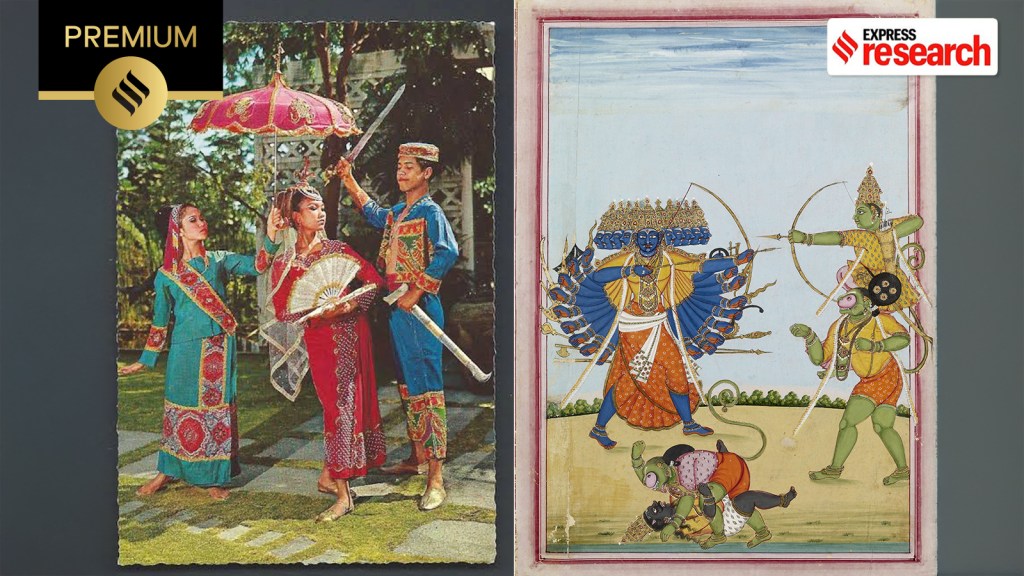 The Maranao people of the Philippines (left) and an illustration from the Ramayana (right) (Wikimedia Commons)


 Share


