
When slaves ended up ruling Delhi: The case of Mamluk dynasty
The most interesting case of the history of slavery in India is that of social mobility inherent in the institution as practised in many parts of the country, so much so that some of these slaves went on to become rulers, administrating over vast populations.
 Qutub Minar (Express photo)
A recent document produced by the International Labour Organisation (ILO) has come across as a cause of much worry to the Intelligence Bureau and the government of India as it states India to be home to the highest number of slaves in the world. The survey explains modern day slavery to be inclusive of people “under threat or coercion as domestic workers, on construction sites, in clandestine factories, on farms and fishing boats, in other sectors, and in the sex industry” and finds India to consist of the largest number of people caught in these circumstances.
The institution of slavery has deep roots in the history of the world and that of India. Over time though, the slave system has undergone significant changes reflective of the modern day socio-economic environment. However, there are some major differences between the way the institution of slavery existed in the Western world and that in the East, including that in India. Unlike in America and Europe where slavery was necessary for plantation and industry labour, in Indian history, there was no single story of slavery. The subcontinent having undergone influences from a myriad range of cultural and religious groups, the slave system here was also different in different contexts. In his work, “Slavery and South Asian history”, historian Richard Eaton has noted that,“each instance of slavery in South Asia was shaped by a unique conjunction of contingent factors; hence each, in order to be properly understood, must be placed in its own unique context.”

Perhaps the most interesting case of the history of slavery in India is that of social mobility inherent in the institution as practised in many parts of the country, so much so that some of these slaves went on to become rulers, administrating over vast populations. Typically, slaves in India who acquired ruling status belonged to either Central Asia or to Africa. In both these cases though, slavery was attached to Muslim rule, that had, by the beginning of the second millennium AD taken control over vast portions in India.
The system of slavery had a unique aspect among Muslim dynasties around the world, in the sense that not only were slaves acquired for taking on central military positions, but also they had the opportunity to rise up the administrative hierarchy. Savery in these cases did not have the derogatory tone that is generally attached to it. These were elite, expensive slaves, valued for their physical skills. When these same slaves were transported to India either in the process of invasions or commercial relations, on many occasions they rose to become rulers in their own capacities. It is a subject of much scholarly interest that India remains the only country where Africans went on to become rulers. The case of Malik Ambar in Janjira, Barbak Shahzada in Bengal and Sidi Masood of Adoni are all examples of African slaves rising in status to become kings.
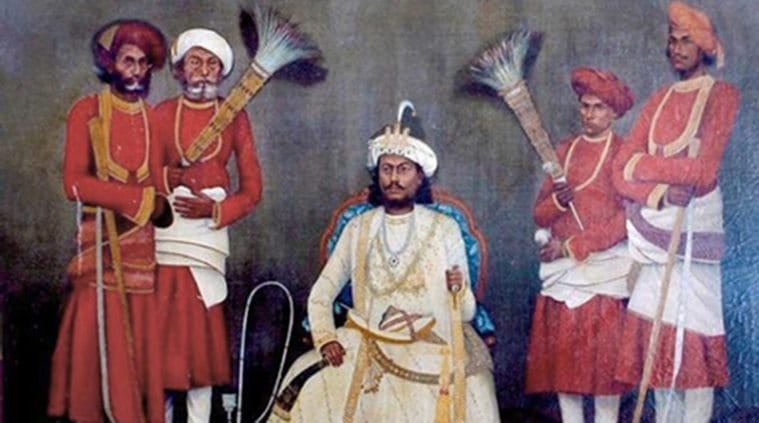 It is a subject of much scholarly interest that India remains the only country where Africans went on to become rulers. (Wikimedia Commons)
In the Northern parts of India on the other hand, the establishment of the Delhi Sultanate resulted in Turkish slaves ruling over a significant chunk of the subcontinent for almost a century. The Mamluks (Arabic designation for slaves) went on to establish their rule in Egypt and Eastern Iran as well. In India though, the rise of the Mamluks was unique in the sense that here, unlike anywhere else, they did not just have to compete with elites of non-slave origins, but also fight against and coexist with a vast range of racial, cultural and religious groups.
Also read: African rulers of India: That part of our history we choose to forget
The case of Turkish slaves in the Muslim world
The institution of military slavery in the Islamic world can be traced back to the ninth century when the Abbasid Caliphate in the Middle East started disintegrating. A number of autonomous dynasties came to establish themselves in Baghdad and Samarra. In order to buttress their illegitimate rule, the new rulers started recruiting Turkish slave corps of their own.
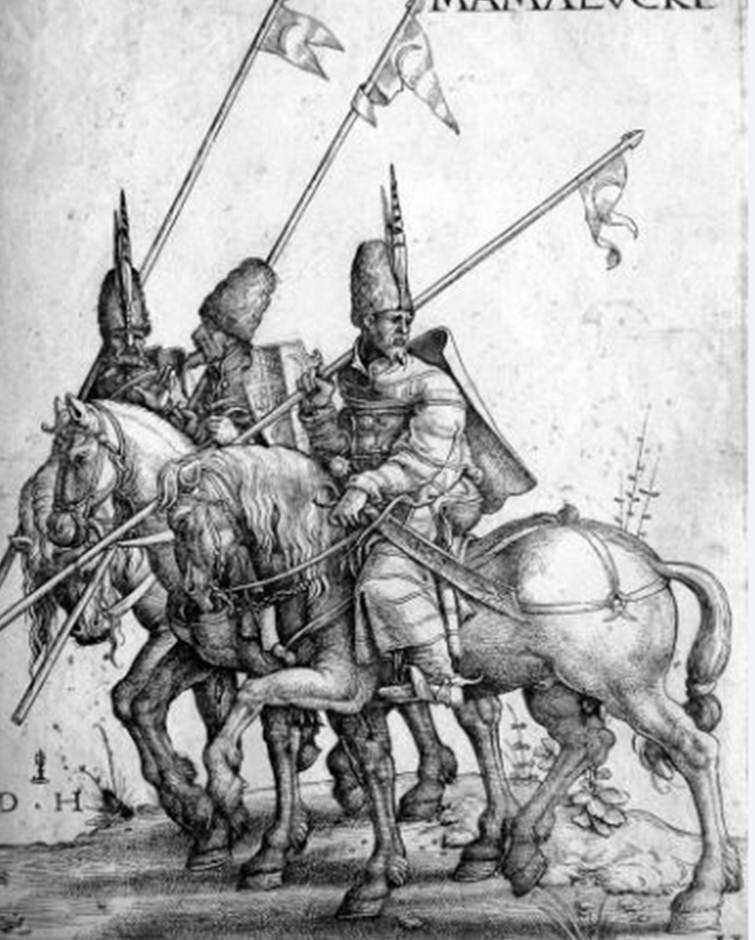 Mamluk lancers, early 16th century (etching by Daniel Hopfer) (Wikimedia Commons)
The Mamluk or slave status in this regard, however, was not something that was considered derogatory. “The Turks from the Eurasian steppe lands were highly prized by their masters, receiving both instruction in the Islamic faith and a rigorous training in the martial arts, and were not employed in any menial capacity,” writes historian Peter Jackson. The Turkish slaves once recruited had to first be uprooted from their indigenous religious traditions and instructed in the Islamic faith. However, the institution of slavery was similarly not despised by the Turkish either. “Unlike all other slaves, the Turkish bandagan seized the opportunities offered by their master and made good in their new homes, where they prospered to eventually become political grandees and governors.” writes historian of medieval India, Sunil Kumar.
By the 11th century, the Turkish slave regiments formed the nucleus of most armies in the Eastern Islamic world. In addition to holding high ranks in the military, several of the Turkish slaves started filling up ceremonial positions in the court as well. Many of these slave officers themselves went on to found dynasties, like the case of the Tulunids and Ikhshidids in Egypt and the Ghaznawids in the Eastern Iranian world. The Delhi Sultanate too came to be founded by a mamluk, Qutubuddin Aibek, a slave of the East Iranian ruler Muizzad-Din Muhammad Ghori.
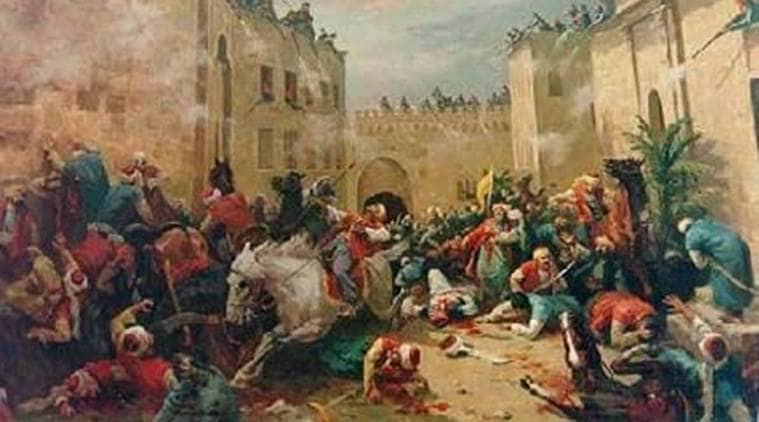 Massacre of the Mamelukes at the Cairo citadel, 1811 (Wikimedia Commons)
The slave status of the Turkish regiments was no barrier for promotion, and in fact it was rather valued. “The Turkish people were highly regarded within the Muslim world for their courage, stamina and military skill, and Turkish ghulams further acquired a reputation for steadfastness and orthodoxy in Islam,” writes Jackson.
The slave dynasty in India
Popular history writing of the Delhi Sultanate, often define the years between the 1192 and 1290 as the period of the Turkish bandagan (slaves). While Qutubuddin Aibek, himself a slave, laid the foundation of the slave dynasty in India, for much of this period the elite corps among the Turkish Mamluks were the ones who provided the military leadership, the provincial governors and the great officers of the state.
The governorship of the Delhi Sultanate following Aibek, was in the hands of former slaves on two occasions. Both Iltutmish and Balban were slaves of their former rulers, who had usurped power upon their master’s death. Each of the three rulers were astute politicians and ambitious governors who sought to extend the boundaries of their empire, apart from making their authoritarian presence felt in the form of extravagant display of wealth and architectural constructions.
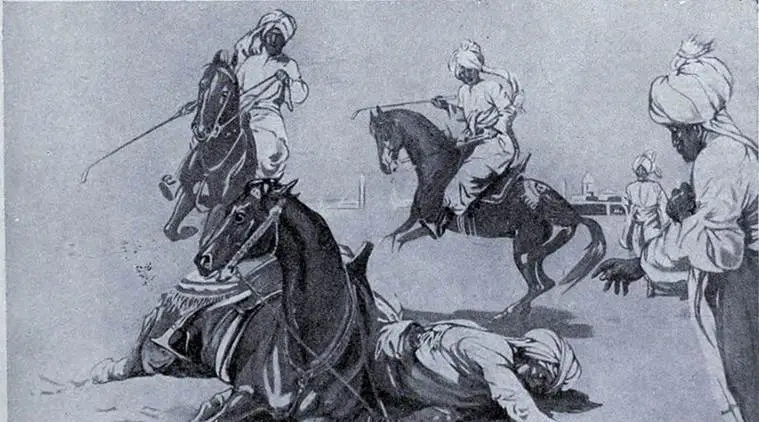 Death of the slave king, Qutubuddin Aibak of Delhi, A.D. 1210 (Wikimedia Commons)
Qutubuding Aibak was sold off as a slave when he was a child and was raised in Persia. He changed hands a couple of times before he became the slave of Muhammad of Ghori who made him the master of the slaves. After Muhammad Ghori invaded Delhi in the 12th century, he left the governorship and the consolidation of the empire in the hands of Aibek, who went on to expand it. When Muhammad Ghori died, Aibak became his successor after having been manumitted (freed from slave status). During his reign Aibek is credit to have built the Quwwat-ul-Islam mosque in Delhi, the Adhai din ka jhopra in Ajmer and he also started building the famous Qutub Minar in Delhi, which went on to be completed by his successor, Iltutmish, after his death.
Shamsuddin Iltutmish, the third ruler of the Mamluk dynasty is believed to have been a highly honoured military slave of Qutubuddin Aibek. He is noted to have been an extremely expensive slave and was highly trusted by the monarch who often referred to him as his son. However, once Aibek died, Iltutmish was quick to benefit from his special position by battling it out with the emperor’s son, Aram Shah and usurping the throne. He then went on to marry Aibek’s daughter. Both the usurpation of the master’s throne and the matrimonial alliance with his daughter was thoroughly looked down upon as poor conduct on the part of the slave. So embarrassing was the occurrence to the court chroniclers of the Mamluks that they often represented the usurpation as a battle between the son and the son-in-law, rather than as a slave’s effort at dissolving the power of his master’s son.
 Grave in Balban’s tomb enclosure, Mehrauli (Wikimedia Commons)
Iltutmish was also an ambitious ruler. He expanded his domain by conquering Bengal, Multan, Siwalik and Ranthambore. He is further noted to have reorganised the monetary system of the slave dynasty, built mosques, dargahs and khanqas and also to have strengthened the hold of Islam in India.
Ghiyasuddin Balban was the ninth ruler of the slave dynasty and is believed to have been the greatest among the slave kings. He too is noted to have usurped the throne of his former master after his death. As per the Muslim political thinker, Ziauddin Barani, Balban’s reign was to instill fear of the governing power, which is the basis of all good government. Balban is recorded to have been the harshest disciplinarian among the slave rulers and is noted to have brought about major changes in the revenue and military systems.
The slave composition of the Delhi Sultanate changed only after the Khaljis deposed it in 1290. “The rule of the Khaljis altered the social and ethnic composition of the military elites: the rulers and their nobility were no longer slaves,” writes Sunil Kumar. For that one century of Mamluk rule though, the prosperity and nourishment of the Delhi Sultanate lay firmly in the hands of the slave rulers.

Adrija Roychowdhury leads the research section at Indianexpress.com. She writes long features on his... Read More
 Share


