
The men who played queens, and the Jatra that left them behind
The death of the traditional folk theatre of Bengal has led us to ask questions about what happened to its artists after their careers ended.
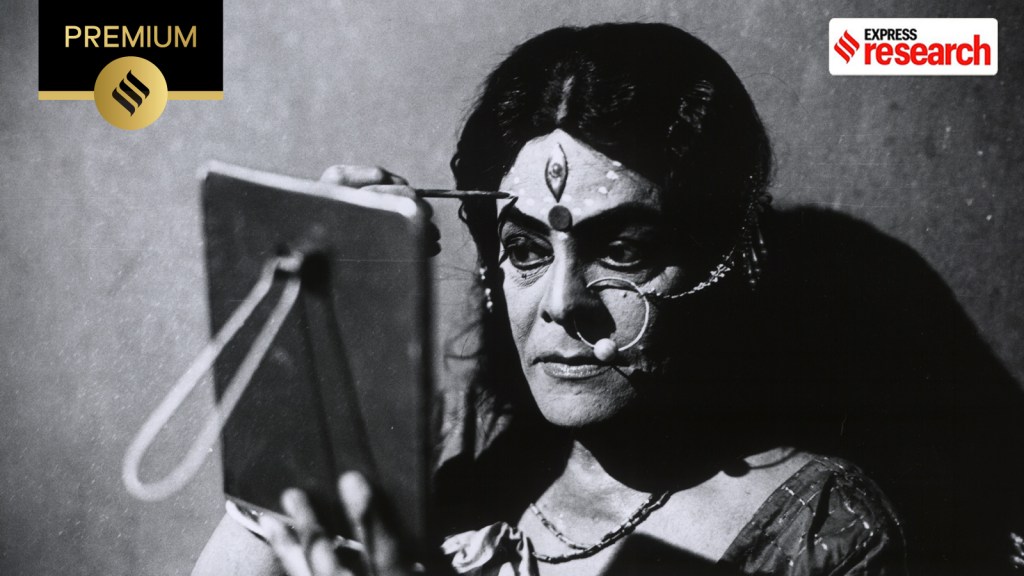 Chapal Bhaduri getting ready for a performance to grace the stage as Chapal Rani. (Photo Credit: Naveen Kishore)
For Rakhal Chandra Das, known on stage as Rakhal Rani, Jatra was not simply a profession. It was a way of life.
Over a career spanning more than 35 years, Rakhal, who first appeared on stage at the age of seven, became known for his graceful and dedicated performances. He belonged to an iconic generation of female impersonators — performers who specialised in playing women’s roles at a time when men dominated the female parts in Jatra. His contemporaries included Chapal Rani and Chhabi Rani.

Rakhal was felicitated by the West Bengal government in 1973. Yet, like many Jatra artists of his generation, he eventually faced poverty and displacement as women increasingly entered the industry.
In Dipankar Dutta’s 2014 Bengali documentary Chena Kintu Ajana, Rakhal’s son, Babulal Das, recalls how his father struggled to find work after leaving Jatra.
“I remember my father taking up a job in a small grocery shop after quitting (Jatra), but he couldn’t continue as a salesman for long. After that, he tried vending peanuts for a few days. Even that didn’t suit him.”
Eventually, acclaimed playwright Brajendra Kumar Dey helped Rakhal rebuild his life, offering him a job as a peon at Ichapur’s North Land High School. Rakhal died on November 30, 1984.
But Rakhal’s story is not an isolated one. It is the story of generations of female impersonators who devoted their lives to Jatra, only to find themselves with little or no means of livelihood when the tradition that had sustained them began to disappear.
The origins of Jatra
Jatra is a folk-theatre tradition associated primarily with eastern India, particularly Bengal, Assam and Odisha.
During the 15th and 16th centuries, Mahapurusha Shankaradeva developed a dramatic tradition known as Ankia Nat. Some of the plays within the tradition were referred to as Yatras by his disciples. These included Kalidamana Yatra, Arjunabhajan Yatra, Jamma Yatra, and Boka Yatra.
In Bengal, Jatra also became closely associated with Gaudiya Vaishnavism and devotional performance, incorporating hymns from Jayadeva’s Gita Govinda and Babu Chandidasa’s Krishna Kirtana. In History of Indian Theatre (1987), Manohar Laxman Varadpande cites scholar Kironmoy Raha’s account that the commonly accepted explanation connects the word to ritualistic musical processions during religious festivals, in which a deity was carried from one place to another.
Over time, Jatra developed into one of Bengal’s most recognisable forms of folk theatre.
The ‘Purush Ranis’
To understand the role of female impersonators in Jatra, it is necessary to understand how femininity and masculinity operated within the form.
In her paper The Last Jatra of the Purush Ranis: A Dying Art of Female Impersonation (2024), Sthitirupa Mukherjee, a postgraduate student of English literature at Jadavpur University, argues that the fluidity between masculine and feminine identities lies at the core of ancient Indian mythology. The concept of Ardhanarishvara, the composite form of Shiva and Parvati, offers a cultural framework through which cross-gender performance can be understood.
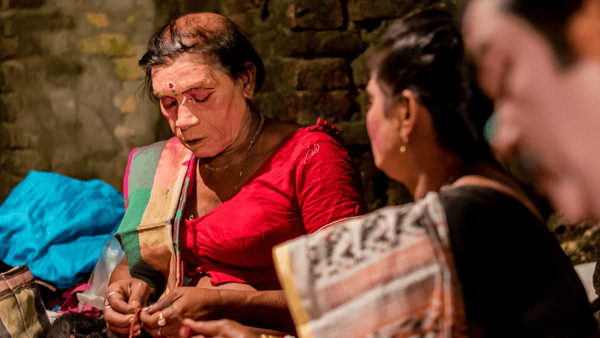 A male lavani folk jatra artist getting ready for performance. (Photo Credit: Tapas Kumar Haldar/wikimedia commons)
There were several reasons why male performers came to dominate female roles in Jatra. Mukherjee notes that the exclusion of women from theatre, and the resulting lack of female performers, made male impersonators essential to the form.
Sandip Roy, author of Chapal Rani: The Last Queen of Bengal (2026), identifies two reasons for the flourishing of female impersonators. Families were often reluctant to allow women to travel alone with theatre groups, while Jatra companies wanted performers with powerful voices capable of reaching large audiences.
The result was the rise of the Purush Ranis, male performers who became celebrated for their portrayals of women.
Female characters in Jatra were associated with the term ‘Rani’, meaning queen or graceful lady. The term eventually came to describe male actors who specialised in portraying female characters on stage.
When the Ranis began to disappear
The tradition of female impersonation began to change as social attitudes towards women performing on stage shifted. Women increasingly entered Jatra and began taking on female roles themselves. But the transition was gradual and contested.
According to Bengali scholar, archivist, and former performer Prabhat Kumar Das, writing in Life of Jatra Actresses: Stories of Unending Struggle (1950s–2010s), the once-thriving tradition of male impersonation began to recede particularly during the 1960s and 1970s.
Das attributes the broader economic crisis in Jatra to several factors. “Due to the partition (of Bengal) and the abolition of zamindari after independence, jatra underwent an economic crisis,” he writes. Women were gradually being inducted into Jatra troupes, but proprietors remained uncertain about whether replacing female impersonators would guarantee commercial success. Eventually, however, the advancing age of many male performers led to women taking over female roles.
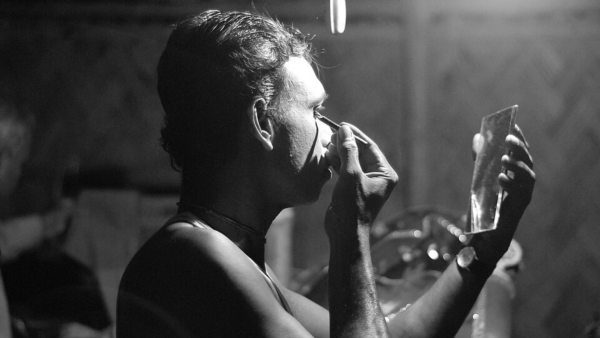 A jatra actor prepares before the performance, Sunderbans. (Photo Credit: Sayamindu Dasgupta/wikimedia commons)
The change transformed the socioeconomic structure of Jatra. Performers who had achieved legendary status through spectacular performances from the mid-1950s onwards were gradually pushed out of an industry in which they had spent their lives.
One of the figures associated with this transition was Jyotsna Dutta, an actress and singer whose success helped accelerate the commercial viability of women performers. Das writes that Dutta’s success as Satyambar Opera’s resident lead inspired the troupe to cast women across female roles, a practice that soon spread to rival companies. The transition helped formalise the role of “theatre actress”, with performers such as Chhabi Roy, Bina Ghosh, Uma Mukherjee, Bela Sarkar, Chitra Mallik and Firozabala emerging as prominent stars.
Not everyone welcomed the change.
Dey, a prominent Jatra playwright, opposed the entry of women into the form, arguing that their presence alongside the nomadic and nocturnal life of Jatra would create problems and that the profession should remain in the hands of men. He also lamented the disappearance of the female impersonators, whom he regarded as central to Jatra, and described the introduction of women performers as carrying the “seeds” of its destruction.
His views were challenged by contemporary Jatra practitioners. The debate was no longer simply who could portray which character, but how the changing social and economic realities of the industry would reshape the form itself.
As Jatra became increasingly commercialised, it became an arena for investment, including the circulation of black money.
In his book, Das cites an Anandabazar Patrika article from 26 August 1960, which criticised the introduction of women into Jatra and warned about the emergence of unethical contracts. “Those who offer money in advance want female roles to be played by women. Although the inclusion of actresses does push up the rate. A three hundred rupees contract becomes a five hundred rupees contract. This commercialism has led jatra troupes to sacrifice their artistic principles,” the article read.
Das also refers to a protest essay in Jatrajagat, a Bengali performing-arts periodical, written by veteran performer Shib Bhattacharya and signed by female artists. The essay criticised what it called the “uncouth gesture” of Dey’s opposition to women entering Jatra.
“Women have been engaged in the art of acting for a long time. It is clear that Brajendra Kumar is unaware of their relations with their male counterparts, which have led him to make such objectionable comments,” it read.
What happened to the Ranis?
The most detailed available account of the lives of female impersonators who worked before Chapal Rani appears in Chena Kintu Ajana. The documentary interviews the children and descendants of several performers, offering glimpses into what happened after their careers in Jatra came to an end.
Their stories point to the economic and social hardships that followed the disappearance of the traditional female impersonator. For many, leaving the stage also meant losing their primary source of income.
Chobi Rani, described as the ‘Elizabeth Taylor of Jatra’, eventually stitched petticoats and sold them in the market. Phoni Rani, once an immensely popular performer, was unable to afford blood-pressure medication towards the end of his life, according to his wife.
The documentary also follows the lives of several other performers. Hari Pada Rani, who played Draupadi in Jatra, died by suicide. Kanchan Rani was later found pulling a rickshaw and selling vegetables to make a living.
The decline of the traditional Jatra
Speaking about the decline of the Jatra, Sandip Roy told indianexpress.com, “The Jatra has had to evolve with changing times. But with the advent of television, Jatra no longer had to roll out to small towns to provide entertainment. Though there are still Jatra companies in the vicinity, the traditional form of Jatra has sort of declined.”
Roy also points to the changing economics of entertainment. According to him, traditional Jatra was once more profitable than commercial Bengali cinema, but the emergence of film stars and the growing dominance of other forms of entertainment altered the economics of the industry. Traditional Jatra performers, he argues, were increasingly “sidelined and paid less”.
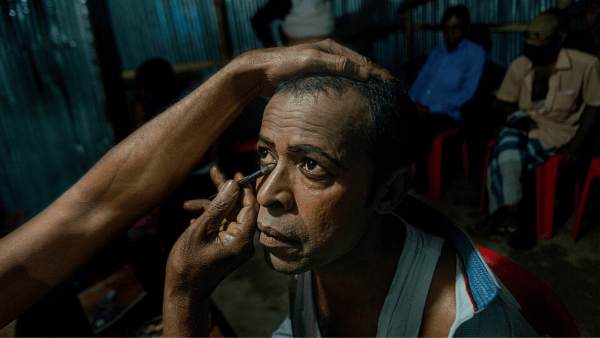 Folk of Jatra Khulna Bangladesh (Photo Credit: NIslamPhoto/wikimedia commons)
Roy’s conversations with Chapal Bhaduri, another celebrated Jatra performer, also offered a glimpse of how far the form had changed. Bhaduri reportedly had not watched a Jatra performance for years. When he eventually did, the changes were so extensive that Bhaduri could barely recognise the form and no longer enjoyed it as he once had.
Other researchers place the decline in a broader historical context.
Md Alamgir Hossain, a former PhD scholar at the Department of Theatre and Performance at Monash University, in his research thesis The Survival of Jatra (2015), identifies several factors that contributed to the decline of Jatra. These include famine, the loss of traditional sponsors, zamindari policies, the influence of Christian missionaries and their criticism of Jatra, the promotion of English education and cultural hegemony, and the introduction of Western-style public theatres.
Roy says there was no sustained institutional or social support for Jatra performers. Even when theatre artists received pensions from state governments, Jatra artists were often excluded. Roy attributes part of this neglect to the perception among sections of the Bengali intelligentsia and government that Jatra was an inferior form of theatre. Chapal Bhaduri is remembered as saying, “Jatra is for the foolish and theatre is done by the genteel.”
Rashmi Ranjan, a PhD scholar at IIT Madras, describes the change as a transformation rather than simply a decline. Jatra, he argues, has adapted to the contemporary entertainment industry rather than disappearing altogether. At the same time, he points to the need for greater institutional protection for those who continue to work within the form.
“Given the current character of Jatra as a profit-oriented and consumer-driven network, legal and systematic investments in the safety and sustenance of those involved must be ensured by the responsible authorities, both in terms of ownership and administration,” he told indianexpress.com.
Ranjan also questions what role scholarship can play in protecting the tradition: “Should we instead mobilise our research and findings to imagine some form of political, ethical, and activist discourse aimed at improving the lived conditions of Jatra practitioners?”
That question is particularly relevant as entertainment and media industries continue to evolve. Preserving Jatra may therefore require more than documenting its history. It may require creating ways for the people who continue to practise it to live and work with dignity.
Jatra is not merely an art form. It is a living cultural tradition shaped by thousands of performers, audiences and communities, and by generations of people who gave their lives to the stage. To preserve Jatra is to preserve not only its performances, but also the lives and memories of the people who embodied it.

 Share


