
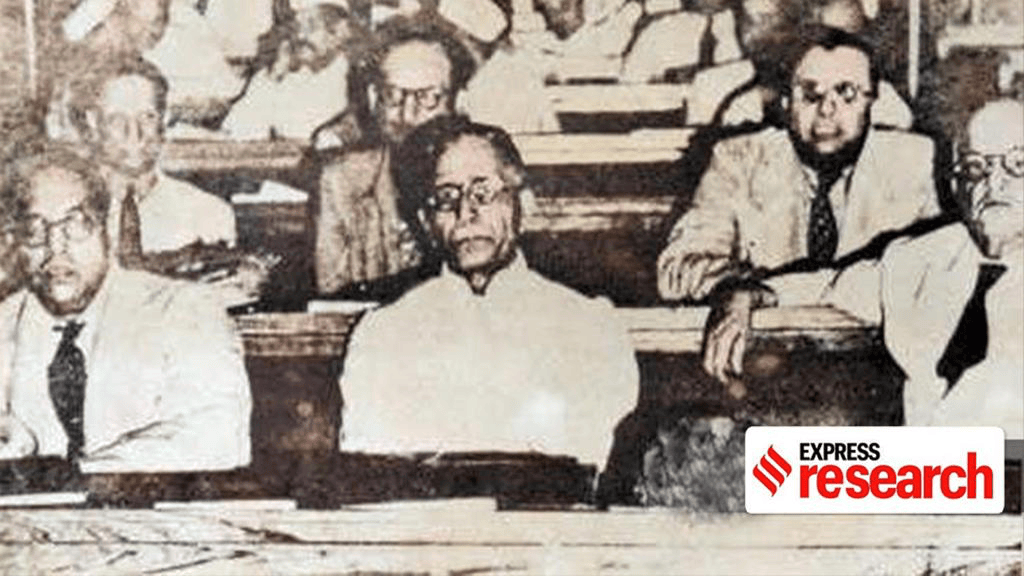
“In India there are castes. The castes are anti-national. In the first place because they are about separation in social life. They generate jealousy and antipathy between castes. But we must overcome all these difficulties if we wish to become a nation in reality.”
〜 Dr BR Ambedkar in his final speech to the Constituent Assembly in 1949.

When the Constitution of India was being drafted by the Constituent Assembly, discussion on minority rights was a key feature in the debates. While they started as a means of establishing political safeguards for minorities, the debates concluded by providing reservations and affirmative action only for ‘backward classes’ and not religious minorities. They also demonstrated the varied criticisms and opinions of the members in producing the present provision of reservations in the Indian Constitution.
The minorities
Before debating the provisions for the protection and upliftment of caste minorities, the Constituent Assembly deliberated on defining the term “minority”. Political scientist Rochona Bajpai in an article Constituent Assembly Debates and Minority Rights (2000) says that minorities encompassed three kinds of communities — religious minorities, Scheduled Castes, and ‘backward tribes’.
Discussions regarding the definition of minority were crucial to deciding the nature of provisions needed. It was relatively easier to demarcate religious minorities and draft a framework of equal citizenship to the Indian state regardless of religious affiliations. However, it was not the same in the case of caste as inclusive citizenship would not address the fundamentally hierarchical and undemocratic character of the caste system. The question of who the caste minorities are and how the term ‘minority’ might be defined remained.
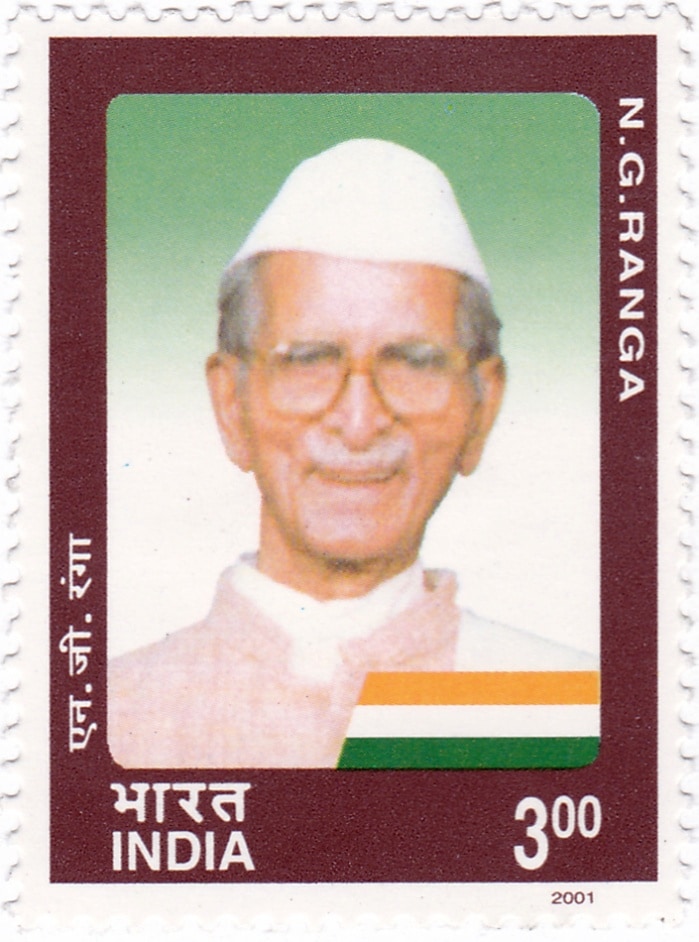 A postage stamp of NG Ranga (Wikimedia Commons)
Freedom fighter and farmers’ leader NG Ranga believed that the masses in India are the real minority. “These people [the masses] are so depressed and oppressed and suppressed till now that they are not able to take advantage of the ordinary civil rights. These are the real minorities who need protection”, he argued during the Constituent Assembly Debates in 1948.
For Ranga, the term minority did not denote the numerical status of any group. Instead, as Bajpai writes, it signified that “the group that suffered from some kind of a disadvantage with respect to the rest that entitled it to special treatment from the state.” Bajpai further says that the numerical strength of these communities only increased their importance to the socio-political fabric of India and prompted the debate on proportional representation. Many groups including the All-India Hindu Depressed Classes Association, which was founded by Ambedkar in 1930, submitted a plea that the Constitution must provide representation for Scheduled Castes in proportion to their population. The Association aimed to achieve representation of socially marginalised groups such as Dalits in India’s political institutions.
Sri Nagappa, a Scheduled Caste Congress representative from Madras, felt that it was important for the Scheduled Castes to be considered a minority. During the debate, he said, “recognition as a minority is crucial if we want to resist appropriation into one or other community.”
Nagappa’s arguments questioned the position of Dalits and untouchables within Hindu society. Lawyer and member of the Constituent Assembly elected from Bombay, KM Munshi, said the term minority was “defined in international treaties and law along racial, religious and linguistic lines, but the Scheduled Castes are none of these”.
He argued that the Dalits were “part and parcel of the Hindu community and the safeguards given to them to protect their rights are only till they are completely absorbed into Hindu community”. As a result, for Munshi, the Scheduled Castes were Hindus and not a minority, and therefore did not require constitutional reservations and protections in a Hindu-majority country.
Research scholar Zubair Ahmad Bader in an article Difference and Reservation: A Reading of the Constituent Assembly Debates argues that the minority debate was tied to the question of difference and disadvantage. Bader notes that the arguments about minority status in the Constituent Assembly highlighted social, cultural or economic differences between communities that were perceived to belong to the same religion.
Tribal groups led this discussion saying that they not only were culturally distinct but also had land rights, which would have to be constitutionally affirmed. Author Jagannath Ambagudia in a 2011 article, Protective Discrimination and Social Justice: Exploring Constituent Assembly Debates writes that isolation of tribal areas and state protection of Scheduled Tribes in cases of encroachment, hostility or exploitation by non-tribals is necessary.
Historian Shabnum Tejani writes that the debate around defining the term minority revealed profound differences in the ideas of democracy among the Assembly members. Scheduled Caste leaders thought of democracy as a means of political and social emancipation. Other leaders like Debi Prosad Khaitan, an upper caste Congress member who was elected to the Constituent Assembly from Darjeeling, feared that if the Scheduled Castes and Tribes were made to be a separate category, along with religious minorities, they would make up more than half of the population. “Independent India could not be composed of a series of minorities, he warned, this was not democracy as people knew it”, he argued.
Now, the dilemma before the Constituent Assembly was to find a constitutional method to politically recognise communities while at the same time fostering national unity and an inclusive democratic structure. Tejani argues that further debates about this predicament brought into question the aim of reservations also. Were reservations a method to celebrate India’s diversity or were they a means for social and political emancipation?
Ambedkar’s views
In his 1936 essay The Annihilation of Caste, Ambedkar argued that “caste is not a division of labour but also the division of labourers”. Hence, along with the minority question, Ambedkar was also faced with the trouble of envisaging a constitution that would guarantee the eradication of caste as an institution and secure lower castes adequate political representation.
Madhav Khosla in his book India’s Founding Moment writes that Ambedkar approached the caste question in three ways. First, by introducing ‘backwardness’ as the principle to identify groups that required constitutional protection and reservations. Although vague, Ambedkar, in a speech in the Constituent Assembly in 1948, clarified his position on the matter.
He argued that caste operates differently in different regions. A community belonging to the Shudra varna in Punjab might not be on the same socio-economic level as a community of the same caste in Karnataka. Therefore, backwardness concerning the socio-economic and political status of the community must be taken into consideration while drawing up the list of communities for constitutional protection. Ambedkar left this task to the State governments.
Khosla argues that introducing backwardness as a means of evaluation was also Ambedkar’s way of reconciling the multiple positions on the minority question. He writes, “The focus on backwardness shows that there was no particular group identity that the Constitution sought to protect. For Ambedkar, the concept of “backwardness” could reconcile the equality of opportunity with the inclusion of specific communities in public life”.
Secondly, the introduction of the ‘backwardness’ evaluation criteria also underpinned class status along with caste. Any scheme of reservations would operate on the principle of equality of opportunity. For instance, reservations would have to be confined to a limited number of seats to make space for everyone eligible for the post.
As a result, the concept of backwardness would be relative. A group could only be considered as backward with respect to other communities. Khosla writes that despite being a numerical minority, the Sikh community was denied preferential treatment because it was “backward relative to other communities.”
Social worker Hriday Nath Kunzu who was elected from United Provinces, supported Ambedkar on this particular argument. He said, “protection can only be granted to a class, whether you call it a minority or backward, only on the ground that it is backward and if left to itself would be unable to protect its interests.”
Thirdly, the concept of backwardness in some ways also resolved the question of whether reservations were for social emancipation or to highlight India’s diversity. Ambedkar’s policies made it quite clear that the purpose of reservations was for the social and political emancipation of backward groups.
Despite being pragmatic towards the criteria for reservations and resolution for the minority question, Ambedkar failed to tackle the minority question effectively. The substitution of minorities with “backward classes” provided no resolution for a definition of minority and the distinct cultural identities that were put forth by several leaders.
Responses to Ambedkar’s approach
Many members of the Constituent Assembly, like TT Krishnamachari and Hriday Nath Kunzu were critical of some parts of Ambedkar’s approach to the caste and minority question. Kunzu and Ramchandra Manohar Nalavade argued that the word ‘backward’ is not defined anywhere in the Constitution. “Article 301 already provides for the appointment of a Commission to enquire into the condition of the backward classes. But only those classes that are educationally or socially backward will be looked into”, Kunzu said.
While Kunzu agreed and supported Ambedkar on some attributes, he believed that ‘backward’ is open to interpretation, has to be defined more robustly, and cannot be left to the states or the courts to deliberate. Kunzu further argued that if constitutional protection for the backward classes is indefinite it might lead the State to believe that its duties towards them are restricted to the facilitation of the provision of reservations. As a result, the reservation must be reviewed and revisited from time to time, he argued.
Krishnamachari argued that there was confusion about the relationship between the definition of “backward” and caste. “The intention of the framers as to who should come under the category of backward classes is unclear. It does not say ‘caste’. It says ‘class’. Is it a class which is based on grounds of economic status or on grounds of literacy or on grounds of birth?”
Krishnamachari believed if literacy rates were considered to draw the list of backward classes, more than 80 per cent of India’s population in 1949 would be backward.
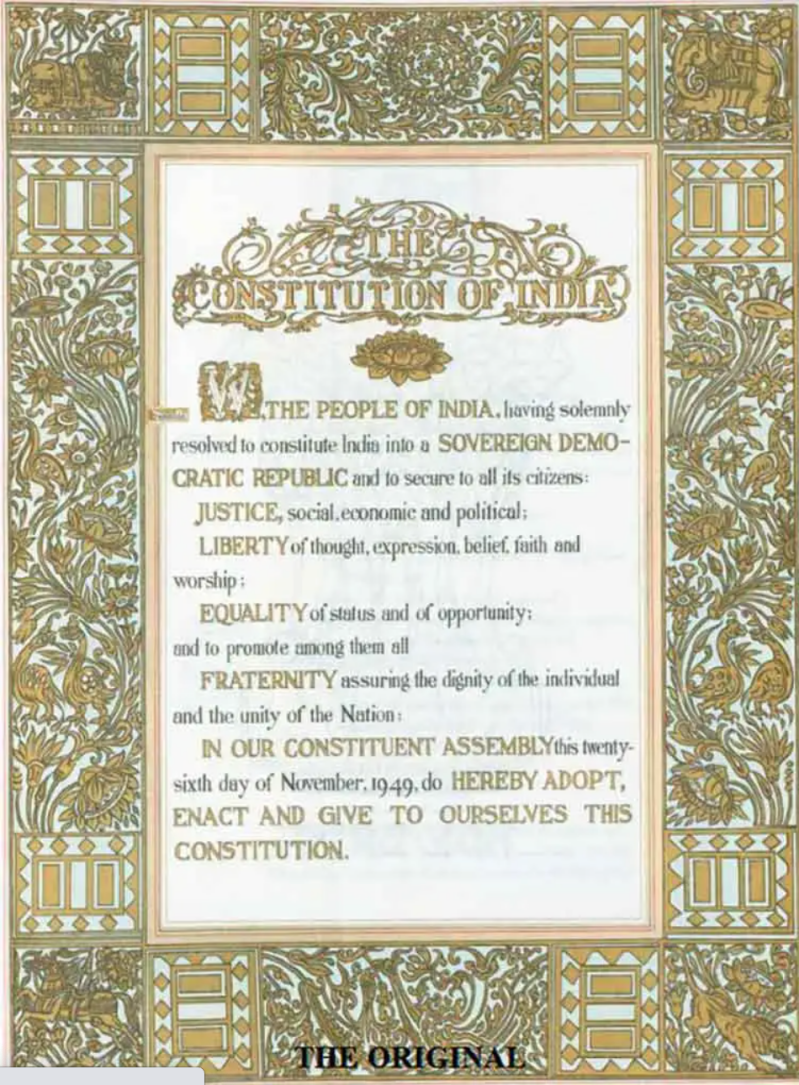 The Indian Constitution
Ambedkar justified the use of the word ‘backward’ by citing the equality of opportunity for citizens and the limited number of seats reserved for groups that have historically not had the opportunity to enter administration. He argued that the Assembly has to safeguard these two factors and said, “unless you use some such qualifying phrase as “backward” the exception made in favour of reservation will ultimately eat up the rule altogether.”
Despite Ambedkar’s justification of reservations, prime minister Jawaharlal Nehru believed that the abolition of reservations for minorities is a “historic turn in our destiny”. He argued that granting safeguards to minorities will isolate them. “Maybe you protect them to a slight extent, but at what cost?”, he asked. Nehru feared that reservations might also forfeit inner sympathy and fellow feelings with the majority of the country.
Although Nehru felt uncomfortable about reservations, he supported reservations for Scheduled Castes. He said, “Frankly, I would like to put an end to reservations but in the present state of affairs in India it would not be a desirable thing to do with regards to the Scheduled Castes”. Nehru affirmed that he did not look at the question of reservations through the lens of religion or caste. He preferred to approach it from the point of view of helping a backward group.
The present provisions for reservation
Ultimately, the Constituent Assembly granted reservations for employment for Scheduled Castes and Scheduled Tribes under Article 16(4A) of the Constitution. It did not take into consideration religious minorities, despite the first draft of the Report of the Advisory Committee on Minorities recommending reservation for religious minorities along with SCs and STs. Initially, the reservations according to the report were sanctioned for only 10 years but have been renewed every year since. Even Christian and Muslim SC and ST communities do not have reservations.
The Partition influenced the decision to not grant reservations to religious minorities. Sardar Vallabhai Patel in 1949 submitted the report of a special sub-committee to consider the problems facing minority populations in East Punjab and West Bengal.
The committee comprised Nehru, Rajendra Prasad, KM Munshi and Ambedkar. The panel thought that conditions in the country had changed to such an extent that “it was no longer appropriate in the context of free India and of present conditions that there should be reservations of seats for Muslims, Christians, Sikhs or any other religious minority.”
They believed that reservation for religious communities might lead to “certain degrees of separatism and was to the extent contrary to the conception of a secular democratic state.” They believed that the Fundamental Rights of the freedom of religion and rights of minorities to maintain their own educational institutions were sufficient safeguards to protect minorities. However, the Advisory Committee agreed that “the peculiar position of the Scheduled Castes would make it necessary to give them reservations for a period of ten years as originally decided.”
Ambedkar attempted to resolve multiple positions on the caste question by introducing the concept of backwardness and reservations as a method of creating a society that transcended caste. However, as political theorist Sudipta Kaviraj says, “We have moved from a framework that recognized equality beyond caste to one where equality-based claims are made through caste”.
References
Bader, Zubair Ahmad. ‘Difference and Reservation: A Reading of the Constituent Assembly Debates’. History and Sociology of South Asia 10, no. 1 (January 2016): 74–94. https://doi.org/10.1177/2230807515600088.
Bajpai, Rochona. ‘Constituent Assembly Debates and Minority Rights’. Economic and Political Weekly 35, no. 22 (2 June 2000): 1837–45.
Constituent Assembly Debates Vol. 5. Government of India.
Constituent Assembly Debates Vol.2. Government of India.
Hasan, Zoya. Politics of Inclusion: Castes, Minorities and Affirmative Action. Oxford India paperb. Oxford India Paperbacks. Oxford: Oxford Univ. Press, 2011.
Jaffrelot, Christophe. Religion, Caste and Politics in India. Reprint. Delhi: Primus Books, 2011.
Khosla, Madhav. India’s Founding Moment: The Constitution of a Most Surprising Democracy. Cambridge, Massachusetts London, Englang: Harvard University Press, 2020.
Sitapati, Vinay. ‘Reservations’. In The Oxford Handbook of the Indian Constitution, edited by Sujit Choudhry, Madhav Khosla, and Pratap Bhanu Mehta, 1st ed., 720–41. Oxford University Press, 2017. https://doi.org/10.1093/law/9780198704898.003.0040.
Tejani, Shabnum. ‘Between Inequality and Identity: The Indian Constituent Assembly Debates and Religous Difference, 1946-50’. In The Indian Constituent Assembly: Deliberations on Democracy, edited by Udit Bhatia, South Asia edition 2018. London: Routledge, Taylor & Francis Group, 2018.

 Share


