
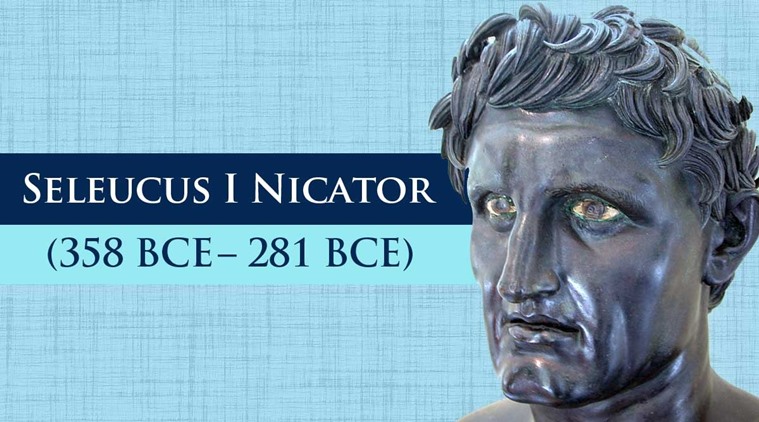
 Seleucus’ success in war also acquired him the surname ‘Nicator’ (a greek title meaning victor) and helped him build his empire which went on to be known as the Seleucid Empire.
Nearly 20 years after the Macedonian emperor Alexander the Great launched a campaign into the northwestern part of the Indian subcontinent in 326 BCE, the region was again on the verge of facing another invasion–this time by one of his generals, Seleucus I Nicator.
By the fourth century BCE, the Mauryan emperor Chandragupta Maurya had overtaken large parts of the region previously ruled by Alexander, which led Seleucus to campaign towards the east to protect his empire’s border. However, in an interesting turn of events, what was to be full-fledged war instead ended up marking a strong foundation of diplomatic relations between the Mauryan Empire and the ancient Greek kingdom.

At a time when the expansion of empires through military campaigns were a common phenomenon, the diplomatic ties between the two kingdoms carried on for generations to come including during the reign of Ashoka the Great.
Who was Seleucus-I?
Following the untimely death of Alexander the Great at the age of 32, his vast empire was left with no heir. The sudden death of the king led to a fight of succession between his rival generals, family, relatives and friends, collectively known as the Diadochi.
Seleucus, son of Antiochos, was one such general who had served in the army of Alexander and was now fighting to take control of his empire amongst others.
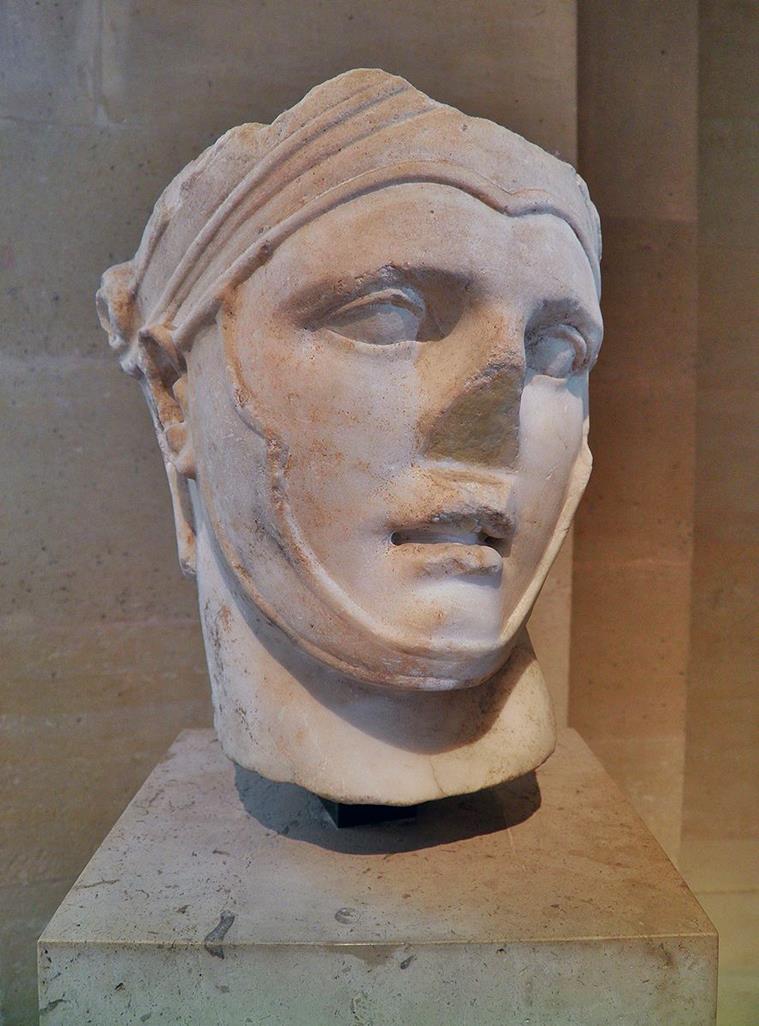 Portrait of Seleucus I Nicator, Louvre Museum, France. (Source: Wikimedia Commons)
“Seleucus had emerged in the latter part of Alexander’s career of conquest as a senior commander, though with little in the way of personal distinction to mark him out from the rest. He was one of a group of Alexander’s contemporaries who were clearly being promoted by the king to free him from the influence and caution of the older men he had inherited from his father,” historian John D Grainger writes in his book The Rise of the Seleucid Empire.
In years to come, Seleucus shifted loyalties during the wars of the Diadochi to rise up the ladder. After gaining control of Babylonia in 321 BC, Seleucus worked upon expanding his empire, which at its peak covered much of Alexander’s territories.
“He was of such a large and powerful frame that once when a wild bull was brought for sacrifice to Alexander and broke loose from his ropes, Seleucus held him alone, with nothing but his hands, for which reason his statues are ornamented with horns,” Greek historian Appian of Alexandria notes in his accounts.
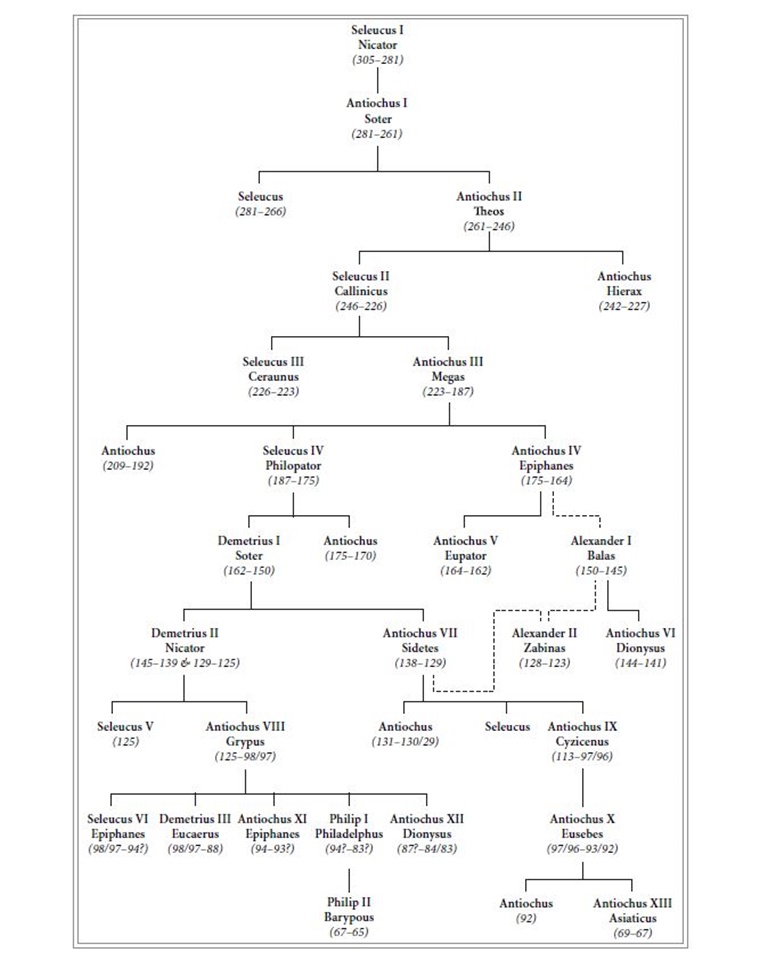 The house of Seleucus. (Source: Paul J Kosmin)
Seleucus’ success in war also acquired him the surname ‘Nicator’ (a greek title meaning victor) and helped him build his empire which went on to be known as the Seleucid Empire and was one of the largest states in the ancient world for nearly 150 years.
An Associate Professor of Humanities at Harvard University, Paul J Kosmin, remarks on Seleucus’ empire saying that it was a sprawling offcut from the carcass of Alexander’s conquests. “It extended geographically from the oasis cities of Central Asia to the riding plains of Bulgaria, from the uplands of Armenia to the Bahrain archipelago,” Kosmin notes in his book The land of the Elephants.
At its peak, the empire of Seleucus also bordered India in the east. Thereby in the fourth century BCE, he decided to conquer the region and led a campaign against the founder of the Mauryan Empire, Chandragupta Maurya.
Seleucus I vs Chandragupta Maurya
Seleucus had first set foot in India in 326 BC as a newly-appointed captain of an infantry guard in the army of Alexander who was fighting against King Porus. However, nearly two decades later he was again standing on the shores of River Indus as a king looking to protect his borders and expand his empire.
India at the time was ruled by Chandragupta Maurya who had established himself as ruler of Magadha around 321 BC. Historians note that somewhere in 305 or 304 BC, the Mauryans had annexed a few areas in the Hindu Kush region which were governed by satraps (governors) who were appointed by Alexander during his campaign.
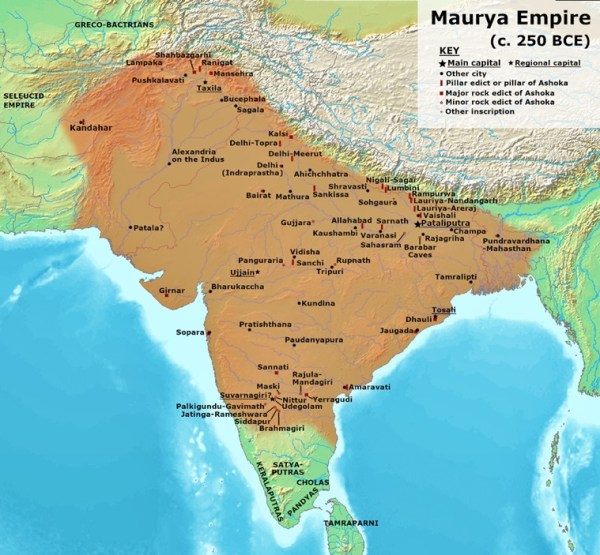 Map of the Mauryan Empire, c.250 BCE. (Source: Wikimedia Commons)
This move prompted Seleucus to campaign against Chandragupta in order to secure the eastern border of his empire. Details of the Greek ruler’s campaign in India, which lasted for nearly two years are still not known in detail. However, it is certain that Seleucus crossed the river Indus to invade India. Whether the armies of the two rulers had faced each other on the battleground is still debatable by historians.
Appian briefly mentioned this campaign of Seleucus in his records. He writes: “He (Seleucus) crossed the Indus and made war on Sandracottus (as Chandragupta was known to the Greeks), king of the Indians about that river, and eventually arranged friendship and a marriage alliance with him.”
Grainger, on the other hand, writes that whatever happened in the military campaign between the two soon ended. “Seleucus will have known of the size of Chandragupta’s empire and of his army before he reached India – there will have been plenty of men in Baktria and the Paropamisadai to inform him – and negotiations soon began. This would imply that whatever fighting took place was inconclusive.”
500 elephants and a treaty
The negotiations and the treaty signed between the Greek ruler and Maurya held considerable socio-political significance at the time.
Seleucus was made to surrender several large provinces on the easternmost border of his empire including Gandhara, Parapamisadae, and Gedrosia (largely area around modern-day Afghanistan and Pakistan). In return, Maurya handed around 500 war elephants to Seleucus, along with mahouts, attendants, equipment, and supplies of food.
Kosmin argues that the treaty was a “momentous and foundational act of the new world order” and the exchange of territory for elephants proved to be beneficial to both the parties.
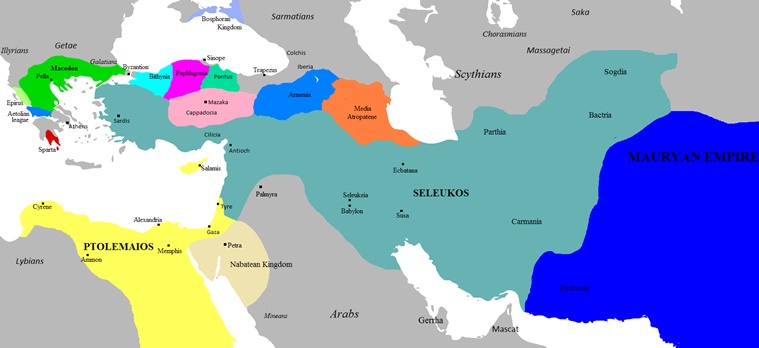 The Seleucid Empire, 281 BC. (Source: Wikimedia Commons)
“Geopolitically, Seleucus abandoned territories he could never securely hold in favour of peace and security in the east. The treaty and elephants allowed him to turn his attention to his rival, Antigonus Monophthalmus, Syria, and the Mediterranean,” Kosmin writes.
On the other hand, the treaty paved the way for an unchallenged expansion into India’s northwest corridor for Chandragupta Maurya and his empire.
The two kings were also joined by some kind of marriage alliance. Historians argue that Chandragupta had likely married the daughter of Seleucus. However, details about the marriage are scarce.
Seleucus’ campaigns in the east were largely about negotiations and administration. With the war elephants that he got from the Mauryas, he was able to defeat his rival, Antigonus at the crucial Battle of Ipsus. He was referred to as “elephant-commander” by his enemies.
Somewhere in 292 BC, Seleucus appointed his son Antiochus I as the viceroy to the eastern provinces of his kingdom. In the coming years, he fought wars with the remaining members of the Diadochi and emerged as the sole predecessor of Alexander.
He was assassinated in September (281 BC) during one such military campaign. The friendly contacts established between the two empires were maintained by Seleucid diplomats for many generations to come.
Suggested reading: The Rise of the Seleukid Empire (323-223 BC): Seleukos I to Seleukos III by John Grainger; The Land of the Elephant Kings by Paul J Kosmin; Classical Accounts of India Rome, Greek by R C Majumdar; Asoka the Decline of the Mauryas by Romila Thapar.
 Share


