Hours after floods hit Nepal, Sandesha Rayapa, a faculty member at Jawaharlal Nehru University, posted her anguish on social media.
“Every time a calamity strikes the Himalayas, we call it a ‘natural disaster’. But perhaps we also need to ask how much of the devastation is intensified by human choices — our idea of development, excessive tourism, disregard for ecological limits and our insistence on making every remote mountain accessible.”
For Rayapa, the question is personal. She belongs to the Rung community, an indigenous Himalayan community whose members live predominantly on the Indian side of the Himalayas.
For centuries, reaching Mount Kailash meant crossing by foot some of the most difficult terrain in the Himalayas. That has changed dramatically. Roads, infrastructure, tourism and unregulated homestays have transformed a pilgrimage once defined by physical hardship.
Accessibility, however, comes at a cost. “Mountains are being blasted to create roads and remote settlements have become tourist destinations,” Rayapa tells indianexpress.com.
That tension — between devotion and development, accessibility and ecological limits — lies at the heart of the modern story of Mount Kailash.
A mountain sacred to many faiths
At 6,660 metres, Mount Kailash is among the world’s most revered sacred mountains. The snow-clad peak lies at the centre of a ring of ranges in the southwestern Tibetan Plateau. To its south are the vast freshwater lakes Manasarovar and Rakas Tal, while nearby lie the sources of four major rivers: the Brahmaputra, Indus, Karnali and Sutlej.
For Hindus, Mount Kailash is the abode of Lord Śhiva; for Tibetan Buddhists, it is associated with the deity Demchok. Jain traditions associate it with Mount Aśtapada, where Riśabha, the legendary first tirthankara, is believed to have attained liberation. The mountain is also sacred to the Bönpo, the Tibetan religious tradition that coexists with Buddhism.
 Mani stones on the path around Mount Kailash (Wikipedia)
But beyond faith, the story of Kailash is shaped by the extraordinary geography of the Himalayas, the routes through which pilgrims travelled, the interventions of colonial rule and the shifting geopolitics of India, Nepal and China.
Historian Alex McKay challenges the assumption that Mount Kailash has been a major pilgrimage site for millennia. “As recently as the early 1900s, it was not a site of any great appeal. It was certainly not the most sacred place in Hindu understanding. While Kailas had long been used as a metaphor for strength and purity in Indic literature, the literary Kailas was an ideal rather than a real place,” he writes in Kailas Histories (2015).
His research suggests that the mountain itself was visited only occasionally by renunciates, rather than by ordinary pilgrims. Early Hindu and Buddhist texts, he argues, portrayed Kailash as a heavenly realm accessible primarily to advanced spiritual practitioners.
Mount Kailash in the ancient texts
The earliest Indian Buddhist references to the Kailash region, interestingly, concerned not a mountain but a lake, most likely Manasarovar.
“The sources of rivers such as the Ganges carried a particular sanctity in Indic conceptions, and even today Manasarovar rather than Kailash is the ritual focus of Hindu pilgrimage there,” McKay notes.
Map of Mansarovar by Joseph Tiefenthaler c. 1784 (Wikipedia)
In Pilgrimage in Tibet (1998), McKay points out that the earlier Vedic texts make no mention of ‘Kailasa,’ despite the Rigveda-Samhita covering a broad geographical area and containing references to the mountains and rivers of the Indus system.
References to Kailash-Manasarovar in Mahabharata and Ramayana are similarly brief. “The Mahabharata is one of the world’s longest works of prose. It contains more than 90,000 stanzas, of which only a handful contain any meaningful allusion to Kailas-Manasarovar, as is the case with the Ramayana,” McKay writes.
The Puranic tradition presents a similar picture. The Sivapurana, a text detailing rituals associated with the worship of Shiva and generally dated to around the 9th-11th centuries, does not mention Kailash, instead describing Shiva as residing at Himavat.
An illustration depicting Shiva at Kailasha (c.1810-1820, Wikipedia)
Yet the mountain’s presence in oral traditions, ancient art and scattered textual references suggests that its sacred associations developed over time.
Among the more detailed Indian accounts of the Kailash yatra is Swami Pranavananda’s Kailas-Manasarovar (1949). Having undertaken the pilgrimage several times, Pranavananda presents the mountain as a sacred centre across religious traditions. He also offers a practical guide to the pilgrimage, detailing the geography of the region, routes to the mountain, passport requirements, medicines and other necessities as well as the physical preparation required for the journey.
The making of a modern pilgrimage
The emergence of Kailash-Manasarovar as a major spiritual and pilgrimage site beyond Asia was a slow process. In colonial India, European knowledge of the Himalayas expanded after the establishment of trading centres in the early 17th century. Manasarovar was occasionally mentioned in connection with commodities such as borax and musk, but there were no first-hand European accounts of the site or indications of significant spiritual associations. “Not until 1715 did the first European, Italian Jesuit Ippolito Desideri, report sighting Kailas. He stated that the region was held sacred by the Tibetans,” McKay notes.
As the East India Company expanded, so did British efforts to map and document the Himalayan region. By the early 20th century, this geographical interest had begun to intersect with commercial considerations. Charles Sherring, the Deputy Commissioner at Almora, Uttarakhand, recognised the potential economic benefits of pilgrimage. Ordinary pilgrims, however, were unlikely to undertake the difficult and unsafe journey to Kailash. After visiting the region in 1905, Sherring recommended improving roads along the pilgrimage route so that, “as elsewhere the devotee will be the pioneer of trade.”
Yaks used in the pilgrimage to Mount Kailash on the banks of Lake Mansarovar (Wikipedia)
“Sherring never returned to Tibet after his 1905 visit, but he became a key figure in the history of pilgrimage to Mount Kailas, indeed he may be identified as the primary agent in the construction of the modern understanding of the site,” McKay argues in his work.
Changes in border regulations facilitated cross-border travel, while improvements to the route gradually made the journey more accessible. By 1951, the last year for which figures were published before the frontiers closed, an estimated 600 pilgrims had travelled from Almora to Kailash. Following the Chinese takeover of Tibet in 1950, Indian pilgrims came under closer monitoring, and the borders were sealed in 1959, bringing the pilgrimage to an end until its revival in the 1980s.
People such as Sherring and the Swedish explorer Sven Hedin helped bring the mountain into public discourse, while the emergence of an Indian middle class made long-distance pilgrimage increasingly possible.
Summing up, McKay writes: “Colonial government contributed through enhanced provision of law and order and with improved transport—notably the railways. There was, therefore, a nexus of factors that came together both to elevate the sanctity of Kailas and to enable it to function as a popular Indic pilgrimage site in the late colonial and modern period.”
Faith across borders
Within India, deteriorating relations with China, culminating in the Sino-Indian war of 1962, also led to a major expansion of road-building in the Himalayas. Improved infrastructure would later facilitate greater access to the region’s pilgrimage sites.
By the late 1970s, as China began to ease some of its earlier restrictions on religious practice and open up to foreign tourism, Kailash emerged as an early beneficiary of this shift. “Kailas was at the forefront of that process, credit for which is claimed by an Iyer Brahmin, Dr. Subramaniam Swamy…” McKay writes.
In April 1981, Swamy raised the issue with Deng Xiaoping, the Chinese Foreign Minister, and arrangements were finalised during his visit to India that July. Two months later, the first group of 60 Indian pilgrims set out for Kailash via Almora and the Lipu Lekh Pass.
Speaking to indianexpress.com, Antara Ghosal Singh, Fellow at the Strategic Studies Programme at the Observer Research Foundation, New Delhi, says the Kailash Yatra has long served as a symbol of cultural exchange and a degree of normalcy in India-China relations. The pilgrimage also has an economic dimension: tourism contributes to the local economy in Tibet, making the yatra relevant to the Chinese authorities.
Yet Beijing remains highly sensitive to issues concerning Tibet and regional security. Public discourse in China, Singh says, can view Indian pilgrims with suspicion, including concerns that they may be gathering intelligence or asserting India’s cultural claims in territory under Chinese control.
The pilgrimage also exists within an increasingly fraught environmental landscape. One of the most significant concerns is China’s large-scale infrastructure development on the Yarlung Tsangpo river, known as the Brahmaputra once it enters India.
Rayapa cautions against assuming that such projects can be sustainable. “Today, we talk about sustainable development, but sustainable development is a myth. Calling something sustainable does not guarantee that it will not damage the environment,” she says.
Despite these tensions, the pull of Kailash is resilient. “Faith is unexplainable, especially when it is about the Kailash-Mansarovar,” Singh says.

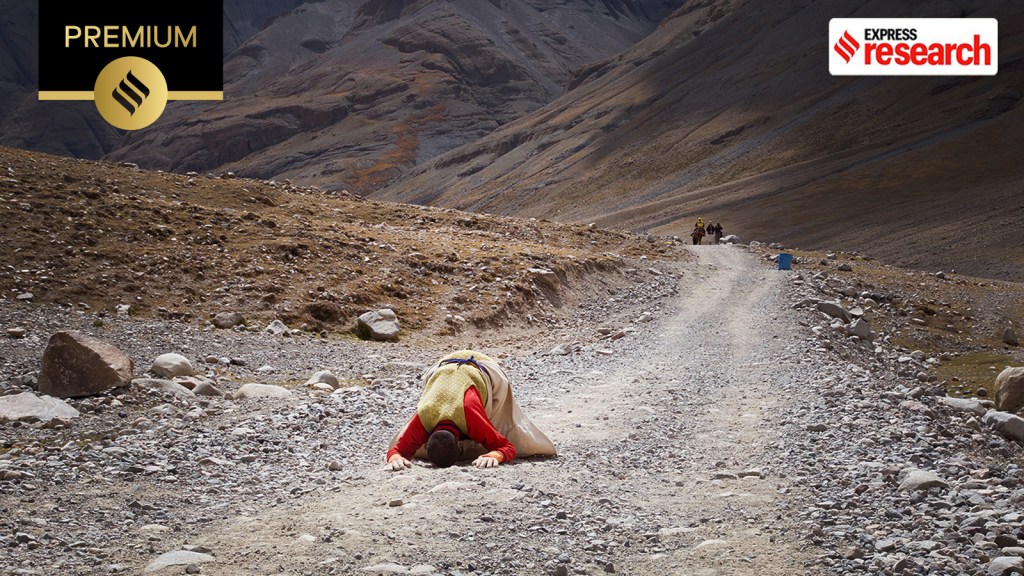 A pilgrim on the Kailash kora (circumambulation) Wikipedia

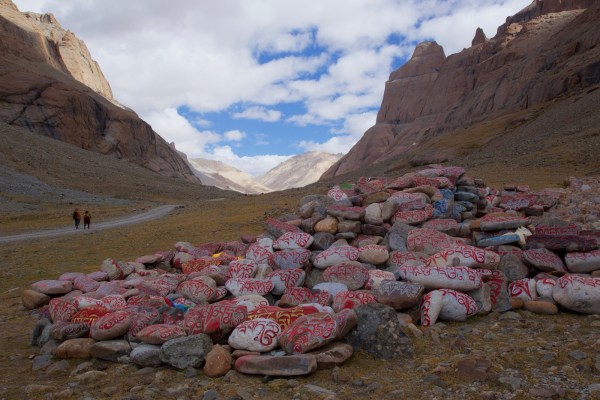 Mani stones on the path around Mount Kailash (Wikipedia)
 Map of Mansarovar by Joseph Tiefenthaler c. 1784 (Wikipedia)
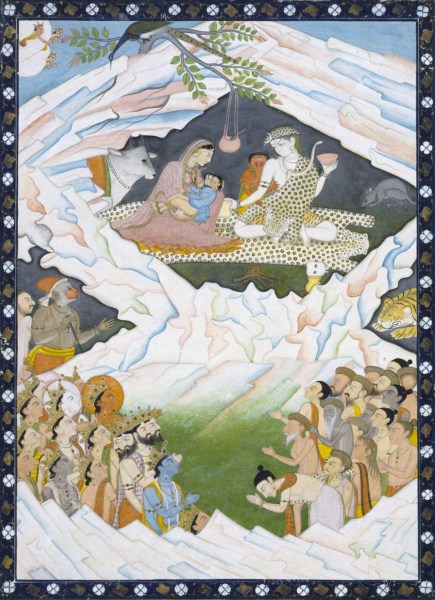 An illustration depicting Shiva at Kailasha (c.1810-1820, Wikipedia)
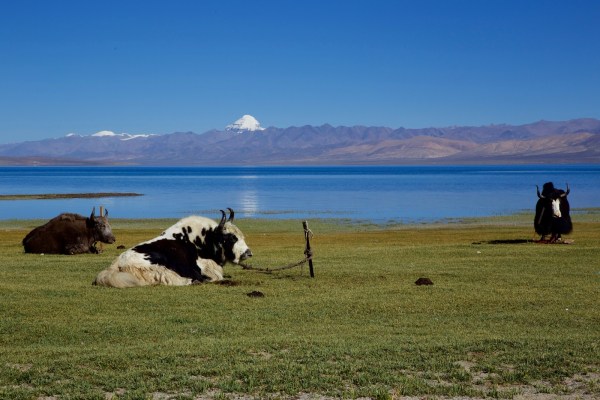 Yaks used in the pilgrimage to Mount Kailash on the banks of Lake Mansarovar (Wikipedia)


 Share


