
Interview: ‘Mughal art borrowed from the Ottomans and Safavids, also absorbed India’
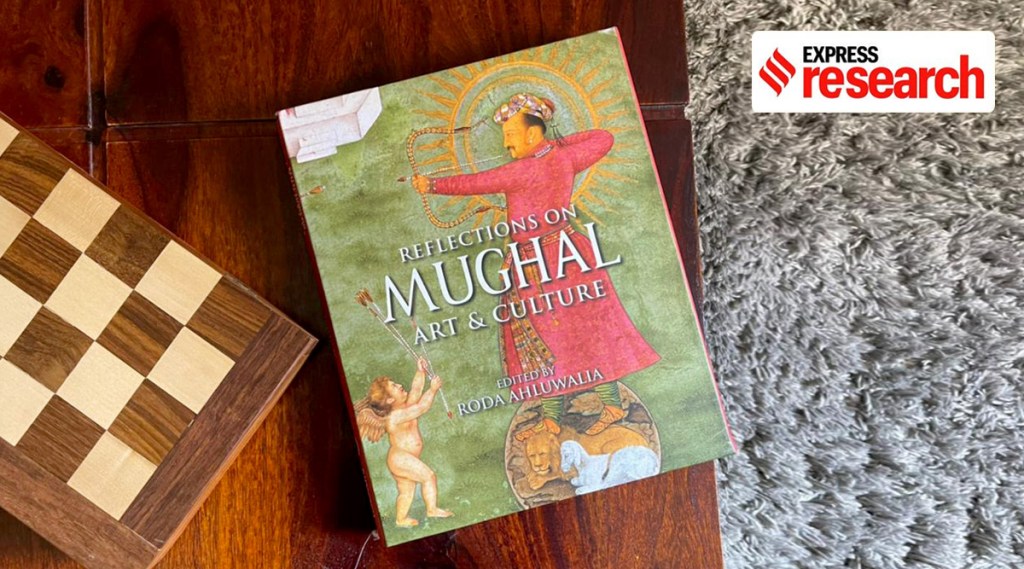
A recent book titled ‘Reflections on Mughal art and culture’ has brought together 13 essays written by some of the finest art and culture scholars. The articles weave together varied aspects and challenge established norms in our reading of Mughal artistic traditions.
 In an interview with Indianexpress.com, Ahluwalia spoke at length about the ethos of the book and how newer research has enhanced our understanding of Mughal art.
The splendid world of Mughal artistic and architectural traditions has long fascinated scholars and connoisseurs of art and culture. Since the mid-16th century when the Mughal empire was founded by emperor Babur, the Turko-Mongol Persiante legacy of the dynasty interacted and absorbed enthusiastically the existing cultural traditions in the Indian subcontinent to produce a unique and rich artistic heritage. Recent research on this period of art and culture in India has opened our eyes to connections and comparisons with contemporaneous ruling dynasties across the world, including the two other major Islamic regimes- the Safavids in Iran and the Mediterannean-based Ottomans, as well as with the European renaissance artists. Recent analysis has also shed light on what the Mughals drew from existing artistic and linguistic traditions in India such as that of the Rajputs.
A recent book titled ‘Reflections on Mughal art and culture’, jointly published by K R Cama Oriental Institute and Niyogi books and edited by Roda Ahluwalia, an independent researcher on South Asian art, has brought together 13 essays written by some of the finest scholars of Mughal art and culture. The articles weave together varied aspects of Mughal art and challenge established norms in our reading of the genre. While one one hand, art historian Mika Natif discusses how important Mughal women in the royal court were depicted as authoritarian figures in the paintings of Akbarnama and Jahangirnama, historian Gülru Necipoğlu reflects on the interconnectedness in the architectural patterns among the Mughals, Ottomans and Safavids.

The first essay by Professor Kavita Singh analyses the practise of calligraphers and painters working together to produce manuscripts and asks the question “were words and pictures in a book as companionable as their makers are shown to be?” Or was art expected to tell a different story from the one being written in the book? Ahluwalia’s article, ‘A noteworthy Ustad in the Imperial Mughal kitabkhane of Akbar and Jahangir’ sheds light on the career of one of the most outstanding master painters, Nanha, who worked in the royal court between 1590 and 1610. This 20-year period encompassing the last years of Akbar’s rule and the beginning years of Jahangir was crucial in the development of Mughal artistic traditions. Ahluwalia in her essay traces the transformation of Mughal painting styles during this period through Nanha.
In an interview with Indianexpress.com, Ahluwalia spoke at length about the ethos of the book and how newer research has enhanced our understanding of Mughal art.
Excerpts of the interview:
What is the overarching theme around Mughal art that ties up the essays by so many scholars in the book?
To explain the ethos or vision of the book, I have to introduce the book from its inception. The book began as a seminar sponsored by the K R Cama Oriental Institute, of which I was the academic advisor, and my vision for the seminar was to attract and encourage leading scholarship on Mughal art and culture. The formidable scholarship that the seminar presented now forms the content of the book. Two phrases that define the book are ‘new thought’ and a ‘diversity of topics’. There is, therefore, no one overarching theme that ties up the many strands of dialogue discussed in the book.
There are, however, kindred or related themes that underpin groups of chapters in the book, and run like a thread, thereby uniting its general ethos. The first principle that unites the diverse themes of the book is the effective visual language of Mughal Art which derives from Islamicate culture and the Islamicate world view. Simply stated these are the principles of geometry, symmetry, rhythm and harmony, the symbolism of Islamic ornament, as well as the metaphors used in Islamic Art. This visual language is an intrinsic part of Islamicate art, whether the art forms are of Mughal, Ottoman, Safavid or Deccani expression.
There are many examples in this book that elucidate our understanding of these principles; let me state just a few. The first example that comes to mind is the Shamsa, a geometrical symbol of the sun, which precedes every important royal manuscript commissioned. Ursula Sims Williams shows us a shamsa that occurred in the beginning of a 15th century Khamsa of Nizami manuscript in the Imperial Library of the Mughals with Shah Jahan’s seal, in her article on the Imperial Library of the Mughals. The A’in-i Akbari, compiled by Abu’l Fazl, compares Emperor Akbar to the glory of the sun, so, in effect, the Shamsa symbolically represents the sun as well as the emperor.
The principle of harmony and symmetry can be seen, of course, in Mughal architectural forms of the Taj Mahal and Humayun’s tomb, and in all architectural monuments in Ottoman & Safavid lands, for example the Suleymaniye Mosque complex in Istanbul and the Sufi shrine at Mashhad. This principle can also be seen in Mughal paintings, in particular the Padshahnama paintings of which there are examples in the book in Professor Kavita Singh’s chapter on word and image relationship, as well as in Dr Subhash Parihar’s chapter on Mughal murals. Padshahnama paintings are so symmetrical as to be drawn in replication on either side of an imaginary line drawn vertically through the page. This is called qarina, or counter image.
Plant and animal forms in Islamicate art can be seen in some of the hardstone examples from Susan Stronge’s chapter on the lapidary arts in the Mughal Empire as well as Dr Anamika Pathak’s chapter on decorative art objects. A pendant made of jade from the collection in the Victoria and Albert Museum has birds made of rubies flying around a large flower with ruby petals. There are floral motifs incised on a prolific number of the rock crystal wine bowls and jade boxes also in Stronge’s chapter.
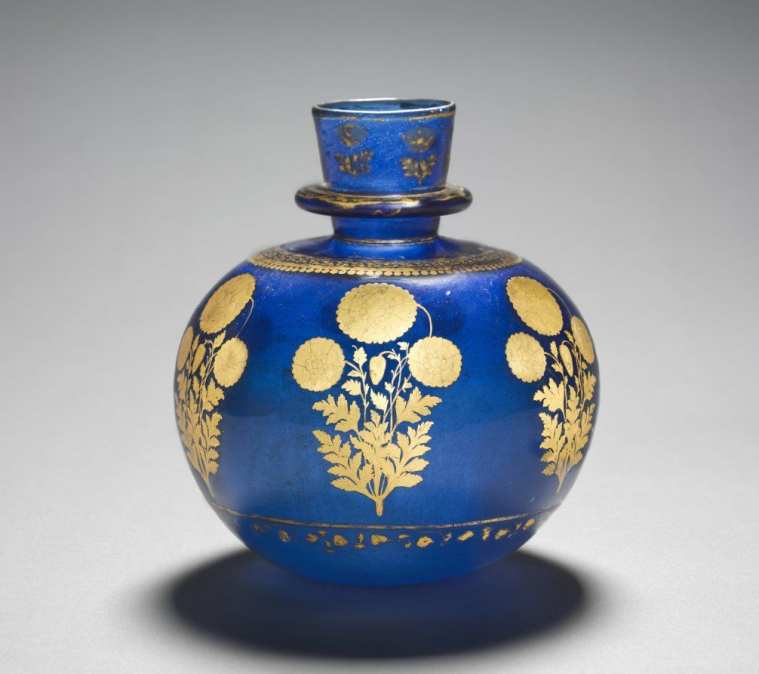 Hookah Bowl. c. 1700. (Courtesy of the Cleveland Museum of Art. 1961.44)
The multiculturalism of the Empire under the reigns of Akbar (r.1556-1605), Jahangir (r.1605-27) and Shah Jahan (r.1628-58) is another theme that is emphasised in various chapters. Prof Asher and I mention Akbar’s egalitarian sulh-i kul (peace for all) policy of inclusion which encouraged temple building and freedom of expression of the arts. Prof Asher cites the acculturation of artistic practices by the Rajput kingdoms closely affiliated to the Mughals.
Dr Vivek Gupta’s chapter begins with a poem written in hindi by ‘Abd al-Rahim, Khan-i Khanan, Akbar’s and Jahangir’s commander in chief of the army, who was a scholar not only of Persian and Chagatai Turki, but also of Sanskrit and Hindi, depicting the Mughals’ adoption of indigenous culture.
The Central Asian Timurid legacy of the Mughals or their Turko-Mongol-Persianate heritage of which they were extremely aware and biased towards, is another recurring theme in two chapters in the book. Dr Mika Natif mentions the esteemed Central Asian Timurid status of two important women at Akbar’s court, his mother, Hamida Banu Begum and his foster mother Mahim Anaga, as the main reason for their depiction in positions of authority in paintings of the Akbarnama and Jahangirnama. Professor Gulru Necipoglu postulates a paradigm in which each of the three superpowers shared a common cultural semi-nomadic Turko-Mongol and a Persianate heritage which binds them into a continuous zone.
The connections in art and culture between the three Islamicate superpowers of the early modern period across all three Empires- the Safavids, the Ottomans and the Mughals, is another theme that unites three chapters in the book. Professor Necipoglu focuses on transregional connections and challenges the assumptions that architecture has evolved in each of these empires in an unmediated fashion. She shows us that the three empires were extremely aware of architectural happenings in each domain, & that there was, perhaps, a certain degree of competitiveness between them. Dr Sheila Canby discusses the influence of Persian painting on Mughal painting by focusing on a particular manuscript, the Shahnama of Shah Tahmasp (2nd quarter of the16th cent) and its influence on early Mughal painting. Professor Sunil Sharma offers different perceptions of the Indian woman across Mughal, Safavid and Ottoman cultures.
We do know that there is a large body of existing scholarship on Mughal art. How would you say that more recent research has altered or developed our understanding of Mughal art?
In my edited book, almost every chapter introduces original thought & new insights, which will change our perception and understanding of Mughal Art and Culture. For instance, I don’t think there has been any research focusing on Mughal murals before the research undertaken in this book. In my chapter I speak about the changes in visual language and content of painting that took place between the Akbari and Jahangiri periods, and the reasons for it. Dr. Laura Parodi’s article on Mughal gardens challenges the assumption of the paradisiacal narrative and charbagh or quadripartite gardens as being mere scholarly conjecture rather than a definite mention in early Mughal or Timurid sources. Professor Kavita Singh’s chapter introduces insights on discrepancies between word and image in Mughal chronicles that were deliberate strategies practiced in the Kitabkhana.
Recent research on comparisons between the triumvirate of Islamicate superpowers has developed our understanding of Mughal art and culture, in that we are now aware of history and art history in a comparative context.
Recent research on the presence of Braj Bhasha poets at the Mughal court, undertaken by Professor Alison Busch, Columbia University, has astonished many scholars. Though Persian was the official language used for all legal and courtly matters such as firmans, dialects such as Rajasthani, Bundeli or Braj were used in speech by the people of northern India including the Rajput nobility whose culture was enmeshed with the Mughals. It now appears that Mughal nobility possibly understood and spoke some of these languages, particularly Braj Bhasha that was the language used by poets such as Keshavdas and Rahim, none other than ‘Abd al-Rahim, Khan-i Khanan.
A new book on a Ramayana illustrated manuscript commissioned by Hamida Banu Begum, Akbar’s mother, has recently been published, which has opened the eyes of the world to the fact that Mughal Emperors and their families were interested in Hindu religious culture, as well as the fact that royal Mughal women were highly educated and cultured.
Could you tell me how Mughal art differed from Islamic art practices in other parts of the world like the Safavids and Ottomans and how it borrowed from these cultures as well?
This is a very difficult question to answer, and as I am not a scholar of Persian or Ottoman art. I will simply enumerate the architectural comparisons drawn by Prof Gulru Necipoglu in her chapter. She compares the iconic building types favoured by each of the three superpowers, and compares the building of the cities of Shahjahanabad, Istanbul and Isfahan. The Ottomans built large mosque-centered complexes, such as the Suleymaniye Mosque; the Mughals favoured mausoleums such as the Taj Mahal and Humayun’s tomb, and the Safavids built monumental shrine complexes in their Shi’ite pilgrimage centres of Ardebil and Mashhad.
The Safavids and Mughals were closely interconnected, more so than Mughal connections with the Ottoman sphere. In the field of painting, in particular, Mughal painting was influenced a great deal by Safavid works. Some Persian painters too emulated the styles of Mughal master painters or ustads.
Can we see European influence in Mughal art and if so how do we explain it?
It has long been known that European painting influenced Mughal painting from the 1580’s onward. Jesuit missionaries carried prints of biblical themes to the Mughal court, during several visits from 1580 to 1599. Portuguese, Dutch and English traders brought prints, paintings and engravings to India’s shores and European artists appeared at the Mughal court. Mughal painters strove to emulate ideas of chiaroscuro, aerial perspective, foreshortening, shading and imparting volume to figures, as well as drawing naturalistic gestures to produce paintings that reflected the European aesthetic of the Renaissance.
In my chapter in the book, I give the reasons for the wholehearted absorption of the visual language of European painting as well as its content, in particular the genre of portraiture in Mughal painting. The reasons are quite a few. Firstly, Akbar’s policy of sulh- i kul encouraged freedom of expression, enabling the kitabkhana to embrace new influences. Secondly, Akbar’s interest in history and the commissioning of illustrated histories, as portraiture painted in these chronicles was the means to assert the Mughals’ legitimacy to rule. Third, Jahangir’s fascination with naturalism in painting encouraged a complete shift toward occidentalism and portraiture.
 Jahangir and his Vazir, I’timad al-Dawlah. Folio from the Shah Jahan Album. (Courtesy of the Metropolitan Museum of Art)
Can we say that Mughal art developed and altered across the reigns of different rulers? If so, could you elaborate a bit on the kind of artistic practices the most noteworthy of Mughal rulers introduced and helped develop?
As I am a scholar of Indian Painting, I can comment on Mughal Painting alone. The Akbari period is credited with the formation, transformation & consolidation of the visual language and content of Mughal painting. Persian painters who made their way to India during Humayun’s reign, set up the Mughal kitabkhana under the reign of Akbar, emulating the Persian model as a prototype with painters, scribes, calligraphers & book-binders, all of whom played their roles in a prescribed hierarchical order.
Akbar began commissioning literary and poetic narratives such as the Khamsa (quintet) of the poet Nizami, the Tutinama, (tales of a parrot) and the Hamzanama (adventures of Hamza, the prophet’s uncle), all popular painted works in Persia. Persian culture was considered the high point of Islamicate culture at that time and was emulated in the Islamicate world. Later Akbar became interested in commissioning illustrated histories of his ancestors, such as the Baburnama, Timurnama, and the Tarikh-i-Alfi, (a new history of the millennium). Akbar commanded his scribes to write the text and then he had his painters illustrate these texts. His friend, and historian, Abu’l Fazl began writing Akbar’s own memoirs, the Akbarnama or the history of Akbar’s reign, which he had his painters illustrate. These Mughal chronicles or illustrated histories became popular commissions from then on, and this tradition was carried on by the Emperors Jahangir and Shah Jahan.
From the 1580s onward European painting played a great role in the transformation of the painting style and the content of painting. Portraiture took precedence and was taken to great heights under the reign of Jahangir who demanded naturalism and the individual persona of the character of the person being painted. Jahangir demanded a great deal from his artists; the visual language and content of painting changed under his rule. His artist, Mansoor, painted splendid illustrations of wildlife and florals. Other artists, such as Abu’l Hasan, Manohar, and Nanha specialized in painting chehre or portraits. The Jahangiri period was the apogee of Mughal painting.
Shah Jahan was interested in architecture and jewelry. Though the painting studio continued in the same manner as under Jahangir, Shah Jahan was interested in depicting the splendour of the Mughal court in his paintings. His illustrated chronicle was called ‘Padshahnama’ which means the ‘king of the world’. Shah Jahan wanted to show that he was indeed the king of the world. So, each painting in the Padshahnama depicts the unparalleled splendour of the Mughal court at that time. It was considered the most powerful and magnificent of the Islamicate kingdoms in the middle of the 17th century.
Painting declined from the mid seventeenth century till the first quarter of the eighteenth century. There was a brief revival of painting under the reign of Muhammad Shah (r.1719-48), a ruler who had no effective power, but one who was an aesthete of painting. Muhammad Shah’s commissions depict him surrounded by a small coterie of courtiers in courtly and garden settings, in which stiff, stylized groups of figures can be seen.
This period is, however, important in the history of Indian painting, as the Muhammad Shah period style influenced provincial courtly painting in Awadh and Murshidabad, as well as later Pahari works.
Adrija Roychowdhury leads the research section at Indianexpress.com. She writes long features on his... Read More
 Share


