
Why Gandhi chose to spend Independence Day in riot-hit Calcutta
It was here in Calcutta, in August–September 1947, that Mahatma Gandhi stayed through the tumultuous weeks around Independence. For a brief moment, his presence brought calm to a city torn apart by communal violence.
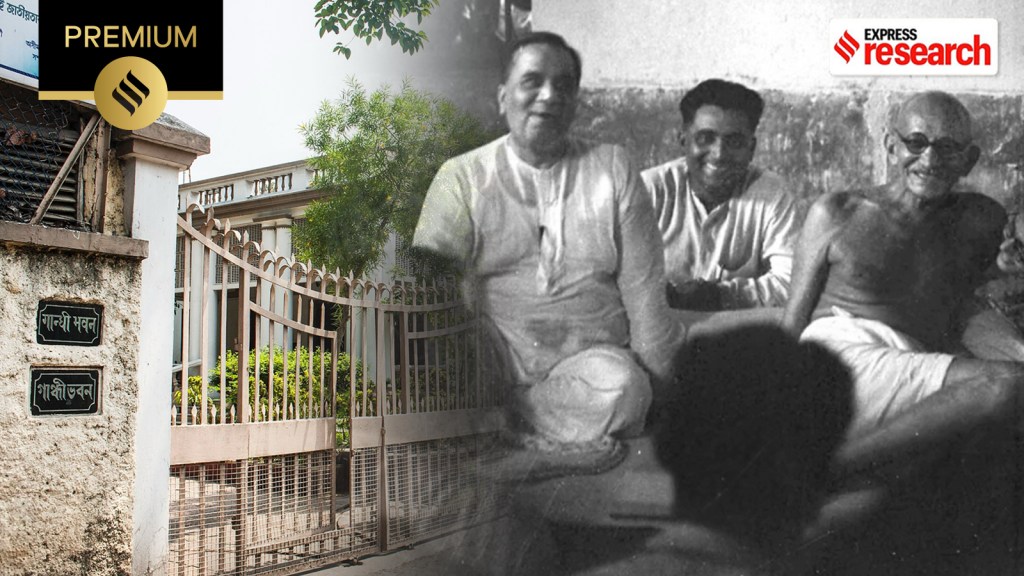 Hyderi Manzil (Wikimedia Commons, edited by Abhishek Mitra)
Aquil Busrai remembers his last visit to his ancestral home, Hyderi Manzil, in Calcutta’s Beliaghata, as a difficult one. The weight of nostalgia was too heavy; he could not bring himself to step inside.
A typical baganbari, or garden house, Hyderi Manzil had Grecian pillars, rooms on all sides, and large windows. “It’s a sprawling place. I don’t remember the exact size, but it must be around four to five acres with a traditional pukur (pond),” Busrai tells indianexpress.com.

Like any ancestral home, it is filled with memories. But Hyderi Manzil also occupies an unusual place in the memory of hundreds of others. It was here, in August-September 1947, that Mahatma Gandhi spent the tumultuous weeks surrounding Independence.
The house has since been renovated and renamed Gandhi Bhavan. But why did Gandhi choose Hyderi Manzil, in the Muslim-dominated locality of Beliaghata? And what did he hope to achieve by staying there?
Communal tension, Chevrolet, and a drive to Calcutta
Since the violence of Direct Action Day in August 1946, Calcutta had been caught in the grip of communal tension. After withdrawing its support to the Cabinet Mission Plan, the Muslim League called for ‘Direct Action’ to press its demand for Pakistan. August 16, 1946, was declared Direct Action Day. Riots broke out across Calcutta, lasting several days and leaving thousands dead. By March 1947, communal violence had spread to many parts of northern India.
“At the moment when India was about to attain her freedom, three million human beings in Calcutta lived in a state of chronic undernourishment, existing on a daily caloric intake inferior to that given to the inmates of Hitler’s death camps… With the savage killings of Direct Action Day in August 1946, that violence had taken on a new dimension, this one fed by the solid religious and racial fanaticism animating its Hindu and Moslem communities,” write Larry Collins and Dominique Lapierre in Freedom at Midnight (2020).
Huseyn Suhrawardy, then chief minister of undivided Bengal, requested Gandhi not to leave for Noakhali (in present-day Bangladesh) but to remain in Calcutta to restore peace.
Between November 1946 and March 1947, Gandhi had travelled through the villages of Noakhali in East Bengal, the villages of Bihar, and the riot-torn slums of Calcutta and Delhi, attempting to stem communal violence. In Noakhali, in particular, he walked from village to village, appealing to Muslims to protect Hindus and restore peace. His presence helped ease tensions in some areas and encouraged displaced Hindus to return home.
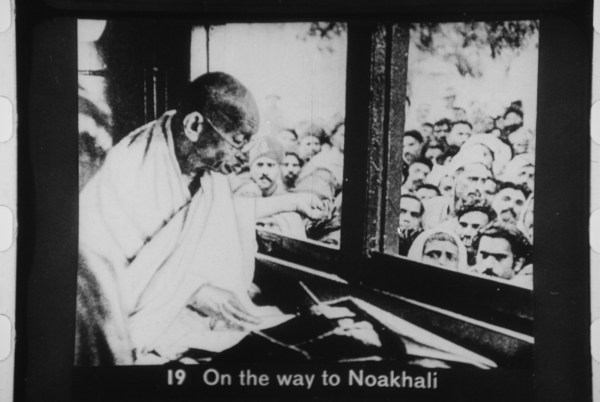 Gandhi on his way to Noakhali (Wikimedia Commons)
“Gandhi was in Noakhali when the riots broke out in October 1946 and stayed there for six to eight months. He had planned only a brief stopover in Calcutta in July 1947, but when riots broke out there, Bengal chief minister Suhrawardy asked him to stay on, drawing on the ‘miracle’ he had worked in Noakhali and the impact he had made there,” says Anwesha Roy, lecturer in modern history at the University of Sheffield, in an interview with indianexpress.com.
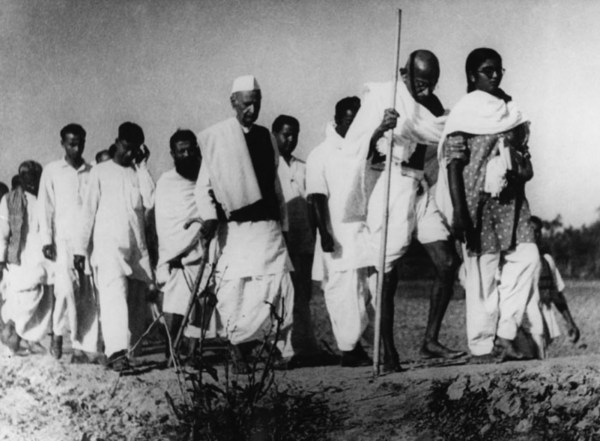 Gandhi in Noakhali (Wikimedia Commons)
In her book Making Peace, Making Riots (2018), she notes: “Gandhi agreed to this proposal but laid down a condition: I would remain if you and I are prepared to live together… We shall have to work as long as every Hindu and Mussulman in Calcutta does not safely return to the place where he was before…”
Suhrawardy agreed.
On August 13, Gandhi was at Sodepur Ashram, on the outskirts of Calcutta, when he left for Hyderi Mansion at about 2:30 pm. Shortly after 3 pm, he reached Beliaghata in a dilapidated pre-war Chevrolet.
The welcome was hostile.
Mobs stood with black flags and stones, shouting slogans against him. “For the first time in three decades, however, Indians were not cheering Mohandas Gandhi’s name. They were cursing it,” write Collins and Lapierre.
The crowd shouted: “Go save the Hindus in Noakhali”; “Save Hindus, not Muslims”; and “Traitor to the Hindus.”
“The response to Gandhi’s arrival was not particularly warm, partly because he was living with Suhrawardy, against whom there was considerable anger. The memory of the Great Calcutta Killing of 1946 was still fresh, and many people believed Suhrawardy had done little to bring the violence under control,” Roy explains.
A frail, 77-year-old Gandhi walked out of the car, alone, into the mob’s shower of stones. “You wish to do me ill,” Gandhi reportedly said, “and so I am coming to you.”
He explained that his presence on Beliaghata Road was helping save the Hindus of Noakhali. Muslim leaders accused of killing Hindus there had given Gandhi their word that not a single Hindu would be harmed on August 15. They knew he would undertake a fast unto death if they failed to keep their promise.
“How can I, who am a Hindu by birth, a Hindu by deed, a Hindu of Hindus in my way of living, be an enemy of the Hindus?” he asked.
“Gandhi’s reasoning, the stark simplicity of his approach, puzzled and disturbed the crowd,” Collins and Lapierre note.
Gandhi told the people of Calcutta that he was placing himself under their protection. “The tactic was similar to Noakhali: to turn the tables upon the perpetrators of violence and make them responsible for his life. He gave the people of Calcutta a stern ultimatum that if they went ‘mad’ again, he would not live to see such madness,” writes Roy.
He then entered Hyderi Manzil.
 Hyderi Manzil (Wikimedia Commons)
In The Miracle of Calcutta (1959), Manubehn Gandhi describes the house as rather shabby. “It was open on all sides—thus being easy to access to outsiders. The doors and windows were broken. There was only one latrine which was used by hundreds of people, including a number of volunteers, policemen and visitors”.
Yet, with his luggage and his men, Gandhi began his chapter in Calcutta.
Gandhi’s days at Hyderi Manzil
Gandhi’s days at Hyderi Manzil were meticulously planned. He rose early, around 3.30 or 4 am.
“Every morning, at around 4 or 5 am, Gandhi would get up and sweep his room,” Busrai recalls his mother telling him.
At 6 am, Gandhi would go for a walk.
 A picture of Gandhi placed inside Hyderi Manzil (Wikimedia Commons)
Much of his day was taken up by visitors: angry Hindu mobs, political leaders, including C. Rajagopalachari and Syama Prasad Mookerjee, and ordinary people who came simply for a glimpse of Bapu.
He would often stand near the window of his room, hands folded, acknowledging those gathered outside.
Evenings were reserved for prayer meetings, where Gandhi would apologise for not being able to speak in Bengali.
“He would also thank the family members for giving him shelter,” adds Busrai.
Hours before freedom
On August 14, India was on the verge of freedom. Across the country, preparations for Independence were gathering pace.
At 5 pm, Gandhi’s frail silhouette appeared at the doorway of Hyderi House. Collins and Lapierre write that the ceremony he walked towards was “as rigidly fixed as any of the events in the Mahatma’s meticulously ordered days.”
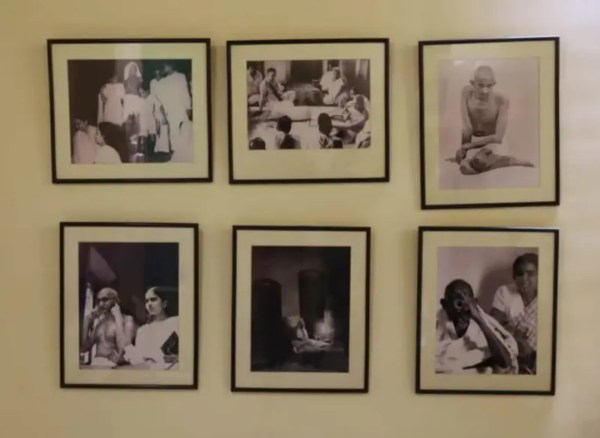 Photographs inside Hyderi Manzil (Express archives)
He began what would be the last public prayer meeting in colonial India.
“From tomorrow,” he told the crowd, “we shall be delivered from the bondage of British rule. But from midnight today India will be partitioned too. Tomorrow will be a day of rejoicing; but it will be a day of sorrow as well.”
In Gandhi: The Years that Changed the World (2018), historian Ramachandra Guha notes that Gandhi believed that if Calcutta could return to “reason and brotherhood”, there was hope for India. But if communal violence engulfed the country, he warned, its newly won freedom could not survive.
Instead of celebrating Independence, Gandhi urged people to mark the day with fasting, prayer and spinning charkha, practices he regarded as a path to saving the country from disaster.
His speech was initially heard in silence. Then some young men began demanding Suhrawardy.
“They began to shout for his blood and stone pelting began again. It stopped only when Gandhi appeared in person in front of the violent crowd,” Roy notes.
Suhrawardy then admitted responsibility for the Great Calcutta Killing. “This was a momentous confession and Gandhi’s presence emboldened him to take such a step,” Roy adds.
Independence at the Hyderi house
Gandhi marked August 15 with a 24-hour fast.
The freedom he had fought for arrived, but at the cost of Partition. Yet, remarkably, communal violence in Calcutta stopped that day. Hindus and Muslims came together to fly the tricolour and raise patriotic slogans.
“While Hindus began erecting triumphal arches at the entrance of streets and lanes and decorating them with palm leaves, banners, flags and bunting, Muslim shopkeepers and householders were not slow in decorating their shops and houses with flags of the Indian Dominion,” writes Guha in India After Gandhi (2023).
Hindus and Muslims drove through the streets together, shouting “Jai Hind”.
The reports of this communal harmony appear to have cheered Gandhi. Later that evening, he decided to hold a prayer meeting at Rash Bagan Maidan in Beliaghata. About 30,000 people had gathered.
“Gandhi said he would like to believe that the fraternization between Hindus and Muslims on display that day ‘was from the heart and not a momentary impulse’. Both communities had drunk from the ‘poison cup of disturbances’; now that they had made up, the ‘nectar of friendliness’ might taste even sweeter,” Guha writes.
The new governor of West Bengal, C. Rajagopalachari, told the city’s Rotary Club, as cited by Guha: “Mahatma Gandhi has achieved many things in his lifetime, but I do not think he has achieved anything so great, so grand, as he has achieved in Calcutta”.
In many ways, Gandhi’s decision to choose Calcutta was right.
A chance at redemption
Today, Hyderi Manzil, renovated and renamed Gandhi Bhavan, retains traces of its old character while bearing the marks of change.
Busrai believes the baganbari occupies a central place in the history of India’s transition to independence.
By the time the Noakhali riots broke out in 1946, Gandhi was, in many ways, a broken man, Roy says. The political community he had spent decades trying to build was not taking shape. With independence seemingly only a year or two away, he was beginning to confront the possibility that his vision of a political community grounded in Satya, Ahimsa, and a moral surplus had not taken root.
“After Noakhali, Calcutta offered him an opportunity to redeem himself, and perhaps non-violence as well…” she says.
The riots would resume within weeks. But, for those few days, Gandhi’s stay at Hyderi Manzil managed to hold together something that seemed on the verge of breaking apart.


Nikita writes for the Research Section of IndianExpress.com, focusing on the intersections between ... Read More
 Share


