
An 18-day excavation in Poompuhar, Tamil Nadu, has uncovered further evidence of the Cholas’ overseas trade. Among the key discoveries are a West Asian “torpedo jar”, four terracotta ring wells, and more than 250 ceramic fragments. A torpedo jar was historically used to transport liquid cargo such as wine and olive oil across oceanic trade routes; this is perhaps the clearest evidence of Poompuhar’s maritime connections with West Asia and the Mediterranean world.
One of the most powerful dynasties in South India, the Cholas ruled over parts of present-day Tamil Nadu, including the regions around Thanjavur and Tiruchirappalli. While the early Cholas flourished between the first and fourth centuries CE, the later Cholas rose to prominence in the ninth century. Military expeditions, naval power, and overseas trade were among the defining features of their rule.

Southeast Asia was among the most important regions in the Cholas’ trading network. In Reflections on the Chola Naval Expeditions to Southeast Asia (2009), author Hema Devare writes, “In bringing India and Southeast Asia closer, an important part was played by the sea link. This connection was used most effectively by the Cholas who combined maritime and mercantile expertise.”
How did the Chola state set up such an expansive trading network? What goods were traded, and how did diplomacy shape these commercial relationships?
The rise of Chola sea power
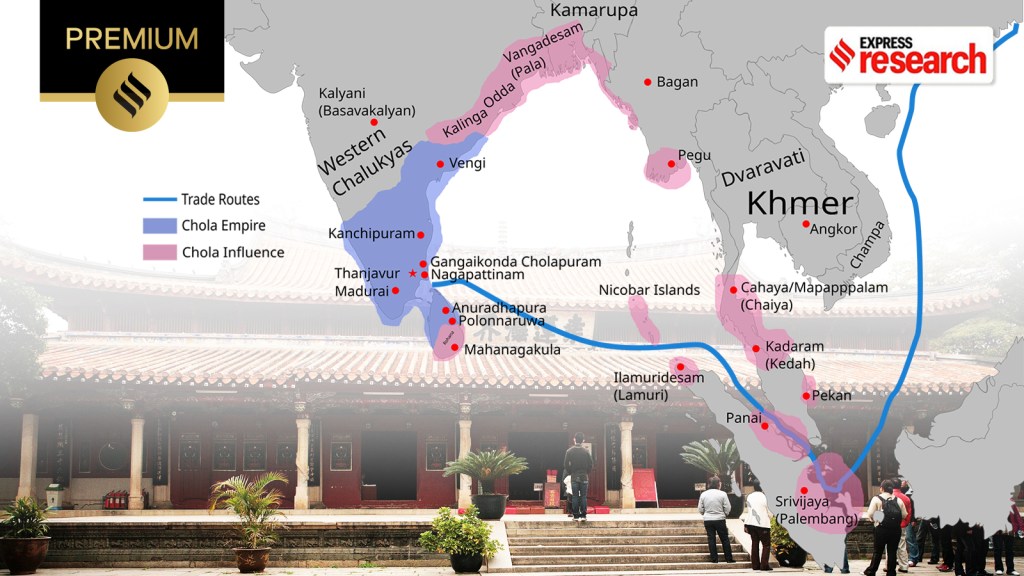
Building on political and economic structures established under earlier dynasties, including the Rashtrakutas and Pallavas, the Cholas emerged as a dominant power in peninsular India between the tenth and thirteenth centuries. Under rulers such as Rājarāja I (r. 985-1014), Rājēndra I (r. 1014-1044) and Rājadhirāja I (r. 1044-1052), they invaded Sri Lanka, launched campaigns in the Bay of Bengal and raided ports in Southeast Asia.
In Buddhism, Diplomacy, and Trade (2015), academic Tansen Sen notes, “The reign of these three rulers, and indeed almost the entire four centuries of Chola administration, is marked by internal stability, flourishing Brahmanical institutions and art, increased occupational specialization, and the expansion of domestic and international trade.”
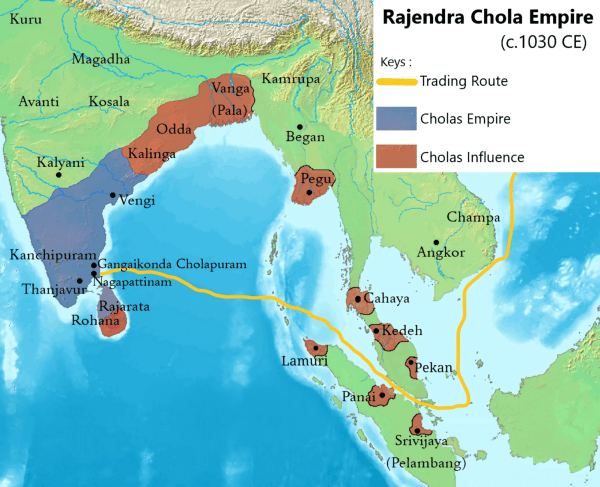 Rajendra Chola’s Empire (Wikimedia Commons)
Control over the fertile Kaveri delta brought the Cholas considerable agricultural and economic wealth, which helped sustain towns, religious institutions, and commercial activity. “At the core of Chola economic organization were the commercial towns known as nagaram,” notes Sen. Spread across the Chola territory, these towns developed strategic relationships with merchant communities as well as religious institutions, especially Brahmanical temples. Temples, in turn, generated demand for ritual and precious goods procured through regional and overseas trade. “The term ‘temple urbanization’ is sometimes used to denote the contribution of religious institutions to urban and economic growth during the Chola period,” Sen writes.
In an email exchange with indianexpress.com, historian Himanshu Prabha Ray says, “Their wealth is borne out by the setting up of the royal centre at Thanjavur including the stupendous Brihadesvara temple which was three times the size of any contemporary shrine…” She adds that it was also a major consumer of many of the commodities involved in trade networks, such as pearls, sandalwood, cloth, and jewels.
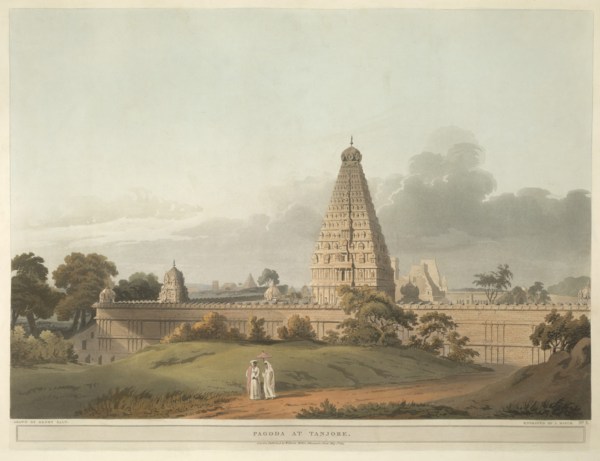 Brihadisvara Temple, built in 1010 by Rajaraja I (Wikipedia)
In Reflections on the Chola Naval Expeditions to Southeast Asia, academic A. Meenakshisundararajan thus describes the Cholas, alongside the Khmer Empire in present-day Cambodia, the Champa kingdom in present-day Vietnam, and China under the Song dynasty, as examples of corporate empires. Their rise, he argues, reshaped the structure of Asian maritime trade.
Meenakshisundararajan explains that the earlier pattern of pre-emporia trade, in which goods were shipped directly from their place of origin to the place of consumption, changed into a new pattern of emporia trade. This introduced practices of re-export, such as breaking bulk or assorting shipments according to the demands of different ports of call.
Another significant development was the emergence of an alternative maritime silk route. The global silk route — from the Mediterranean via the Middle East to China overland — became less serviceable due to regional conflicts in the Middle East. The alternative sea route that encircled the Indian Ocean and crossed the Southeast Asian waters to China was found to be both convenient and economical. In this context, South Indian ports, including Muziris, Nagapattinam, and Kavirippoompattinam, became important centres of trade, strengthening commercial ties between South India, Southeast Asia and China.
Merchant guilds and maritime expeditions
Tamil merchant guilds had been active since the pre-Chola period, but the Cholas were quick to integrate themselves into this system and expand it. This close relationship between the state and merchant communities became a defining feature of Chola trade.
According to Ray, “From the 9th to the mid-14th centuries, several merchant associations dominated economic transactions in south India, such as the Ainurruvar (Ayyavole), Manigramam, Nanadesi, and the Anjuvannam.” These guilds worked alongside weavers, basket-makers, potters, and leather workers. Ray adds, “Not only did these merchant associations develop powerful economic networks, but they also employed private armies…”
The relationship was mutually beneficial. “The kings provided safety and security for the movement of merchant guilds and did not tax them heavily; while members of the merchant guilds served in administering temple properties, and ritual processions. Donations to royalty and the temples were a part of their regular activities,” Ray says.
Sen concurs, “Indeed, the Chola court wooed merchants by providing them protection, favorable terms of trade, and sometimes even entered into marital relationships with the mercantile community. Merchant communities, in turn, supported the Chola kings in times of war and in managing newly conquered lands.”
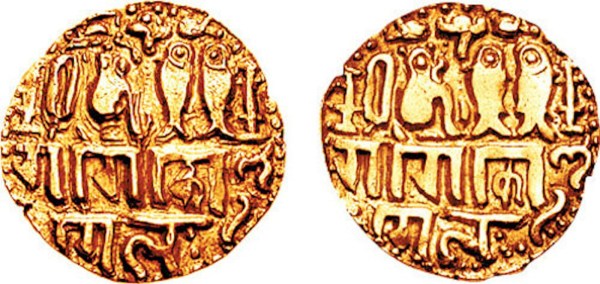 Coins of emperor Rajaraja I (Wikipedia)
The Cholas also engaged with established trading centres such as Palembang, the capital of the Srivijaya kingdom in present-day Indonesia, which flourished between the seventh and fourteenth centuries. Despite competing interests, the Cholas maintained trade ties with Srivijaya.
Rājarāja I sent a trade mission to China in 1015 CE, reflecting the growing importance of East and Southeast Asian markets. Devare writes, “Beginning with this, a series of trade missions were sent to China during the Chola dynasty. Up until then, the focus of these trade associations was the Middle East…”
Historian K. A. Nilakanta Sastri discusses these missions in The Colas (1955): “How eager the Colas were to take advantage of the extended opportunities thus opened to them is evident from the missions sent to China by Rajaraja and Rajendra.”
From Arabian horses to West Asian Frankincense
The Cholas traded in a wide range of goods, from textiles, spices, rice, and grains to sandalwood, camphor, pearls, ivory, and precious stones. Horses were another important import, particularly from Arabia. Sastri links the popularity of the Arab horse trade to the expansion of Chola power in South India, as horses were vital to the Chola cavalry.
 Flag of Chola Kingdom (Wikimedia Commons)
Indian cotton textiles were also in demand in China. Devare writes, “China was one of the earliest eastern markets for Indian cotton.” Chinese demand for cotton cloth grew partly because it was used for soldiers’ uniforms and as payment to officials and troops. Indian traders carried textiles through Southeast Asia to China, while Southeast Asian merchants re-exported them alongside other goods.
Not all the goods passing through Chola ports originated in India. “Frankincense, which was used to make incense, came from West Asia and was in high demand in China. It travelled through the Coromandel Coast and Southeast Asia, with both the Cholas and Srivijaya benefiting from this trade,” Sen explains.
Chinese porcelain was also becoming an important commodity, finding markets in West Asia, while Indian pepper gained prominence in trading networks between the 11th and 13th centuries.
Trade also generated significant revenue through customs duties. Meenakshisundararajan notes, “Customs duties played a major role in the budgets of these corporate empires.” Although some scholars such as Sastri argue that high taxes discouraged trade in the Chola kingdom, evidence of thriving port towns and foreign merchant settlements suggests that overseas commerce remained strong.
The cultural legacy of Cholas
Trade also facilitated the spread of Indian religion, art, architecture, languages, and customs across Southeast Asia, a process some historians have described as the emergence of “Greater India”.
In her work, Devare explains, “Ships carrying cargo between India and China stopped at ports on the west coast of Southeast Asia to barter and exchange. This intense activity not only enhanced trade and commerce, but was also a conduit for the spread of religions, especially Buddhism and Brahmanism.”
“The third pillar of Chola trade was religion,” says Sen. “The worship of Vishnu and Shiva spread into Southeast Asia, where Tamil traders not only settled but also established temples, leaving behind Tamil inscriptions and images of Hindu gods and goddesses.”
Sen adds, “We find two Tamil inscriptions in China, along with evidence of a Hindu temple — the only archaeological evidence we have of Tamil temples in China.”
This reciprocity between commercial towns, merchant guilds and religious institutions under the Cholas facilitated both maritime and cultural exchange across the Indian Ocean. Sen argues that these networks contributed to the emergence of a “world economy” by linking the major markets of the maritime world.


 Share


