
The ‘raja’ who ‘sold’ the Himalayas: A colonial-era story still playing out
British forest policies transformed the Himalayas, bringing commercial timber extraction, restricting local forest rights and leaving an ecological legacy still visible today.
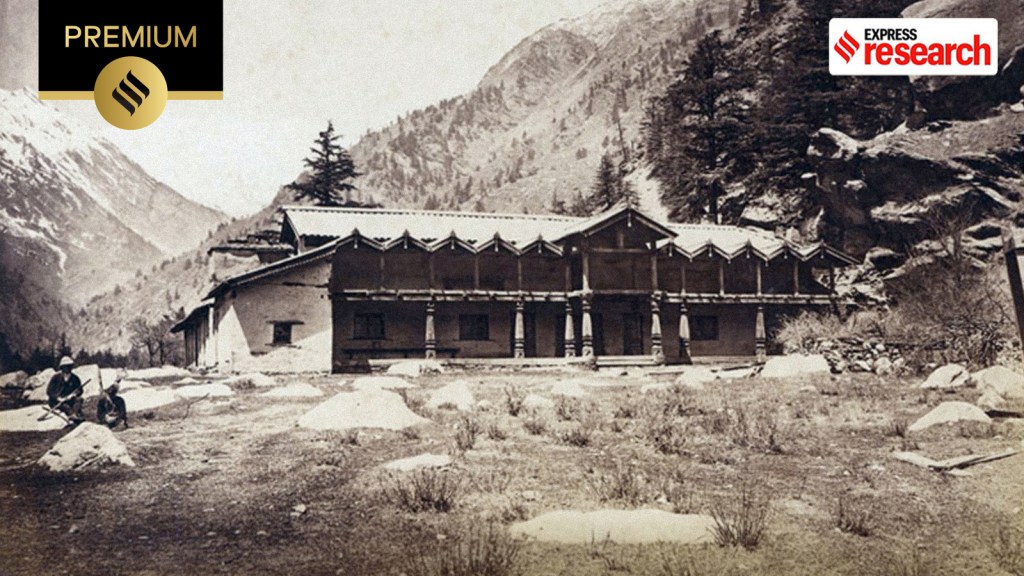 Wilson eventually settled in the remote village of Harsil in the Bhagirathi Valley, where he made a considerable fortune through hunting, the trade in animal skins and musk, and, most importantly, timber.
In the mid-19th century, an Englishman named Frederick Wilson arrived in the upper reaches of the Himalayas and struck a bargain with the Raja of Tehri-Garhwal. He secured a lease to exploit the forests of the rugged Bhagirathi Valley, a landscape covered in towering deodar and chir pines.
Soon, the sound of his axes echoed through the mountains.

Trees that had stood for centuries were felled in great numbers, and vast stretches of forest were cleared, marking the beginning of a new era of large-scale commercial timber exploitation in the region.
Wilson came as a soldier in the East India Company’s army. He deserted the army during the First Anglo-Afghan War under circumstances that remain unclear. The story goes that he eventually settled in the remote village of Harsil in the Bhagirathi Valley, where he made a considerable fortune through hunting, the trade in animal skins and musk, and, most importantly, timber.
His wealth and influence in the region earned him the sobriquet ‘Pahari’ Wilson, and he came to be known as the Raja of Harsil.
Wilson’s enterprise opened the door to a new kind of colonial exploitation – one that would reshape the Himalayan landscape for decades to come.
Impressed by the scale of his success, the British authorities in the North-Western Provinces secured a 20-year lease from the Raja of Tehri-Garhwal and enlisted Wilson himself to exploit the forests on their behalf.
As the railway network expanded in the second half of the 19th century, demand for timber surged. This was followed by further demands for timber and firewood during the two World Wars. The colonial state consequently tightened its grip on the Himalayan forests. In the process, local communities were steadily stripped of their traditional rights over the forests, while the expansion of commercial timber extraction left an ecological legacy whose consequences are still visible today.
How timber brought the British deeper into the Himalayas
Kumaon and Garhwal, in present-day Uttarakhand, came under British control after the Anglo-Nepalese War, also called the Gorkha War, of 1814-16. While the British initially showed limited interest in the region’s forests, this changed by the mid-19th century as demand for timber and firewood grew.
Environmental historian Dhirendra Datt Dangwal of Ambedkar University explains how British control over the Himalayan forests expanded, and what that meant for the mountains and their people.
“The British had been attracted to the region since the time they set foot upon the subcontinent. European travelers would frequent the Himalayas, lured by its scenic beauty,” says Dangwal. In the years following the war, the British opened a sanatorium in the Himalayas for soldiers and others seeking to recuperate.
The population of the hills at this time consisted largely of peasant proprietors who cultivated small landholdings and depended heavily on forests for their existence. In the initial years, British policies in the region were largely confined to collecting certain forest dues along the foothills. By the late 1840s, however, forests had gained increasing importance as demand for timber and firewood grew.
Dangwal notes that the introduction of the railways in 1853 was particularly instrumental in expanding demand for timber from the Himalayan forests. Timber was required for sleepers used to lay railway tracks. “They identified Teak, Sal, and Deodhar trees to be especially useful in this regard. While Sal was found extensively in the Himalayan foothills, Deodhar trees grew in abundance deep inside the region.”
Wilson’s success in transporting timber had also provided a viable precedent, demonstrating to the British the possibility of undertaking similar operations on a much larger scale.
To bring large quantities of timber under their control, all forests were placed under the Commissioner of Kumaun by 1858. The Forest Acts of 1865 and 1878 facilitated a further expansion of state control over the region.
“In 1879, large tracts of sub-Himalayan forests were reserved. In these reserved forests, the rights of local people were redefined: they were granted only limited rights that were recorded and specified in the forest settlement,” writes Dangwal in his research paper, Commercialisation of Forests, Timber Extraction and Deforestation in Uttaranchal (2005).
Further, in 1893, all unassessed lands outside the reserved areas were constituted as District Protected Forests, which were thereafter controlled by the Deputy Commissioner. Restrictions were also imposed on forest use by local communities.
The process of controlling the forests and restricting the rights of their users went hand in hand with the construction of roads and other communication networks to transport timber. “The contradiction of roads by itself is destructive to forests, but more than that, these roads opened up forests for further destruction,” Dangwal notes in his paper.
The numbers are telling. During the 1870s, he writes, an average of 13,959 trees were felled annually in Kumaun and Garhwal alone. By the 1880s, the number had risen to more than 65,000.
When villagers turned against the forest department
The tightening of British control over the forests provoked growing resistance among local communities, particularly following the forest settlements of 1911-17. The discontent reached a dramatic peak in 1921, when protests against forest restrictions and compulsory labour escalated into a widespread campaign of forest burning.
Historian Ramachandra Guha, in his book The Unquiet Woods (1991), writes, “from the last week of April (1921) a systematic campaign, especially in Almora district, had been launched for the firing of the forest.” When the Forest Department called upon villagers to extinguish the blazes, many refused and instead helped the fires spread.
The scale of the unrest forced the colonial government to establish the Kumaon Forest Grievances Committee in 1921. The committee travelled through the hills and examined more than 5,000 witnesses, who complained of restrictions on grazing, lopping trees, collecting forest produce and obtaining timber, as well as the intrusive conduct of forest officials.
The committee’s recommendations led to the reclassification of forests and the transfer of large areas of less commercially valuable forest from the Forest Department to the Revenue Department. A further consequence was the introduction of the Kumaon Panchayat Forest Rules in 1931, which provided the legal basis for the creation of van panchayats, giving village communities a degree of control over designated forests.
The ecological cost of commercial forestry
Dangwal believes that despite the concessions made by the British government after 1921, the fundamental thrust of its forest policy in the Himalayan region remained unchanged, carrying a high environmental cost.
“The Himalaya is a temperate forest and not as dense as the central Indian forests,” he says. “Significant removal of the forest cover resulted in loss of soil, siltation of the river, and so on.”
As forest cover was removed, soil became increasingly exposed and vulnerable to erosion and landslides. The consequences of this transformation extended beyond the colonial period.
The exploitation of Himalayan forests did not end with the British. Independent India continued many of the commercial forestry practices inherited from the colonial period, fuelling new conflicts over forest access, livelihoods and conservation. It was against this backdrop that the Chipko movement emerged in the 1970s, bringing the question of who controls the forests — and for whose benefit — back to the centre of public debate.
Today, as floods and landslides expose the vulnerability of Himalayan communities from Uttarakhand to Nepal, the history of forest exploitation offers a crucial lens for understanding how centuries of human intervention have altered the fragile mountain ecology in which these disasters unfold.


Adrija Roychowdhury leads the research section at Indianexpress.com. She writes long features on his... Read More
 Share


