
Written by Devendra Pratap Singh and Shreya Saksena
Very few people leave a temple, a pandal, or a pilgrimage without taking something home. Often, it is a small souvenir: a framed image of a deity, a photograph, or a fridge magnet. These objects serve as a reminder of the place and the memories associated with it.

Pilgrims in nineteenth-century Bengal did something similar but, instead of postcards and souvenirs as we know them today, they brought paintings of goddesses.
Known as Kalighat paintings, these small, single-sheet works did the job of a postcard decades before India’s first official postcard was issued in 1879: offering visitors an image of a place, something they could carry home and show others.
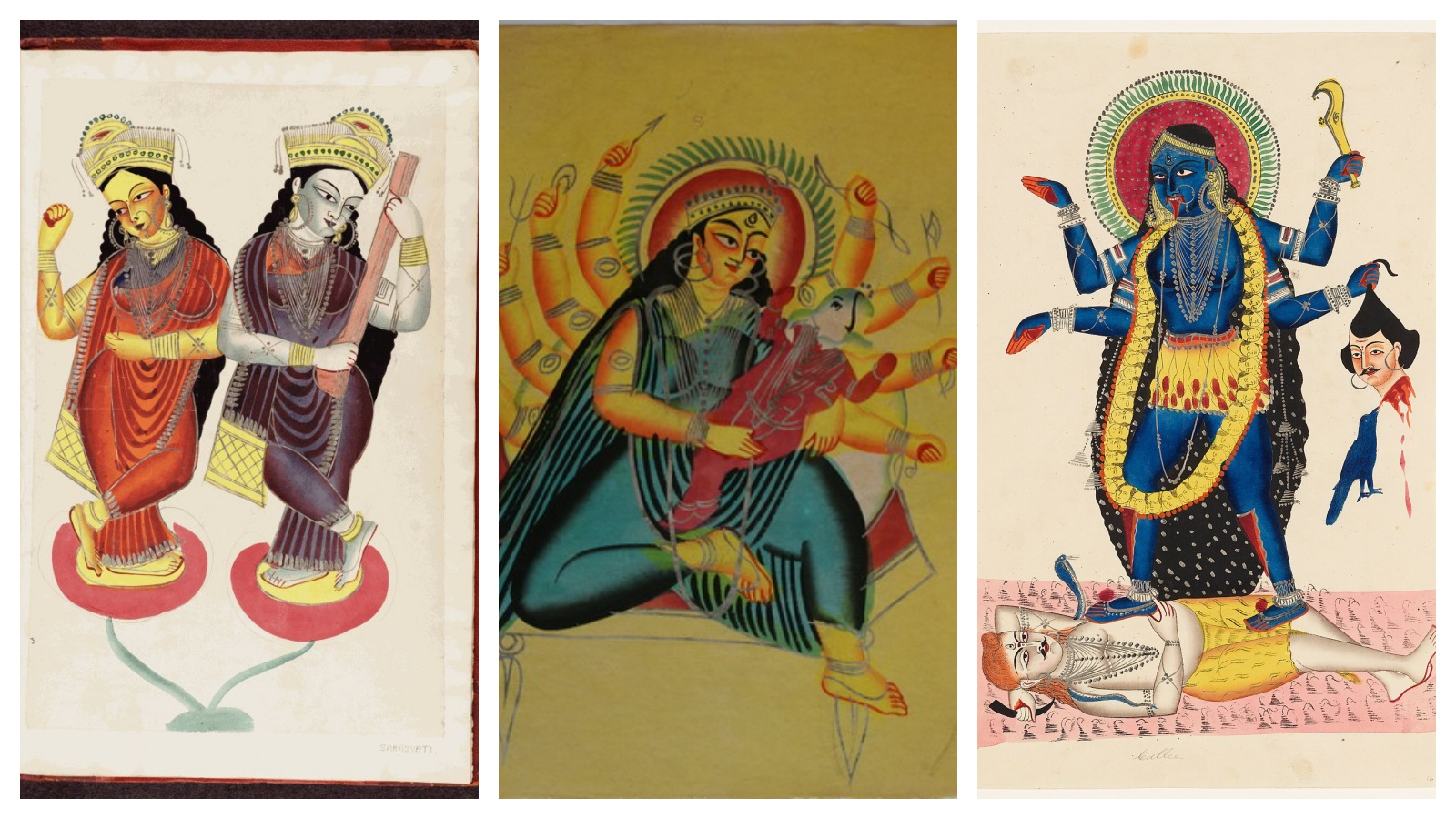 From left to right, ‘Lakshmi and Saraswati’, ‘Ganesha in the lap of Parvati’ and ‘Durga and Mahishasura’ (Wikimedia Commons)
Created around the Kalighat Kali temple, the story of these paintings is one of faith, adaptation, and gossip.
From long scrolls to portable pictures
Kalighat paintings were characterised by bold outlines and flat, vivid colours. This style developed from the artistic practices of Bengal’s Patua community, traditional painters who produced narrative scrolls, some as long as twenty feet, depicting stories from mythology and folklore. Artists would unroll these scrolls bit by bit, narrating or singing stories for their audiences.
In the nineteenth century, as Calcutta grew into an important urban centre under British colonial rule, Patua artists began moving towards the city in search of new opportunities. The Kalighat temple, which attracted pilgrims, offered a ready market for their work.
 Patua painters of Bengal ( Wikimedia Commons/ Biswarup Ganguly)
Pilgrims’ demand for small, portable souvenirs led to the creation of individual paintings on affordable mill-made paper, often featuring one or two figures against a plain background.
Now, instead of taking home just a memory of the temple, people could take home an image of the goddess herself.
But these paintings did not stop at goddesses.
A record of society and history
Over time, the Kalighat painting tradition began catering to a market beyond pilgrims: from residents and merchants to European travellers and collectors.
The transition from long Patua scrolls to smaller paintings transformed how artists communicated. Without the accompanying songs and narratives, a painting now had to tell its story at a glance. For this, the artists developed a visual shorthand from the people, trends, and behaviours they saw in the city, using it to comment on what was happening around them.
As a result, the paintings often brought the changing world into familiar religious stories. A painting of Goddess Durga killing the buffalo demon Mahishasura, for instance, depicts the demon wearing European buckled shoes, which is now read as a judgement of and dislike for the increasing Western influence.
Such elements appeared frequently in Kalighat paintings.
One recurring subject that highlighted this dislike was the Westernised Bengali gentleman, or babu, who adopted British clothing, manners and lifestyles. The iconic painting English Babu (Native Indian Clerk) Holding a Hookah depicts a seated Bengali man whose attire and conduct combine Indian and Western styles, offering a glimpse of changing social identities and effects of colonial modernity in Calcutta.
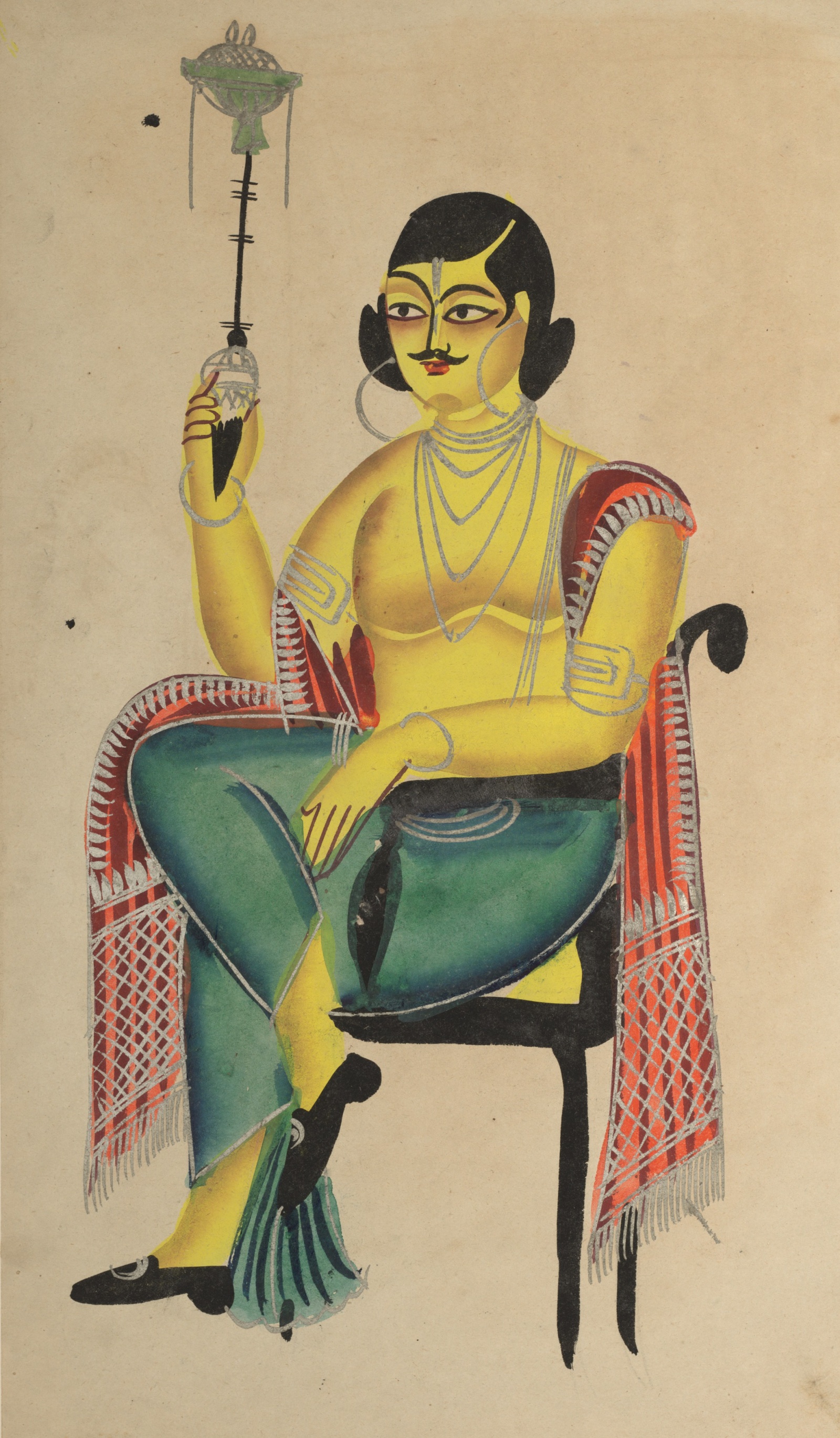 https://clevelandart.org/art/2003.145
Writing for the Cleveland Museum of Art in 2011, Deepak Sarma, Associate Professor of South Asian Religions at Case Western Reserve University, explained that English-educated babus were upwardly mobile Bengalis employed by the British who embraced Western sensibilities. He describes Kalighat artists as “observers, critics, victims, and reluctant beneficiaries of the decadence of the British, who ridiculed vain babus as foppish nouveau riche and offered a subaltern voice against the decadence of globalisation.”
Women were another popular subject in these paintings, appearing as goddesses, urban figures, courtesans, and wives.
In Barber Cleaning a Woman’s Ear, a woman smokes a hookah while a male barber leans towards her to clean her ear. To the ordinary eye, this may look like a regular painting of a woman at leisure, but it expresses larger anxieties around sexuality, change, and domestic relationships. The story is that as Bengali babus began spending more of their time and money on courtesans and mistresses, their neglected wives and concubines sought attention and intimacy from unlikely companions, including domestic servants or street tradesmen.
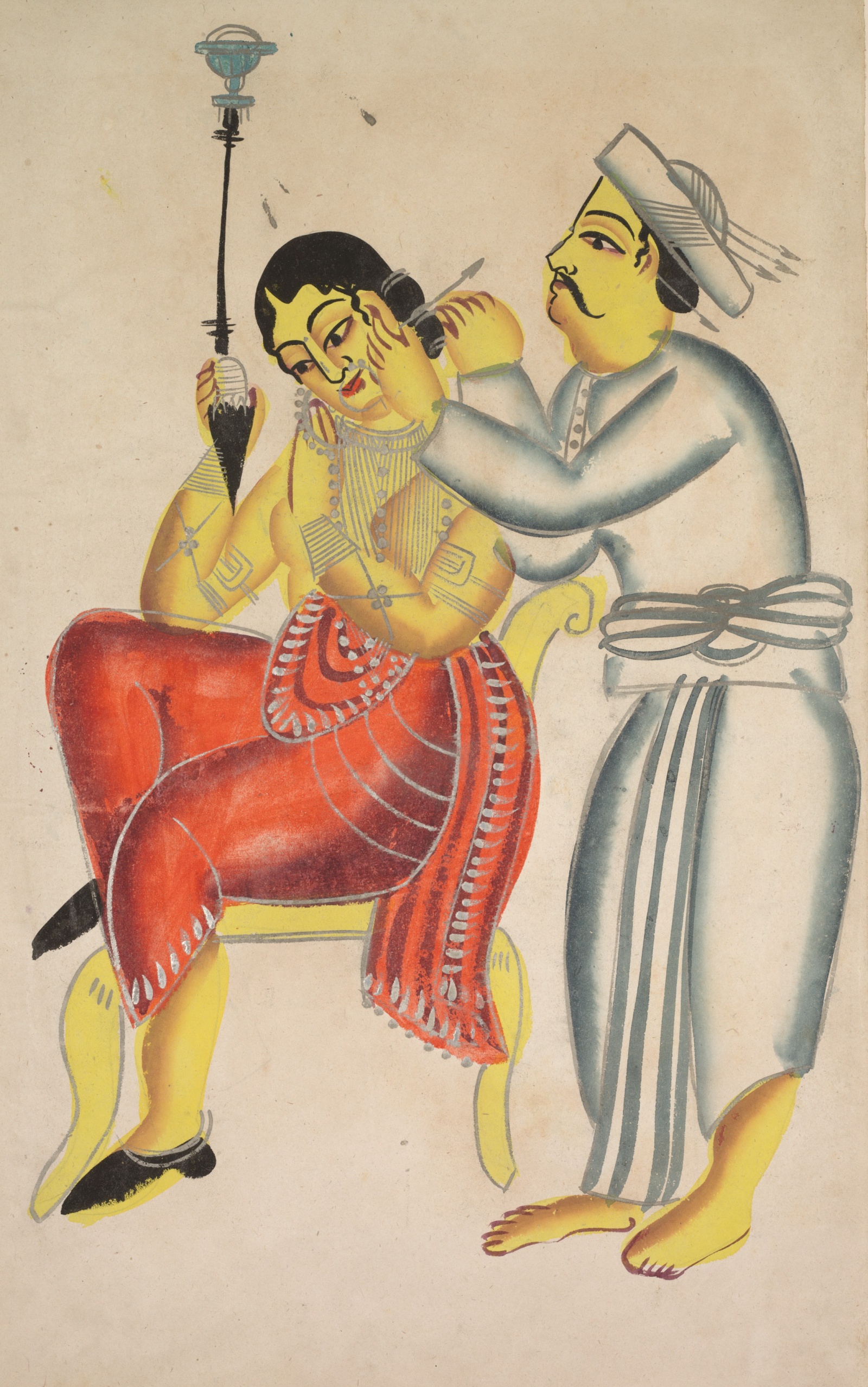 Barber Cleaning a Woman’s Ear, 1890 (The Cleveland Museum of Art)
A scandal that became a painting
One of the most sensational, and later controversial, subjects to enter Kalighat paintings was the Tarakeswar case of 1873.
The case involved Elokeshi, a young married woman who was allegedly said to be having an affair with the head priest of the Shiva temple, Madhavchandra Giri. Upon learning about this affair, or coercion, scholars can’t say for certain, Elokeshi’s husband, Nabin, killed her.
The case attracted public discourse and led to criminal proceedings, after which the priest was sentenced to three years in prison, and Nabin was sentenced to life, but was reportedly released after public petitions.
Kalighat painters turned the story of the alleged affair into a series of images.
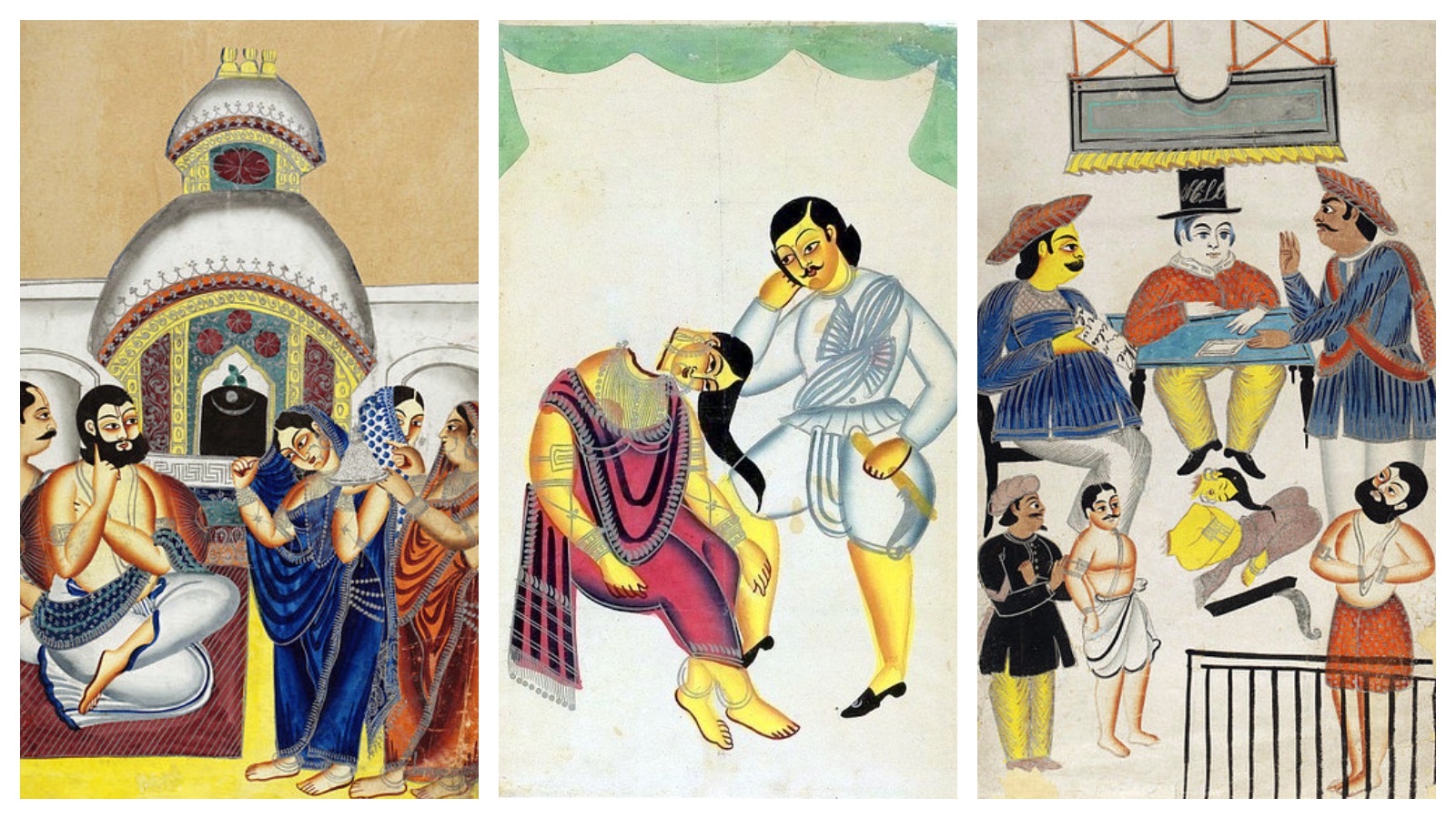 Series of Kalighat paintings on the Tarakeshwar case of 1873. (Wikimedia Commons)
The Victoria and Albert Museum, for instance, holds a painting titled The Mahant and Elokeshi Share a Hookah and Paan, dated 1875-1890. Another painting at the Royal Ontario Museum shows Elokeshi holding a flower while the priest fans her.
While these paintings passed judgment on the case and the characters involved, they also brought a contemporary scandal into the same marketplace that sold images of goddesses. A visitor could take home an image of a religious figure, a fashionable gentleman, or even a story that had captured public attention.
Decline and afterlife
By the turn of the twentieth century, Kalighat painting declined as a major commercial practice. Inexpensive coloured lithographs and other mass-produced images offered buyers cheaper alternatives, competing with the individual paintings made by Patua artists. Many families eventually moved away or took up other occupations.
Despite this, by the late 1800s, the paintings had already caught the eye of collectors and museums. The Victoria and Albert Museum (V&A) began acquiring them in 1879, the very year that India’s first official postcard was issued. In 1917, the V&A received 233 paintings from John Lockwood Kipling’s collection, donated by his son, Rudyard Kipling. The University of Pennsylvania Museum had also received 57 paintings from collector Maxwell Sommerville in 1895.
Thus, what had once been affordable pictures sold outside a temple gradually became important indications of history and society, making their way into international museum collections.
Today, the tradition lives on in the work of artists from rural West Bengal, in villages like Medinipur and Birbhum.
The people who first bought these paintings are long gone. But look at what they carried home. They were not just buying the painting of a goddess; they were also buying a city: its babus with their hookahs, its demons in buckled shoes, its wives and servants, and a murder that everyone was talking about.
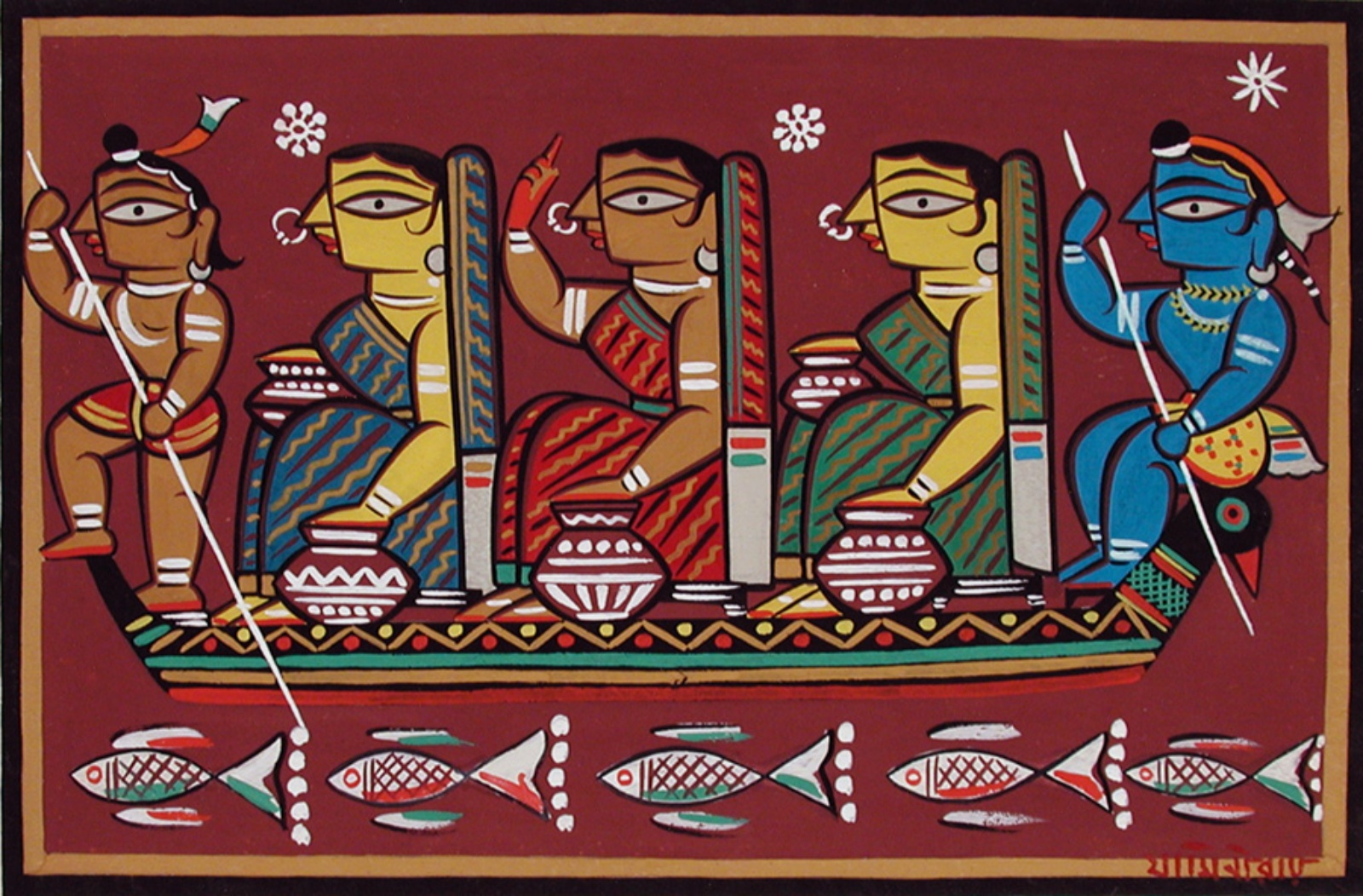 Painting by Jamini Roy who was significantly influenced by the Kalighat school of paintings (Wikimedia Commons)
Even today, we still bring a piece of every place back home.
Culture is never only what a place worships; it is also what it laughs at, argues over, and talks about. The patuas understood this, folding all of it into one small painting that the pilgrim could carry home.
Devendra Pratap Singh and Shreya Saksena are freelance journalists and founders of the e-magazine ‘Fitoor’.

 Share


