
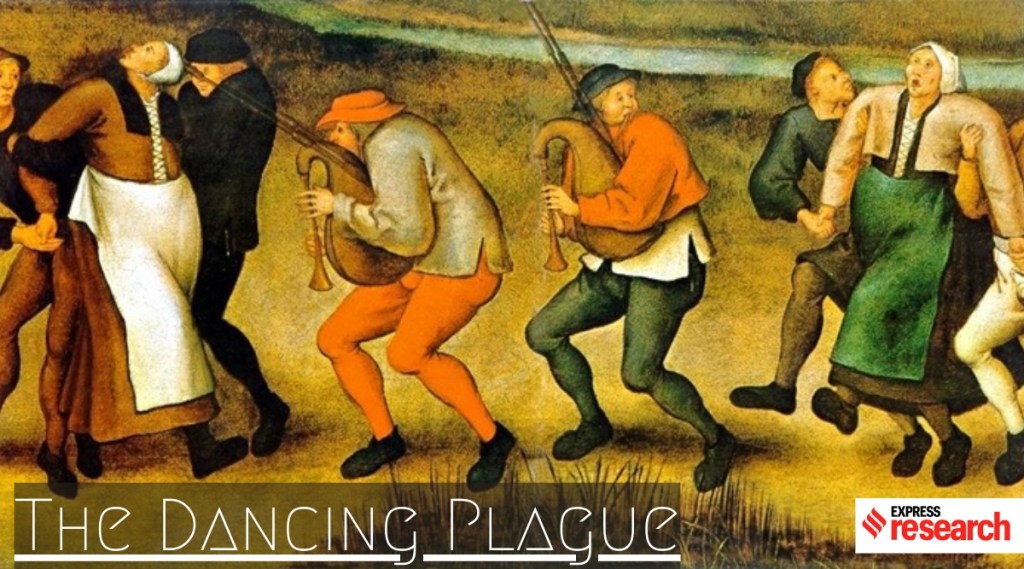
On July 14, 1518, somewhere in the French town of Strasbourg, a woman named Frau Troffea stepped out of her home and began dancing. Soon, she had a large crowd around her. Some clapped, some laughed while some just gazed in awe. The event was intriguing since Troffeau had no control over her dancing. Neither did she start out of choice, nor did she know how to stop. Rather, she was suffering from what came to be known as the ‘dancing mania’ or ‘dancing plague’. To everyone’s horror, Troffea kept dancing for six days. She would collapse out of exhaustion each night, her shoes soaked in blood, but would wake up the next morning only to start dancing again.
In Europe of the 16th century, dancing mania was not a new disease. It had been in existence since the seventh century, occurring in phases with long gaps in between. It is said to have reached its peak in the 15th and 16th centuries though, infecting thousands of people, and killing several as well.

In modern medical terms, the dancing mania of medieval Europe was a psychogenic disease – a kind of illness in which a physical abnormality occurred due to psychological factors. Though no instance of dancing mania has been observed since the 19th century, other psychogenic diseases are common in contemporary times in the form of seizures or body aches caused by sudden shocks or prolonged periods of emotional or mental distresses.
“With the advent of the dark ages and the pervasive concern with religiosity and righteousness, outbreaks of mass psychogenic episodes became more frequent,” wrote sociologist Alan C. Kerckhoff in the book Mass psychogenic illness: A social psychological analysis (1982). He explained that the best example of such episodes from the medieval period was the dancing epidemic. He wrote further that such epidemics affected other cultures in differing ways.
In the 15th and 16th centuries, however, little was understood about the science behind the dancing plague. The societies of the time offered explanations, ranging from demonic possession to wrath of God, a spider bite as well as consumption of ergots (a kind of fungus that grows on rye).
Historical instances of dancing plague
E L Backman, a Swedish physician in his book, Religious Dances in the Christian Church and in Popular Medicine (1952), suggested that evidence of outbreaks of the dancing plague was recorded as early as the seventh century across Europe. Backman noted that amongst the first well-documented incidents was the one that had taken place at a Saxon town called Kolbigk in which several people began dancing in a graveyard “until a priest cursed them to keep dancing for an entire year”.
 Location of the Dancing mania outbreaks in Europe. (Source: The Dancing Plague by John Waller)
A similar incident was also reported by Giraldus Cambrensis, a royal clerk and historian in the year 1188, about a religious ceremony at a church in South Wales. In his chronicles, Cambrensis mentioned an incident where “dozens of people danced and sang around in a churchyard until they fell to the ground”.
One of the deadliest and most vividly documented outbreaks was the one that occurred at Rhineland (Germany) in the summer of 1374, right after the Black death pandemic hit large parts of Europe.
Justus Friedrich Karl Hecker, a German physician and medical writer, in his book The Black Death and The Dancing Mania (1888) vividly described those affected.
 The dancing mania by Eugen Holländer (1867-1932). (Source: Wikimedia Commons)
“They formed circles hand in hand, and appearing to have lost all control over their senses, continued dancing, regardless of the bystanders, for hours together, in wild delirium, until at length they fell to the ground in a state of exhaustion. They then complained of extreme oppression, and groaned as if in the agonies of death, until they were swathed in cloths bound tightly round their waists, upon which they again recovered, and remained free from complaint until the next attack.”
At its peak, the mania affected five to eleven hundred people, and while most recovered bodily control within ten days from being infected, others relapsed one or more times.
At Strasbourg, where Troffeau was affected in 1518, the outbreak again reached monumental proportions. The exact number of casualties that occurred during the outbreak in Strasbourg remains to be known till date. Though one chronicle suggests (at least for a time) that as many as fifteen people were dying every single day.
A manuscript in the city’s archive of the time offers a glimpse of the scale of the epidemic that followed. It read:
“There’s been a strange epidemic lately
Going amongst the folk,
So that many in their madness
Began dancing,
Which they kept up day and night,
Without interruption,
Until they fell unconscious.
Many have died of it.”
Like Troffea, many of the dancers were usually taken to the shrine of St. Vitus (a Christian saint from Italy) where, over time, their movements ceased. Several cases of relapse were also chronicled, but eventually, the epidemic vanished from the city.
Modern analyses of the dancing plague
A nuanced, modern understanding of the bizarre disease came after one of the last major outbreaks, recorded in Madagascar in the 1800s where it was called tigretier and had infected hundreds.
Andrew Davidson, a Scottish physician of the time, in a research paper in 1867 suggested that the disease, a psychological one, was associated with religious superstitions and rigid cultural imagination of the time.
 Saint Vitus, from the Nuremberg Chronicle, 1493. (Source: Wikimedia Commons)
Davidson wrote that much like in Strasbourg, the mental and moral state of people “induced by great calamities such as the black-death, political and religious conditions of the people, unwarranted resistance of authority,” were all amongst the causes of disease’s epidemic manifestation.
In an email conversation with Indianexpress.com, John Waller, a medical historian and an Assistant Professor of History of Medicine at Michigan State University said, “Strasbourg is distinctive because it was driven by a set of beliefs that have now largely vanished (i.e. in the power of a saint to curse by dancing). But what happened there does underline the power of distress, especially during periods of dramatic economic decline and social conflict, to make extreme beliefs more believable.”
About why the dancing plague did not occur after the 19th century, Waller explained: “This is an area for speculation alone. I do think it’s worth pointing out that epidemics of dancing had always been very rare – a big gap, for example, between the 1370s and 1518; so perhaps it is not all that surprising that the events in Strasbourg were not repeated soon after.” “And, by the late 1600s, the educated were less likely to lend credence to cursing saints,” he said.
Calling it an unconventional disease, Dr. Samir Parikh, Director of Department of Mental Health and Behavioural Sciences, Fortis Healthcare, said that psychogenic illness or cultural-bound syndrome does not have one or a particular range of symptoms. “Each syndrome is a different illness and hence has its own set of symptoms. In each case, manifestations will be different based on people and their belief systems,” he told indianexpress.com
Also read: Black death: The great plague that killed millions, and feudalism
“In the case of the dancing plague, you are looking at a time when there were no means of communication between villages. So we are essentially looking at close communities with a very strong belief system with a high level of interdependence and a lot of aspects of thinking, where one thing leads to another,” Dr. Parikh told.
But does this mean that mass psychogenic illnesses do not occur anymore?
“There is no current evidence to suggest that mass psychogenic illnesses have reduced. The form may have changed but they continue to exist,” Kamna Chhibber, Clinical Psychologist, Head of Mental Health & Behavioral Sciences, Fortis Healthcare told indianexpress.com. She added. “Most recently in 2019, there was a report of schoolgirls in Malaysia who had started screaming with some claiming to have seen the face of pure evil.”
Further reading:
*The Dancing Plague: The Strange, True Story of an Extraordinary Illness by John Waller
* The Dancing Mania of the Middle Ages by Justus Hecker
* Religious Dances in the Christian Church and in Popular Medicine by E L Backman
*Mass psychogenic illness: A social psychological analysis (1982) by Alan C. Kerckhoff

 Share


