
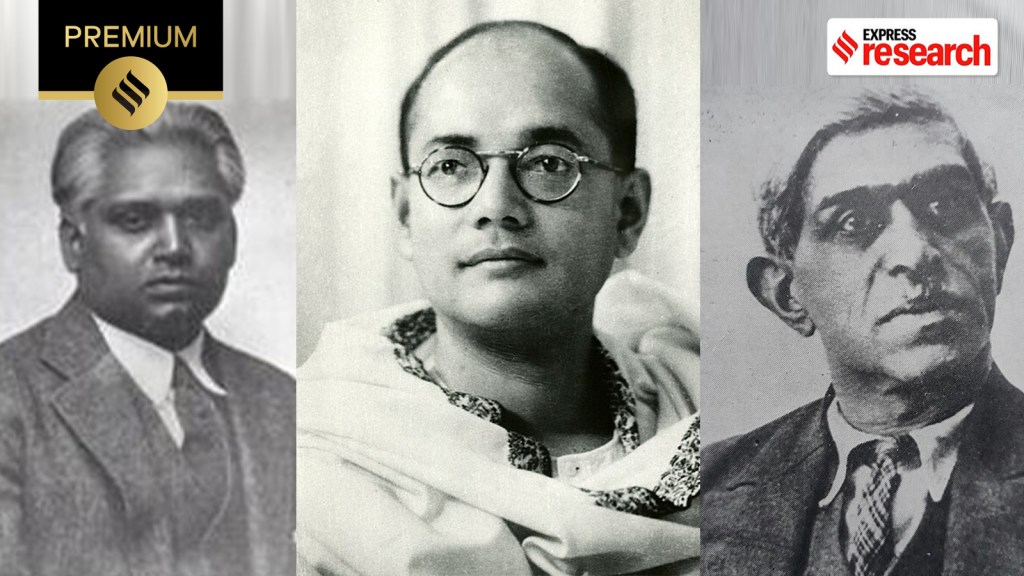
On June 3, 1920, the British Committee of the Indian National Congress met at Kingsway Hall in London to condemn the Jallianwala Bagh tragedy. In a speech titled: ‘The Agony and Shame of Punjab,’ Sarojini Naidu vividly described the brutality inflicted on women, underscoring the betrayal of the British. Spaces like these shaped young Indian political thought. The decade was grim, the call for freedom was growing louder, and every corner of the world had Indians churning a revolution.
In this multi-part series, we look at some of the lesser-known Indian independence movements beyond the border. Our first story looked at the Indian independence movement in London. The second piece here explores the role of the Indian diaspora in early 20th-century Germany and their contribution to the freedom struggle.

In a 1939 broadcast on Azad Hind Radio, Subhas Chandra Bose said: “I know that the Germans, having had personal experience of Britain’s policy, understand India and her fight better than any other nation in the world. I am, therefore, convinced that our fight is closely connected with the struggle now being waged by Germany and other Tripartite Powers.”
Bose’s statement echoed a much older connection. The Indo-German link in the freedom struggle, though unusual, dated back to the First World War. What bound the two sides together was a shared hostility toward Britain. In 1914, the India Independence Committee or the Berlin Committee was formed under the aegis of the German Foreign Ministry and consisted of Indian nationalists in Berlin who sought to spread anti-colonial propaganda and organise resistance abroad.
Historian Baijayanti Roy describes the committee as “the institutional beginning of Germany’s utilisation of Indian anti-colonialism to fulfil its own political goals.”
The partnership, however, was of mutual opportunism. “The Indian diaspora tried to use the Germans, and the Germans tried to use them,” says historian Amar Farooqui. He suggests that the Indians may not have aligned with many of the ideological positions of the German state during the First World War, but because Germany was anti-British, they thought this was a good base to work with. “In fact, Germany also provided financial assistance to some of these groups.”
By the time of the Second World War, Indian students and intellectuals in Germany, much like their counterparts in London, had become prominent voices in the independence movement. The German case, however, was unique: activism unfolded under the watchful eyes of the Nazi regime, with shifting geopolitics complicating the diasporic activism.
This prompts one to think: How did Germany become a hub for the Indian independence movement? Who were the Indians present there, and in what way did they contribute to India’s struggle for freedom?
The India Institute, an Indo-German brainchild
Indian students and academics in Germany stood united in disseminating an anti-British sentiment. The first committee formed by the Indian diaspora in Germany was the Indische Ausschuss or India Institute in 1928, the brainchild of Taraknath Das, an Indian student, and Karl Haushofer, professor of Geography at the University of Munich.
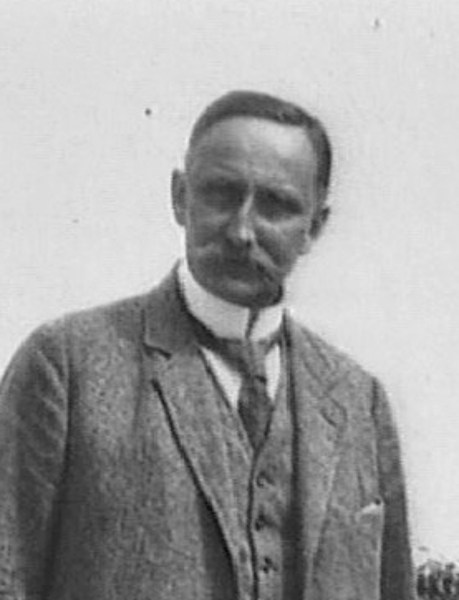 Karl Haushofer (Wikipedia)
On paper, the Institute was formed to promote cultural cooperation between India and Germany. As printed in its brochures, it would provide scholarships to enable Indian students to study in Germany, including the study of India in the German curriculum, and organise cultural centres across the country. However, “their journey was sponsored by the German government, which sought to encourage Indian nationalists to destabilise the British Empire through propaganda and combative acts,” says Roy. “The India Institute aimed to bypass the British colonial state in furthering cooperation between India and Germany.”
In the decade of the 1930s, guests to the Institute included Rabindranath Tagore and CV Raman. Politicians from the Indian National Congress (INC) were also invited.
Beginning in 1933, when the Nazis came to power, however, most organisations conducting cultural politics were expected to conform to Nazi ideology. This implied emphasising the ‘achievements’ of Hitler and the ‘new’ Reich. According to Roy, aligning with the regime was a form of self-mobilisation that secured both financial help and prestige from the government.
“The most prominent measure of self-mobilisation that the Institute undertook after 1933,” suggests Roy, “pertained to defending the Nazi regime against indictments of rising racism towards Indians.
While stipends were still provided to Indian students for academic and professional pursuits, it was expected that stipend holders were to get ‘the best of German culture’, which supported a National Socialist worldview. Roy explains, “The Institute needed academics with discursive knowledge of India to familiarise German opinion-making classes with India in order to reinforce its own status as a mediator of Indo-German cultural relations.” Upon their return, the former sponsees were to keep in touch with the Institute and, in turn, German culture.
The Institute also began monitoring the ‘political activities’ of the Indian students’ club in Munich after 1933. “Such ‘activities’ mainly comprised protesting against the mistreatment of Indians in Germany,” says Roy.
In the same decade, the Institute got in touch with Nazi networks in India, including German diplomats and merchants, emerging as the most prominent organisation conducting Nazi cultural politics in India.
With the start of the Second World War, however, cultural ties with India became difficult to maintain. The Institute now openly presented Nazi Germany as a sympathiser of India’s anti-colonial movement through various journals and books. One such book, India in the British Empire, was written by Koodavuru Anantrama Bhatta, a stipend holder at the Institute. The book discussed in detail how British colonial domination could be done away with.
When occupying American forces captured Nuremberg, the centre of the Nazi regime, in April 1945, they banned the Institute on the grounds that it was a Nazi organisation. It was only in the 1950s that the Institute was revived. Thereafter, efforts were made to erase its political past and present it as an organisation which kept its distance from the Indian anti-colonial movement.
The aegis of the German Foreign Ministry
Since the second decade of the twentieth century, Berlin had provided fertile ground for diasporic politics, ranging from left-wing activism to anti-colonial movements. This environment gained new momentum with the arrival of Bose in April 1941. Arriving as a political fugitive seeking German support to free India, Bose quickly sought to institutionalise Berlin’s anti-colonial efforts. He demanded the setting up of a special department in the German foreign ministry for directing Germany’s policy towards India, leading to the creation of the Special Department India or Sonderreferat Indien (SRI) in 1941.
 The director of the Special Bureau for India, and Secretary of State, Wilhelm Keppler, 1943 (Source: Wikipedia).
The SRI succeeded the Arbeitskreis Indien (Working Group India), formed in August 1939 under the Information Department of the Foreign Ministry. The head of the Working Group India was Adam von Trott zu Solz, an aristocrat from the University of Oxford. “Trott zu Solz secretly opposed the National Socialist regime and tried to use his connections in the Anglo-Saxon world to garner support for overthrowing it. This was probably his reason for joining the Foreign Ministry,” reckons Roy.
By 1940, Trott had planned a programme titled Freies Indien (‘Free India’).
In her book, Roy notes that the “Indian anti-colonialism in Berlin, which had become subdued after the advent of the Nazis, was rejuvenated by Bose who established an ‘Indian Students’ Association’ in 1934.” The name of the association was a cover for anti-colonial activities involving Indians living in Berlin, under the leadership of Devendra Nath Bannerjea. Born to an educationist father in Lahore in 1890, Bannerjea came to study at the University of Oxford in 1912. As part of odd jobs, he wrote articles for various journals, which the British found extremist in nature.
In 1922, Bannerjea received a one-year visa to visit the German health resort of Baden-Baden. He, however, had different plans and desired to stay on. His association with the University of Berlin began a few years later, and in 1929, he received a contract to lecture on social, economic, and political aspects of contemporary India.
Another eminent name is that of ‘Chatto’ or Virendranath Chattopadhyaya, the anti-colonialist turned Marxist revolutionary. He was, what Roy describes, “the centre of this anti-colonialist and leftist clique in Germany.” Though ‘Chatto’ left for the Soviet Union in 1931, many of his followers would later join Bose’s mission.
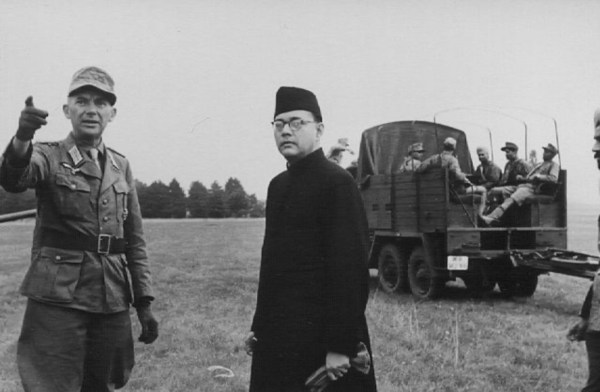 Bose in Germany (Wikimedia Commons)
The Indian Students’ Association, meanwhile, organised special functions on Jallianwala Bagh Day on 13 April and Mahatma Gandhi’s birthday on 2 October. The Nazi government was not unsympathetic towards these celebrations. “With time, ritualistic observation of these occasions would become an integral component of the joint anti-British propaganda conducted by Bose and the Nazi government,” suggests Roy.
Bose and the Azad Hind
On arriving in Berlin, Bose presented ambitious plans to the Foreign Ministry: establishing a ‘government of Free India in exile’ and raising an Indian Army, which would march into India. “It is well-known that Bose’s demands for the establishment of a provisional Indian government in Berlin fell on deaf ears, mainly due to Hitler’s apathy towards anti-colonial movements…,” says Roy.
However, with the support of the German Foreign Ministry, Bose set up a Free India Centre (FIC) in Berlin in May 1941. The SRI oversaw the activities of the FIC, which consisted of members of the Indian Students’ Association and Indian communists and anti-colonialists such as ACN Nambiar, a journalist based in Berlin. “It was called the Students’ Association, but basically these were anti-colonialists,” added Roy in her interview.
 Azad Hind (Volume 1, No. 443) Source: Wikimedia Commons
Bose also gained access to broadcasting facilities in Berlin and inaugurated the Azad Hind (Free India) Radio, which later became a monthly magazine.
In her journal article, At the Crossroads of Anti-Colonialism, Axis Propaganda and International Communism: The Periodical Azad Hind in Nazi Germany (2022), Roy discusses the periodical Azad Hind, published in both German and English languages, from 1942 to 1944. “The periodical was the mouthpiece of the Free India Centre, established in Berlin by the Indian nationalist leader Subhas Chandra Bose with the help of the German Foreign Ministry, to conduct diasporic anti-colonial politics.”
Germany’s support for Indian anti-colonialism predated Bose’s arrival. As early as 1939, the German press started to support the Indian anti-colonial movement. The aim, Roy notes, was to stir up trouble and divert the attention and resources of the British Empire away from the developments in Europe.
The Azad Hind journal was distributed to European cities via the German consulates. Additionally, Habibur Rahman, an Indian propagandist affiliated to the FIC as well as the German Propaganda Ministry, wrote another pamphlet called Azad Hind for the Indian POWs stationed in Germany. “This was different from the erudite and sophisticated Azad Hind journal published by Bose and his associates from the Free India Center,” says Roy.
Yet problems persisted. The German Foreign Ministry censored Azad Hind. “The Nazi government seems to have been especially concerned about the opinions expressed by Bose. His speeches were scrutinised by Karl Megerle, a prominent Nazi propagandist who was in charge of Propaganda in the Foreign Ministry,” says Roy.
Bose’s radio programmes, although popular in India, were banned by the British.
While he left for East Asia in early 1943, Bose’s speeches continued to serve as the inspiration for Azad Hind.
“For historians, the significance of Azad Hind lies not with the popularity of its reception but in the fact that it is a unique example of an integration of the diasporic anti-colonial politics conducted under Bose’s leadership, within the parameters of wartime Nazi and Axis propaganda,” writes Roy.
Much like their counterparts in London, Indian students and academics spearheaded the independence movement in Germany. What makes the German case stand out is that much of this activism took place under the watchful eyes of the Nazi regime. The changing geopolitics, in the wake of the First and Second World Wars, further complicated diasporic activism. The efforts of figures like Nambiar, Das, Chatto, Bose and others sowed the seeds for what was to happen in the 1940s that would eventually contribute to India’s independence.
Reference:
The Nazi Study of India and Indian Anti-Colonialism by Baijayanti Roy


 Share


