
Andamanese Hindi: how Andaman and Nicobar Islands came to embrace a unique linguistic identity and take pride in it
Decades of migration and settlement in the Andaman Islands have led to the rise of Andamanese Hindi as the chief language of communication while native languages like the Great Andamanese face extinction.
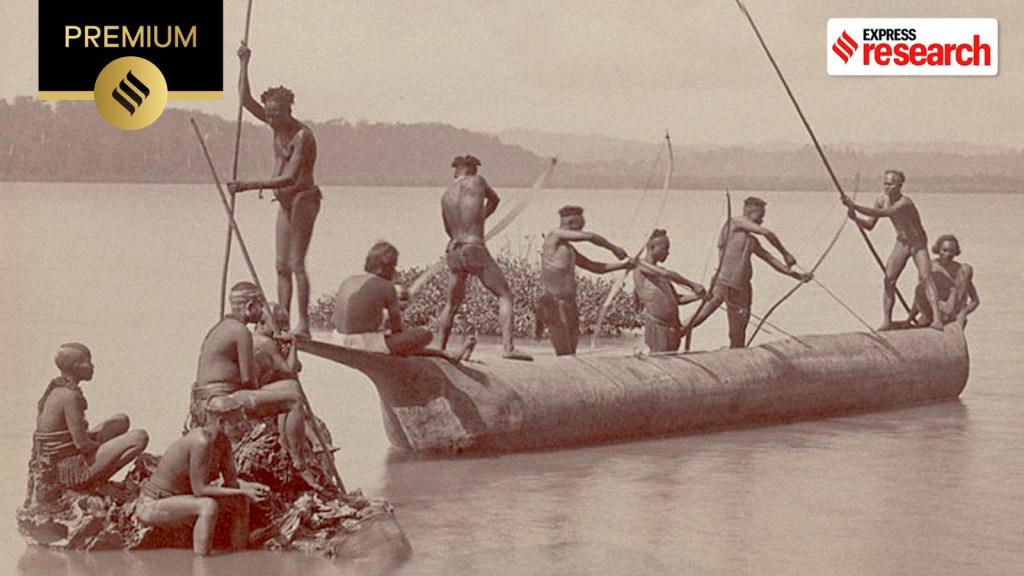 The tribes of Andaman and Nicobar Islands (Wikimedia Commons)
For 26-year-old Lephay, her mother tongue is mostly an idea lost in time, one that was spoken long ago by her grandparents. The only traces that have been passed on to her include basic phrases such as ‘give me water’, ‘give me food’, and so on. The Great Andamanese, her mother tongue, is a near-extinct language family today, with fewer than 10 speakers alive. As their native language vanishes swiftly, what has come to take its place is Hindi, which has connected the tribal and non-tribal inhabitants of the Andaman and Nicobar Islands.
Lephay – indigenous Andamanese people do not traditionally have surnames – grew up in the capital, Port Blair, where her parents had first moved for work from Strait Island when she was still a child. All her life, she has spoken Hindi. Married to a local Bengali man, she says that they communicate with each other in Hindi. “It is the only language I know,” Lephay says, adding that even though she went to an English-medium school, she struggles to speak the language. “But everyone here speaks only in Hindi,” she claims, a curious ring in her voice.

The proliferation of Hindi in Andaman and Nicobar, say scholars, is a product of the long history of migration and settlement of multiple Indian communities in the islands. “It is a mini-India,” says linguist Anvita Abbi, a leading authority on the languages of Andaman and Nicobar. She recalls that when she first visited the islands in the early 2000s, she was surprised to see that almost all state languages were spoken in Andaman.
“There is a large Bengali-speaking community, a Malayalam-speaking community, Telugu, Tamil, and many more,” says Abbi. At home, they speak their native languages, she says, but once outside, Hindi is what they choose to communicate in. “Hindi is our national language. They speak very proudly,” says Abbi. “The kind of love for Hindi I see in Andaman is something I didn’t even see in the Hindi heartland,” she observes.
History of migration
Scholars have long speculated about the precise origins of the inhabitants of the Andaman and Nicobar Islands. While one theory contends that the islands have experienced continuous occupation for at least the past 2,200 years, there are others who have claimed that the ancestors of the archipelago’s current inhabitants reached there approximately 35,000 years ago.
As noted by anthropologist Sita Venkateswar in her article, ‘The Andaman Islanders’ (1999), “The Andaman Islanders followed the traditional way of life of these people – one of semi-nomadic hunter-gatherer-fishers – well into the 19th century, when the British colonists arrived and began to take over the islands.”
Sprawled like an arc on the Bay of Bengal, the 572 islands of Andaman and Nicobar have historically held a lot of strategic importance. They are located at a key position along the trade routes on the eastern portion of the Indian Ocean. They formed a perfect base to strike upon the East Coast of India or, for that matter, anywhere in Southeast Asia. Moreover, the harbours of Port Blair and Nancowry were perfectly situated to replenish the water supply of ships passing along these routes, or to provide timely information regarding weather and storms in the Bay of Bengal.
 Detailed map of Andaman and Nicobar Islands (Wikimedia Commons)
Consequently, these islands were a source of great interest to both Asians as well as the European powers. Venkateswar in her book, ‘Development and Ethnocide: Colonial Practices in the Andaman Islands’ (2005), notes that “the islands and its inhabitants had long been a subject of European fascination and dread.” Very little was known about the inhabitants except the myth that they were barbarous, cruel cannibals, an account that had been kept alive by several foreign travellers’ tales.
Given its strategic importance, it was the Danish East India Company which first attempted to colonise the islands in 1755. The Nicobar Islands were turned into a Danish colony, first named New Denmark and later as Frederick’s Islands. With the Dutch consolidating power in the East Indies, their presence in the Andaman Islands became crucial for the British to control trade networks in the region.
In 1788-89, the British government in Bengal sought to establish a penal colony in the Andaman Islands. After an initial survey carried out by Lieutenant Robert Hyde Colebrook and Lieutenant Archibald Blair, the penal settlement was established in September 1789 on the South-East bay of South Andaman, now known as Port Blair. In 1792, the settlement was shifted further northwards, considering the superior strategic location. However, this new settlement proved to be extremely unhealthy, resulting in high mortality rates among inmates, and was soon abandoned by 1796. Venkateswar, in her book, notes that even these seven years of “British and convict presence on the islands” are likely to have had a long and insidious impact on the islanders.
About 60 years later, when the 1857 Sepoy Mutiny broke out, the British were convinced that they had to reinstate the strategic base in the Andaman Islands. “The Mutiny brought up the question of accommodating thousands of mutineers sentenced to life imprisonment. Indian historians writing about this period imply that the sole motive of settling up a penal colony in the Andaman Islands was to transport mutineers to a place where they pose no political threat to the British,” notes Venkateswar.
However, she points to other British records which maintain that long before the mutiny, the conduct of the Andamanese “had made it imperative that the islands should be occupied, and friendly relations established with the Aborigines”, and that this would have been done sooner, had the mutiny not broken out. Thereafter, a permanent settlement in the form of a penal colony was established in 1858.
The islands remained in British control until the Independence of India, when it was transferred to the Government of India and installed as a Union Territory. In the years before Independence, several of the most radical and active freedom fighters, including Vinayak Damodar Savarkar, Barindra Kumar Ghosh, and Batukeshwar Dutt, were incarcerated at the cellular jail in Port Blair. When they were released during Independence, they were received amid much publicity and celebration by the press, even though very little attention was given to the aboriginal Andaman Islanders.
Immediately after the Partition, the Andaman Islands were chosen as a place for resettling displaced Hindu families from East Pakistan. Accordingly, large tracts of land in South and Middle Andaman were allotted to thousands of Partition refugees, often coming into conflict with local Jarawa territories. Consequently, there exists at present in Andaman, a very large community of Bengali speakers.
Yet another wave of a large influx of settlers from mainland India happened in the 1960s and 70s when comprehensive schemes were established for the development of the islands. “Almost 30,000 hectares of forest was cleared by the early seventies for settler villages, most of it encroaching on the territories of the remaining Onge groups (a tribal community in the Andaman islands),” writes Venkateswar.
The construction of roads, government offices, private industries, a harbour, a sub-naval base, an agriculture farm, and a helipad, all contributed towards bringing in more settlers from mainland India, consequently pushing the tribal community into smaller pockets in the north and southern parts of the island.
Abbi points out a community called ‘Ranchi’ in the islands. “They are called so since they were brought from Ranchi in Jharkhand to combat with the local Jarawas when the Andaman Trunk Road was being made,” she explains. The Jarawas would frequently attack the construction workers for invading their solace, and the rationale of the government at the time was that since the tribals from Jharkhand resembled the Andaman tribals, they could match up to them.
Among the other communities settled in the islands, linguist G N Devy provides the example of the Bhantu, a sub-group of the Sansi tribe, originally from Central and North-Western states of India, who were moved to the Andaman as prisoners. “However, after their jail term, they settled down there along with their families,” he explains.
There also happens to exist a community of Burmese who are descendants of those who had settled in the Andaman during the Second World War, when the islands came under Japanese control for a brief moment. One can find echoes of this historical episode in the traces of the Burmese Karen language being spoken in the island till date, explains Devy. “One can say that the Andaman language landscape reflects the history of South Asia,” he says.
Impact on local languages and emergence of Andamanese Hindi
The subsequent waves of migration to the Andamans had a significant impact on the local population. At present, only four tribes live on the islands – the Great Andamanese, the Onge, the Jarawa and the Sentinelese. Scholars say that at one point some 12 distinct linguistic and separate territorial groups inhabited the islands.
 The Great Andamanese in 1876 (Wikimedia Commons)
Among the four existing tribes, the Great Andamanese are nearing extinction. Abbi says that when she first visited the islands at the turn of the millennium, there were only 10 speakers of Great Andamanese left. Today, there are only three or four, she says. “And even they have almost forgotten their language and call me when they need to find out how a certain phrase is spoken in their language.”
The Great Andamanese, reveals Abbi, is a mixture of tribal languages such as Jero, Sare, Bo, and Khora – all languages of North Andaman. Abbi’s research concluded that the Great Andamanese were effectively isolated for thousands of years, during which time their languages evolved without discernible influence from other cultures. She also argues that the Great Andamanese constitutes a sixth language family, separate from all other language families in South Asia.
Scholars argue that the disappearance of the Great Andamanese is a product of the tribe coming into contact with the outside world. Abbi, in a research paper published in 2023, explains that when the British established the penal colony in the Andaman in the 19th century, the Great Andamanese resisted the invaders, but were no match for the guns and cannons that the Europeans brought. Even more fatal were the many diseases they were suddenly exposed to, and to which they had no immunity.
Is the language nearing extinction on account of the incursion of new languages brought by the multiple waves of migration? Devy says no. He believes that a language dies when the people who speak it get eliminated. “When new languages arrive, they might also enrich existing languages,” says Devy. He gives the example of the arrival of English in India, which he says, did not amount to Hindi disappearing. “Rather, Hindi has been enriched by borrowing new words from English,” he argues.
Why then did a similar pattern of enrichment not happen in the case of the Great Andamanese language? Devy explains that the Andamanese had been completely isolated from the outside world for centuries, and since the time they met with outsiders, first with the British colonisers and later the Indian government, it was always in the context of a relationship of conflict. Consequently, their language never found an environment that was conducive to its growth.
Abbi suggests that even when the Great Andamanese language is on the brink of extinction, the other tribal languages of the islands, such as those of the Jarawas and the Onges, have been retained through intergenerational transfer. This, she says, is mostly because both these tribes have remained largely away and secluded from the other resettled population in the Andaman. “It is only very recently that some of the male members of these two tribes have started communicating in Hindi,” she says.
About the six languages of the Nicobar Islands, Abbi says that they too are well and alive, mainly passed on through oral traditions in homes.
When the Andaman and Nicobar Islands came under the Republic of India in 1947, Hindi was established as the primary language in schools. “However, because there were speakers of so many different languages on the islands, they created their own version of Hindi with a lot of local flavour,” adds Devy.
The Andamanese Hindi, says Abbi, has some special characteristics. “It does not have any gender agreement or number agreement,” she says. “Andamanese Hindi is the main language of communication. The entire archipelago speaks it and is very proud of it. Even when I am in Andaman, I switch to Andamanese Hindi and can no longer speak the Hindi I use in New Delhi,” says Abbi.
The proliferation of Andamanese Hindi is perhaps the most significant byproduct of the decades of efforts towards settling on the islands without attempting to engage with the local Andamanese languages. Devy sums it up perfectly when he says, “The entire Andaman and Nicobar Islands have been transmitted because there was no possibility of translation.”
Further reading:
Sita Venkateswar, Development and ethnocite: Colonial practices in the Andaman Islands, IWGIA, 2004
Sita Venkateswar, The Andaman Islanders, Scientific American, 1999
Anvita Abbi, This ancient language has the only grammar based entirely on the human body, Scientific American, 2023


Adrija Roychowdhury leads the research section at Indianexpress.com. She writes long features on his... Read More
 Share


