For anyone chronicling German politics, it’s impossible to write the far-right ideology out of its history. From the Nazi atrocities during WWII to the longstanding presence of the National Democratic Party of Germany, founded in 1962, and Die Republikaner, founded in 1983, the ideology has persisted into the early 2000s.
This changed with the rise of the Alternative for Germany (AfD).
“Having narrowly missed the five percent threshold in the 2013 federal election, the AfD achieved an impressive success in the European elections at the end of May 2014, just over a year after its founding, with 7.1 percent of the vote,” notes political scientist Frank Decker in his 2015 article, APuZ: AfD, Pegida and the shift in the political centre.
That support would only grow in the years to come. Last week, protests followed a striking result for the AfD in Saxony-Anhalt, where the party won nearly 44 per cent of the vote on September 6, far ahead of the roughly 17 per cent secured by Chancellor Friedrich Merz’s Christian Democratic Union (CDU).
How did the AfD emerge? Why has it gained such support? Is the party a return to Germany’s past, and is it here to stay?
Origins of the AfD
The Alternative für Deutschland (AfD) was founded on February 6, 2013. It emerged from a protest movement that had been building, particularly among conservative economists, against the Christian-Liberal government’s euro bailout policies.
◆
Emerged from a protest movement of conservative economists opposed to the Christian-Liberal government's euro bailout policies during the eurozone debt crisis.
◆
Founding leadership included Bernd Lucke, an economics professor, and Alexander Gauland, a conservative commentator — both former CDU members.
◆
With its founder and other prominent members drawn from academia, it was described by some as a "professor party."
◆
Under Lucke, it emerged as a "soft Eurosceptic" party — critical of the common currency, but not of European integration outright.
◆
Its first manifesto actually called for Germany to attract large numbers of skilled immigrants — a striking contrast to its later positions.
"It is also clear that despite its socially conservative positions — which had been there from the beginning — the early AfD cannot be characterized as a right-wing populist party."
— Maximilian Conrad, academic, 2020
Former CDU members who would later form the AfD’s leadership, including economics professor Bernd Lucke and conservative commentator Alexander Gauland, drove the initiative.
In an email exchange with indianexpress.com, Marcus Böick, Associate Professor in Modern German History at the University of Cambridge, explains: “The AfD emerged as a political party in the context of the euro currency crisis of the early 2010s. Led primarily by West German academics and liberal-conservative professors, it opposed the financial rescue measures introduced during the so-called Greek crisis, when the German government was also involved in efforts to rescue Greece, which was facing sovereign default…”
David F Patton, Professor of Government and International Relations, Connecticut College, told indianexpress.com that since its founder and other prominent members came from academia, the AfD was described by some as being a “professor party”.
 Angela Merkel (Wikipedia)
Under Bernd Lucke’s leadership, the AfD initially emerged as a soft Eurosceptic party, critical of the common currency and former Chancellor Angela Merkel’s oft-quoted claim that there was “no alternative” to the euro.
In his 2020 journal article, From the Eurozone Debt Crisis to the Alternative for Germany, academic Maximilian Conrad explains that while hard Euroscepticism entails an outright rejection of European integration, soft Euroscepticism involves a more qualified rejection of certain aspects of European integration.
Interestingly, the AfD was not initially the far-right party it would later become. “It is also clear that despite its socially conservative positions—which had been there from the beginning…the early AfD cannot be characterized as a right-wing populist party,” writes Conrad.
In fact, despite references to stricter immigration laws, the party’s first manifesto called for Germany to attract large numbers of skilled immigrants.
The turn to radicalisation
A core ideology shared by recent right-wing parties is that immigrants do more harm than good to the economy and society. For the AfD, this came to the fore during the 2015–16 refugee crisis, which marked a decisive turning point for the party.
Patton of Connecticut College describes the episode as “extremely significant” in shaping the AfD’s growth and political identity. “During the 2015 refugee crisis, the AfD reinvented itself as a right-wing populist party that opposes immigration, is critical of Islam, and calls for law and order.”
Beyond its right-wing turn, University of Cambridge’s Böick argues that the crisis was also decisive in the AfD’s transformation into a “party of the East”. He argues that Merkel’s decision in September 2015 to open Germany’s borders to large numbers of people fleeing the Syrian civil war acted as a “major political accelerant”.
The AfD subsequently shifted from a Eurosceptic to a “migration-critical” party and gained growing support, particularly in East Germany. It became a “broad catch-all” for conservative, national, nationalist and, in some cases, extremist voices that no longer felt represented by the centrist course of Merkel’s CDU.
Protests against right-wing extremism in Stuttgart, 2024 (Wikipedia)
The AfD’s transformation was also driven by the declining relevance of its initial opposition to the common currency and a growing ideological divide between its market-oriented founders and its increasingly radical national-populist wing. This culminated in a party split in July 2015 and prompted the party’s ideological reorientation from mid-2015 onwards.
The divide also had a regional dimension. The soft Eurosceptic wing around founder Bernd Lucke had a mainly West German profile, while the national-conservative wing, led by Frauke Petry, had a mainly East German profile.
By 2016, the AfD’s programme had converged with those of anti-immigrant populist parties in Western Europe. In his 2017 essay, The Alternative for Germany’s radicalisation in historical-comparative perspective, Patton notes that it called for allied troops to leave Germany, the reintroduction of military conscription and a stronger German national army.
It held that “Islam is not part of Germany” and called for a ban on minarets, the call to prayer, full-body veiling, and headscarves for teachers and schoolgirls. It rejected multiculturalism and large-scale immigration, while asserting that there is no right to naturalisation. It described the German language as “the central element of German identity” and called for its constitutional recognition as the state language.
The Party of the East
After the fall of the Berlin Wall in 1989, the German Democratic Republic (GDR), or East Germany, collapsed, paving the way for reunification with West Germany in 1990. Many East Germans, however, grew frustrated with the political and economic changes brought about by reunification. The eastern economy was in tatters, unemployment was nearly twice the level in the West, and social services were drastically cut back.
Germans stand on top of the Berlin Wall in the days before the wall was torn down (Wikipedia)
“The many causes of this striking imbalance between eastern and western Germany can be traced back to a deficit in the GDR’s social development,” notes political scientist Gerard Braunthal in Right-Wing Extremism in Contemporary Germany (2009). This history would later provide fertile ground for the AfD.
Although the AfD has recently surged in the West and now polls above 20 per cent in some western states, its support in the East is roughly twice as high.
Patton explains: “In Saxony-Anhalt elections in September [this year], the AfD won 43.8 per cent of the vote, even though the state’s office for constitutional protection had determined that the AfD branch chapter was right-wing extremist…”
2013 Federal Election
< 5%
Narrowly missed the 5% threshold needed to enter the Bundestag, in its founding year.
2014 European Election
7.1%
Just over a year after founding.
2017 Federal Election
12.6%
Became the third-largest party in the Bundestag — the first party right of the CDU/CSU to enter parliament since the early 1950s.
Recent Polling, Western States
> 20%
Support in the East runs roughly twice as high as in the West, per political scientist David F Patton.
Saxony-Anhalt, Sept 6, 2026
43.8%
Compared to the CDU:
AfD: 43.8% vs. Chancellor Friedrich Merz's CDU: roughly 17% — despite the state's own office for constitutional protection having determined the local AfD chapter to be right-wing extremist.
He says that many easterners vote for the AfD to express their dissatisfaction with the political establishment, immigration and the economy. By rejecting sanctions on Russia and military aid to Ukraine, the AfD appeals to easterners who on the whole are somewhat more sympathetic to Moscow and more sceptical of the European Union and Nato than are western Germans.
Böick emphasises the “shock of the 1990s”, which continues to shape eastern Germany, particularly rural regions that experienced deindustrialisation, unemployment and emigration after the fall of communism and the transition to capitalism. This produced a prolonged sense of decline.
“Beyond the larger cities, the state and political parties have increasingly withdrawn. Police stations, schools, courts, and hospitals were closed, but so too were cinemas and restaurants. For some time now, the AfD has been precisely the party that, both physically and digitally, has sought to fill this gaping ‘gap…’” he argues.
The overall message, Böick says, is essentially: “We are here with you; the others are sitting in the capital cities and making politics against you.”
That message has successfully reached a widening support base.
Federal election of 2017
The September 24, 2017, federal election sent shockwaves through Germany’s political establishment. While Merkel’s CDU and its Bavarian sister party, the Christian Social Union (CSU), remained the largest grouping in the Bundestag, the right-wing populist Alternative for Germany (AfD) secured 12.6 per cent of the vote.
“For the first time since the early 1950s, a political party had unlocked viable political space to the right of the CDU/CSU. Not only that, it became the third largest party grouping in the Bundestag. The AfD performed strongly across Germany but did particularly well in states of the former East Germany,” writes academic Charles Lees in his 2018 journal article, The ‘Alternative for Germany’: The rise of right-wing populism at the heart of Europe.
West German ministers in the Bundestag (Wikipedia)
The AfD also mobilised previously disengaged voters through a narrative of “culture war” and difference that resonated particularly strongly in eastern Germany.
“Upon entering the Bundestag in 2017, the AfD challenged norms of behaviour through aggressive heckling, sarcastic laughter, sometimes in unison, peppering the other parties’ speakers with questions, frequently interrupting, and using provocative language that on occasion recalled that of the Nazis,” writes Patton in his interview.
“As a populist party, the AfD claims to champion free speech, while opposing ‘political correctness,’ ‘wokeness’ and ‘cancel culture’. When others refuse to engage with the AfD, it presents itself as a victim of an allegedly intolerant and out-of-touch cartel of the ‘old parties.’”
Growing support
Despite protests, support for the AfD continues to grow. Patton partly attributes this to the unpopularity of recent federal governments.
“Amidst a prolonged economic slump and widespread fears of deindustrialisation in Germany, Chancellor Merz and the governing coalition of Christian Democrats and Social Democrats have extremely low approval ratings. That said, it is becoming clear that more voters are backing the AfD not just out of protest but rather to support its policy positions.”
Böick draws parallels between the AfD’s rise and the success of populist parties in countries including the US, the UK, France, Poland, Brazil, and Argentina.
He says voters increasingly feel that established elites are unable to address crises such as migration, inflation, war and artificial intelligence, and are no longer making policies for the “little guy”, who sees himself as the backbone of society.
This, he argues, creates an opening for parties such as the AfD to build mass support through a strong local and online presence, particularly as established parties are increasingly seen as entrenched and out of touch.

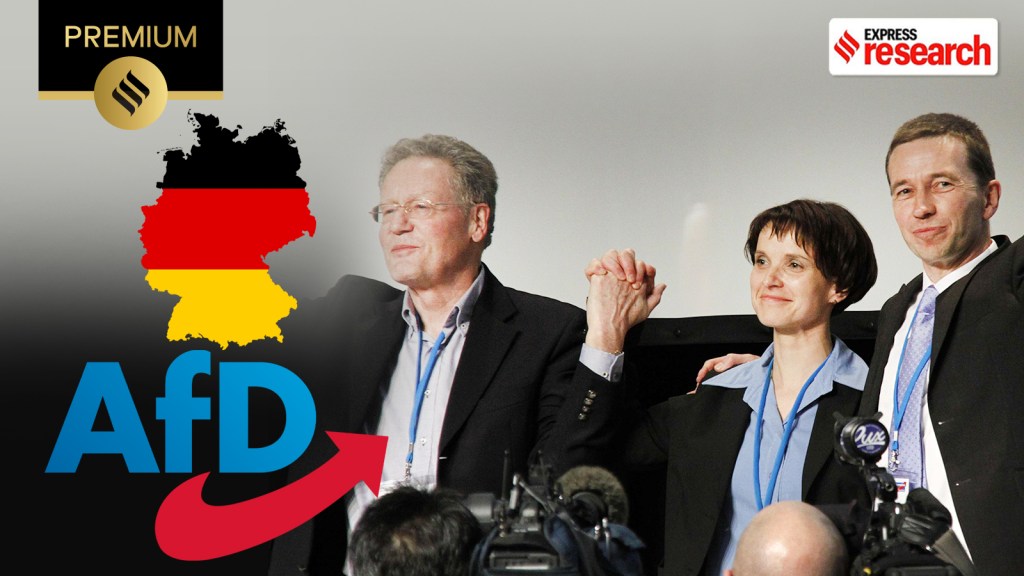 l-r: Konrad Adam, Frauke Petry, and Bernd Lucke at the first AfD convention in Berlin, 2013 (Wikipedia)

 Angela Merkel (Wikipedia)
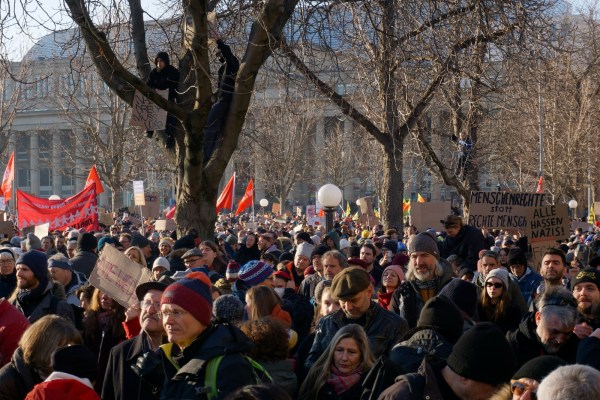 Protests against right-wing extremism in Stuttgart, 2024 (Wikipedia)
 Germans stand on top of the Berlin Wall in the days before the wall was torn down (Wikipedia)
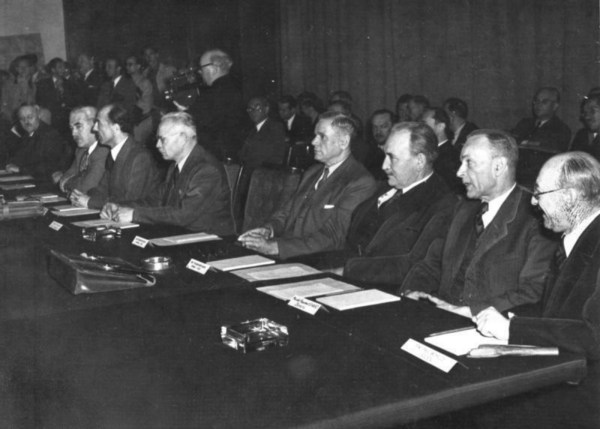 West German ministers in the Bundestag (Wikipedia)


 Share


