


Journalism of Courage
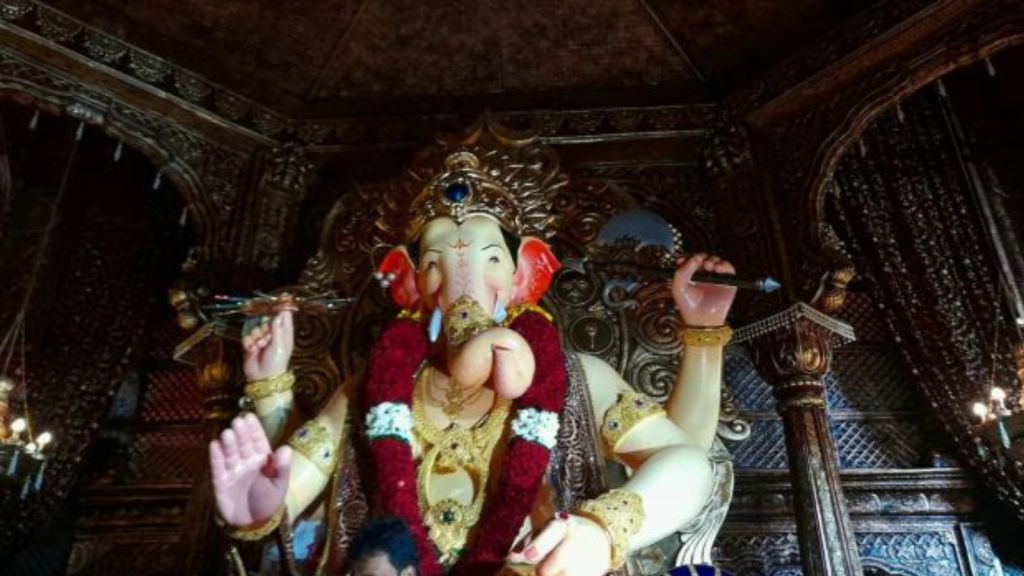 For the inmates who shaped the clay, sculpted the features and carefully brought the idol to life, the work offered something rarely associated with prison life — a chance to create something that would be welcomed by society. (Express Archive)
Written By Kalyani Lad
Amid the colour, grandeur and extravaganza marking the beginning of the 38th Pune Festival, an unlikely group of artisans has quietly found a place at the heart of the celebrations — prison inmates who have turned clay into a symbol of hope, dignity and second chances.
The idol, installed by PMRDA Commissioner Dr Abhijit Chaudhary, is among more than 300 Ganesh idols crafted by inmates in Maharashtra’s prisons. For the Pune Festival, President Krishnakumar Goyal visited the workshop and personally selected the idol that would become part of the city’s annual celebration.
What makes the idol distinctive is not merely where it was made, but what it represents.
For the inmates who shaped the clay, sculpted the features and carefully brought the idol to life, the work offered something rarely associated with prison life — a chance to create something that would be welcomed by society.
The initiative is part of ‘Preranapath’, a reform programme being run by the Maharashtra Prison Department in collaboration with Bhoi Pratishthan, Pune, and Adarsh Mitra Mandal, Pune. The programme seeks to equip inmates with practical skills and create pathways for their eventual reintegration into mainstream society.
As part of the initiative, inmates were trained in Ganesh idol-making by renowned sculptors Vivek Khatavkar and Viraj Khatavkar. What began as a skill-building exercise eventually resulted in more than 300 idols being created by the inmates.
The journey from learning the craft to seeing one of their creations installed at one of Pune’s prominent cultural festivals adds another dimension to the effort.
“For a festival that celebrates culture and community, this initiative highlights how celebrations can also become a bridge to social reform,” said Pune Festival President Krishnakumar Goyal.
According to Goyal, when people consciously choose to purchase idols made by inmates, they contribute to more than the sale of a product. “It gives inmates a marketable skill, a sense of dignity, and visible proof that society is willing to accept their positive contribution,” he said.
The significance of that acceptance is central to the idea behind Preranapath. Rehabilitation does not end with acquiring a skill; it also depends on whether society is willing to recognise and accept an individual’s effort to change.
For the inmates, an idol leaving the prison workshop and finding a place at a city-wide festival offers precisely that recognition. Something they created with their own hands is no longer confined to the prison environment; it becomes part of a public celebration, a family’s devotion and the cultural life of the city.
As the Pune Festival begins with its usual extravagance, its Ganesh idol this year quietly carries a different message. It is a reminder that a person’s past need not define the work they are capable of creating, and that sometimes, the most meaningful symbol of a festival can be one that gives people a chance to begin again


