“You know the biggest damage all this ‘Hindu-Muslim’ has done?… You start raising important issues like education, unemployment, and parties come up with something on religious lines,” says Moin Khwaja, 21, who after graduation works as operator at a cyber cafe, earning Rs 10,000 per month, in Ruknuddin Sarai village in Sambhal constituency.
However, in the seat that will vote on Tuesday, religious fissures hung heavy through the campaign.
Samajwadi Party candidate Zia ur Rahman Barq, 35, the grandson of the party’s long-lasting leader Shafiqur Rahman Barq, faced an FIR on charges of “objectionable comments” after he allegedly sought votes citing the “sacrifice” of Mohd Shahabuddin, Mukhtar Ansari and Atiq Ahmed. All three were mafia dons turned politicians who died while in custody.
With the BSP too fielding a Muslim candidate, Chaudhary Saulat Ali, Zia made frequent references to the BJP government’s “bulldozer raaj (reign)” and “threats to the Constitution”, and urged the community to vote as one. “Ye hamaare mustaqbil ka chunaav hai (This is the election for our future)… Do not forget Shafiqur Rahman saheb, he never did politics on the basis of caste, but of community only. In Parliament, he raised the voice of the region and the community. It is up to you to decide whom you want to strengthen – those who are demolishing your houses with bulldozers or those who represent you,” he said, addressing one such gathering, not very far from the cyber cafe where Khwaja works.
“Iss waqt ki nazakat ko samajhiye (understand the gravity of this situation), remember what has happened to us… This election is very special. The BJP is keeping an eye on me,” Zia said, referring to the FIR against him.
Sambhal has long been an SP stronghold, with founder Mulayam Singh Yadav and senior leader Ram Gopal Yadav also winning from the Lok Sabha seat earlier.
In 2014, the BJP won Sambhal for the first time, with Satyapal Singh Saini defeating Shafiqur by a narrow margin of over 5,000 votes. In 2019, Shafiqur made a comeback as an SP-BSP alliance candidate, defeating the BJP’s Parmeshwar Lal Saini by over 1.74 lakh votes. The BJP has fielded Parmeshwar again.
The BSP’s Saulat Ali is a former SP MLA, who has also been in the Congress. The last time he contested an election was in 2012.
Of the around 19.50 lakh voters in Sambhal constituency, Muslims are 8.75 lakh, with Jatavs following far behind at 2.30 lakh, Yadavs at 1.40 lakh, Sainis at 1.15 lakh, and 1.7 lakh upper castes.
‘Model villages’
At first glance, Ruknuddin Sarai, adjacent to the Sambhal city area, looks deceptively unlike a village. As part of a Uttar Pradesh government scheme to develop villages in every district as “model villages”, Ruknuddin Sarai got picked in June 2022.
Consequently, it has a government school, water tank, dustbins for wet and dry garbage and an MRF centre for ‘garbage segregation’. But the centre closed long back, and Khwaja says that the rest too is “tokenism”.
“At least a model village should have good education facilities, a hospital… The SP won many times, but what have we got?” he scoffs, adding that despite this, the SP is likely to win again “because Muslims do not have any options”.
 A waste segregation plant as part of ‘Model Village’ has been closed for months. (Express Photo)
Mohd Mashroor Hussain, 65, shows a crumbling building in front of his kirana store. It was to be a hospital, but is used as a garbage dump. “Yehan model jaisa kuchch bhi nahin hai (There is nothing like ‘model’ here)… In Mayawati’s time, construction started on the hospital, but so far, this is it… There are Swachhta dustbins, but nobody has cleared them for months,” says Hussain.
However, he is grateful for the free rations, by both the Centre and state governments, calling it their “haq (right)”.
Around 30 km away is SC-dominated Maulagarh, the other ‘model village’ in Sambhal district. Krishan Pal Chaudhary, 45, says he would rather have a gaushala to take care of stray animals. “This is our biggest issue, but nobody is talking about it,” says Chaudhary, who owns 4 bighas of land.
Roshan Lal, 66, talks of the fact that in their ‘model village’, there is no government school after Class 5.
In his campaign, Zia focused on his grandfather’s legacy. The sitting MLA from Kundarki in Moradabad district, he got the Sambhal ticket after Shafiqur passed away at the age of 94 in February. He was a four-time MLA from Sambhal and five-time Lok Sabha MP – three times from Moradabad and two times from Sambhal.
Zia contested his first Assembly poll in 2017 from the Sambhal Assembly seat on the AIMIM ticket, but lost. His 2022 win from Kundarki was largely owing to his grandfather’s popularity.
Speaking to The Indian Express, he contested the FIR against him, saying he had not held up the three dons-turned-politicians as “ideal”. “However, I must say that, as per the Constitution, a person who becomes an MLA or MP gets legal (protection). I cannot say if the cases against them were right or wrong… but now punishment is being given via bulldozers. Not all cases are correct,” he said.
At the BSP office one afternoon last week, Ankul Kumar, 24, is the only one around. A resident of Phulsingha village, he drives an e-rickshaw around the constituency, with loudspeakers mounted over it, blaring the BSP’s message. “Behenji created this district,” Kumar says as he hurries out, adding that he hoped she returns.
The BJP’s election office ran from a private hotel. Saurabh Gupta, its ‘Lok Sabha media convenor’, says the BJP will win due to its welfare schemes, apart from the BSP acting as a “vote-katua (vote cutter)”. As for Zia, he says: “There are no sympathy votes for Barq Senior as he died a natural death. Our traditional voters like Sainis, Thakurs, Jats, Vaishyas are with this. Jatavs are leaving the BSP as they see that Mayawati is not in the race and the candidate here is a Muslim. Satta ka prabhav toh padta hai naa (Power has its draw)… hence Yadavs too are now avoiding Zia.”
Rashid Ali, 70, a resident of Siras Khera village, knows who is missing from this BJP equation. Development and welfare schemes are one aspect, Ali says. “The pain of the distance between the Hindu and Muslim communities will not end.”

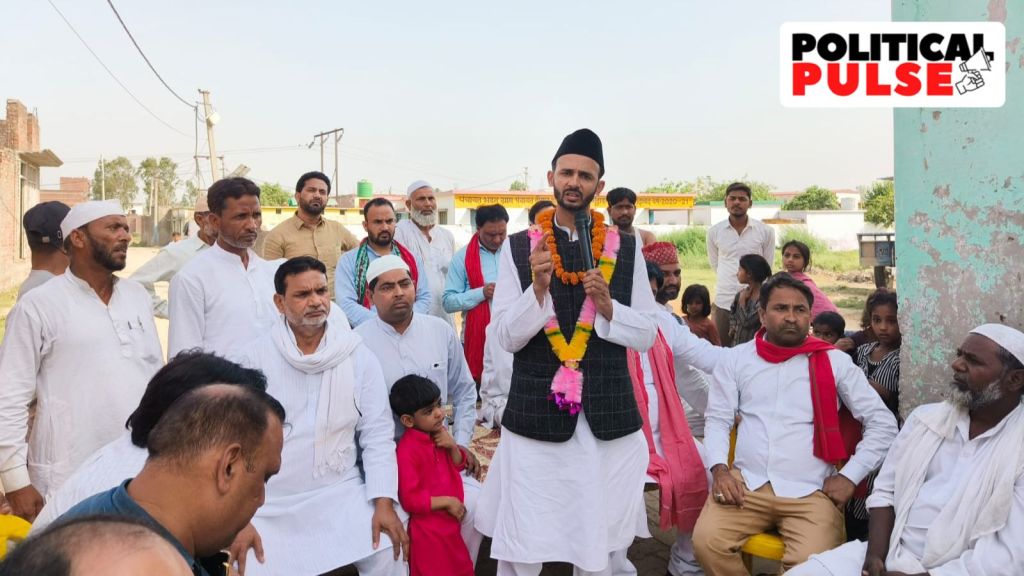 Samajwadi Party candidate Zia ur Rahman Barq campaigning. (Express Photo)

 A waste segregation plant as part of ‘Model Village’ has been closed for months. (Express Photo)


 Share


