
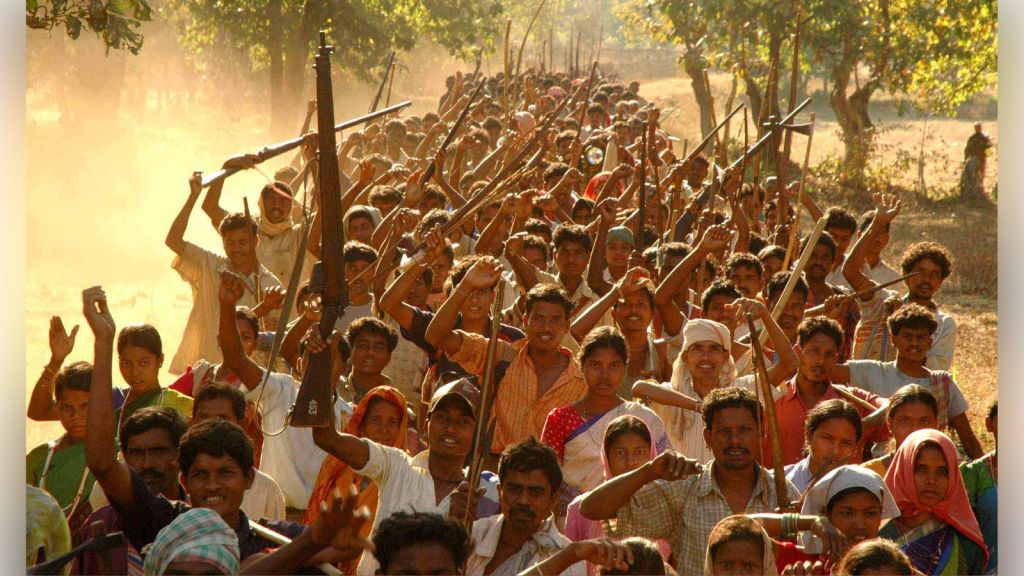
In what started in 2005 as “Jan Jagran” (public awareness), a peaceful movement against Maoists by a section of frustrated villagers in Chhattisgarh’s Bijapur district, who were sandwiched between Naxalites and security forces, soon snowballed into Salwa Judum — a state-sponsored militia, largely comprising tribal youths, raised and armed to counter the Maoist insurgency in the tribal-dominated Bastar region.
Till the Supreme Court struck down the practice of Salwa Judum in 2011, Bastar witnessed extreme violence from 2005 to 2011, when 422 Maoists, 1019 villagers and 726 security personnel were killed, several villages burnt and many tribals displaced, as per official figures. The Chhattisgarh government was then led by the BJP under chief minister Raman Singh.

Justice B Sudershan Reddy was part of the Supreme Court Bench along with Justice S S Nijjar, which in a landmark judgment in July 2011 in Nandini Sundar vs State of Chhattisgarh case, disbanded Salwa Judum for being illegal and unconstitutional.
Recently, Justice (retired) Reddy has been named by the Opposition parties as their joint candidate for the Vice-Presidential election to be held on September 9.
On Friday, Union Home Minister Amit Shah accused Justice Reddy of “supporting Naxalism”, claiming if he had not delivered the Salwa Judum verdict, the Maoist menace would have ended before 2020.
Salwa Judum period
An incident that took place in Bijapur led to the beginning of Salwa Judum (peace march). In May 2005, Maoists looted ration and other materials meant for a police camp from the Kutru-Bedre road in Bijapur. On suspicion, the police detained some villagers. A group of villagers came to their rescue and promised police they would help nab the real culprits. The villagers returned to hand over to the police a Maoist who was said to be involved in the looting incident. The villagers then held a meeting to discuss how they were facing trouble from Maoists as well as police, deciding that they would not allow any Naxal activities in their village.
However, Naxals who wanted to crush the movement started targeting leaders who held such meetings. A month later in June 2005, senior Congress tribal leader and ex-minister Mahendra Karma was invited to one such meeting in Bijapur’s Naimed village, where Karma named the movement, “Salwa Judum”.
Several villages and families across Bastar got divided due to the ensuing violence and many were forced to live in relief camps guarded by villagers recruited by the state government as Special Police Officers (SPOs). While Naxals attacked villagers for revolting, armed SPOs too targeted Maoist sympathisers.
The Salwa Judum movement did not help Karma politically as he lost his Dantewada seat to the BJP’s Bhima Mandavi in the 2008 Assembly elections.
Months before the 2013 Assembly polls, during the Congress’s election campaigning, over 30 people, including Karma and several senior party leaders, were killed by Maoists in Bastar’s Jhiram Ghati.
Former IPS officer, R K Vij, who served as Inspector General of Police of Bastar Range during 2006-2008, told The Indian Express: “The Salwa Judum movement was started by ordinary villagers because they were frustrated by Naxal activities. Several villages took out rallies against Maoists following which their leaders came under attack from Naxals. Due to this many people were displaced and lived in relief camps. The SPOs were mainly meant to guard these relief camps.”
Vij also said, “Salwa Judum benefited Naxals as they started recruiting villagers who got divided due to the movement. The movement helped Naxals to form multiple companies and platoons. The villagers joined the Maoist movement not because they were politically driven but out of fear and because the villages got divided over Salwa Judum,”
Another police officer who served in Bijapur when Salwa Judum was launched said, “Before naming it Salwa Judum, it was called Jan Jagran. It was a people’s movement and did well for a few months but politicians got involved in it for their vote bank and tried to gain mileage out of it. If it would have continued as a people’s movement the Maoist problem would have ended a decade ago.”
The main petitioner in the Salwa Judum case before the apex court, Nandini Sundar, however, told The Indian Express, “It was an illegal state-sponsored vigilante movement. Hundreds of villages were burnt down, about a lakh were displaced to Andhra Pradesh or Telangana, hundreds were killed, and many women were raped. Half-a-lakh people were forcibly kept in Salwa Judum camps. This is an unforgettable chapter in the history of Bastar in terms of the scale of human rights violation. Many things need to be done even today. In these 20 years since Salwa Judum days, nobody has been compensated for their burnt houses. All those people who were killed during and after Salwa Judum, there is no justice for them – nobody has been prosecuted.”
A peace activist from Bastar, Shubhranshu Choudhary, said, “The forced migration of villagers accelerated after creation of Salwa Judum. In post-1980 period Maoists started driving out tribal village heads to make room for their Sanghams in villages in South Bastar. This trickle became a flood after 2005. Today, in around 300 villages/forest settlements in Telangana and Andhra Pradesh, around 90% of villagers are IDPs (internally displaced people) and most went there post Salwa Judum when the conflict intensified.”
Several activists do not agree that Salwa Judum started as a public movement. Choudhary said, “Salwa Judum was a new version of an age-old military strategy called Strategic Hamletting. It was used in Telangana quite successfully against the first Communist (Maoist) uprising between 1946-51. In early 1990s, it was tried in Bastar when it was called ‘Jan Jagran’ and was not a success. Mahendra Karma (with CPI during ‘Jan Jagran’, who later joined the Congress) was contacted in 1997 to lead it. Revolt in Karkeli in Bijapur district was the spark which strategists were patiently waiting for all these years to give it a legitimacy of spontaneous people’s uprising.”


 Share


