
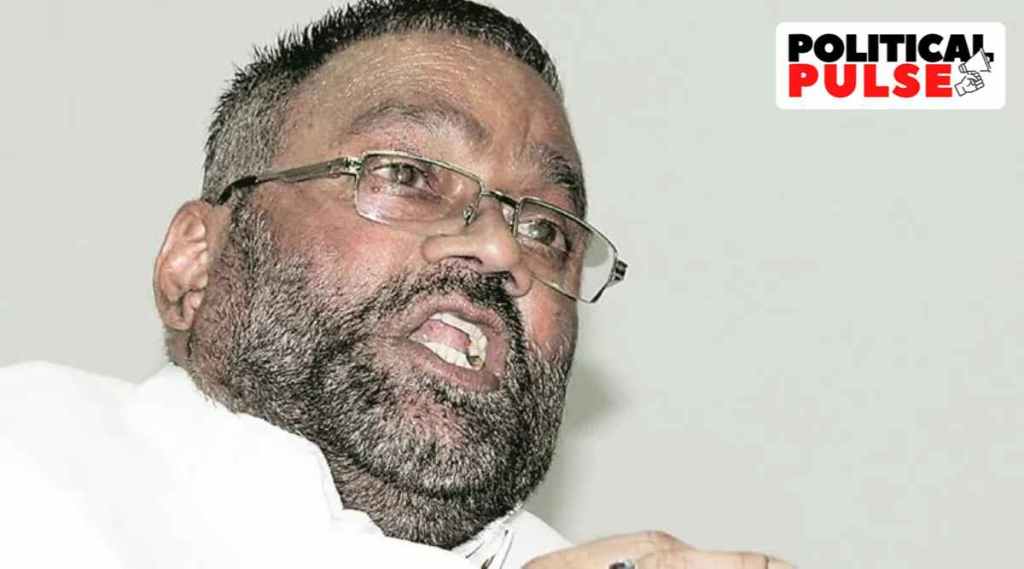
History seems to be repeating itself in Uttar Pradesh politics over social justice, which has flared up afresh in the wake of the Ramcharitmanas row kicked up by senior Samajwadi Party (SP) leader and MLC Swami Prasad Maurya’s remarks that certain sections of Tulsidas’s epic were disrespectful towards women, tribals, backward castes and Dalits. A prominent OBC leader and ex-minister, Maurya’s stand mirrors Arjak Sangh founder Ramswaroop Verma’s campaign in the 1970s and that of BSP stalwarts Kanshi Ram and Mayawati’s politics in the 1980s and 1990s.
Maurya has drawn fire from the ruling Bharatiya Janata Party (BJP), but the SP has backed him, even elevating him to the post of its national general secretary days after the controversy erupted last month. Maurya had switched to the SP from the BJP ahead of the UP Assembly elections early last year.

On Thursday, the SP expelled two women upper caste leaders from the party soon after they took on Maurya over his criticism of Ramcharitmanas, thereby sending out a clear signal again that it will staunchly stand by him.
On Wednesday, at a programme of a TV channel in Lucknow, Maurya and his supporters and those of Mahant Raju Das of Ayodhya, who had announced Rs 21 lakh on the SP leader’s head over his remarks on Ramcharitmanas, and his followers sparred with each other, exchanging allegations and counter-allegations. Later, both sides lodged their respective complaints with the police against each other.
The SP’s strategy is aimed at expanding its MY (Muslim and Yadav) support base to include non-Yadav OBC and Dalit communities in its fold. The Akhilesh Yadav-led party had managed to win only 111 of the total 403 seats in the 2022 UP Assembly polls, which was easily won by the incumbent BJP that bagged 255 seats.
The BSP founder late Kanshi Ram and his political heir Mayawati, the party chief who had been the UP CM four times, had practised an aggressive social justice politics in the 1980s and 1990s, tearing into Manusmriti. Over the last two decades, however, Mayawati, also tried to expand the BSP’s social base, although the party could just get 1 seat in the 2022 polls. On the Ramcharitmanas controversy, Mayawati has taken a non-committal position, neither defending the epic nor criticising it, even as the BJP has accused Maurya of allegedly hurting Hindu sentiments.
The Ramcharitmanas row broke out early last month when Bihar Education Minister and RJD leader Chandra Shekhar charged that Tulsidas’s epic “spreads hatred in society”. “Why was Ramcharitmanas resisted, and which part of it was resisted? Lower castes were denied education, and Ramcharitmanas says that once educated, lower-caste people become as poisonous as a snake,” he said.
Days later, Maurya joined the Bihar minister in criticising the 16th century epic. “Crores of people don’t read Ramcharitmanas. We welcome religion, but why abuse in the name of religion — Dalits, tribals, backwards, naming their castes, abusing them by calling them shudra?” he said.
Significantly, Maurya, who had started his political innings in the Chaudhary Charan Singh-led Lok Dal, gained prominence after joining the BSP and was once considered the number two in the party after Mayawati. During 2017-2022, he was a minister in UP in the Yogi Adityanath-led BJP government.
The 2024 Lok Sabha polls is going to be a high-stakes affair for the SP, given that the party lost a few key bypolls following the Assembly elections, especially the Azamgarh constituency which is dominated by the Yadav and Muslim communities. Not being able to form its government in two successive elections may result in further erosion of the party’s vote base.
A look at UP’s political and social situation since mid-seventies is revealing. By clinching the 2022 polls, Adityanath made history by becoming the first CM since 1952 to secure a majority after completing a full five-year term. The BJP achieved the feat through its aggressive campaign centred on its development and Hindutva plank, which was backed by the RSS’s machinery at the ground-level.
Since 2002, when the BJP lost the election under the then CM Rajnath Singh, UP did not see an upper caste CM until 2017, when Adityanath took charge following the saffron party’s landslide victory.
The SP has mounted a bid to make a dent in the BJP’s fort by trying to woo a section of its non-Yadav OBC leaders, while several bureaucrats belonging to the Scheduled Castes, who were once close to the BSP, have now moved to the BJP camp, even as Mayawati has continued to fight the battle of her party’s survival by trying to reach out to minorities.
Maurya might have borrowed a leaf from the book of Ramswaroop Verma, who founded Arjak Sangh in the late 1960s for the cause of social equality and to oppose Brahmanism. Verma had also formed a party, Shoshit Samaj Dal, in the seventies. Its third state conclave was held on March 3-5, 1978, in Basti, when a fire broke out in its tents amid a procession being taken out and pamphlets being distributed. The meeting organisers had then complained to Basti Kotwali that some “upper caste miscreants” had tried to eliminate them by targeting their tents. It was investigated by the CID of the UP Police, which failed to crack the case.
Later, Verma asked his supporters to burn copies of Manusmriti and Ramcharitmanas, alleging caste bias and Brahminism from April 14, 1978 (B R Ambedkar’s birth anniversary). The matter had also made ripples in the UP Assembly many times. Four years earlier, another UP MLA Rampal Singh Yadav, also from Kanpur like Verma, had torn the pages of Ramcharitmanas in the UP Assembly.
Verma vigorously campaigned against Brahmanism. He was elected as an MLA for the first time in 1957 as a candidate of Ram Manohar Lohia’s SSP from Bhognipur in Kanpur. He served as the finance minister in Charan Singh’s SVD government in 1967. During late 1980s, when Mulayam Singh Yadav and Beni Prasad Verma emerged as dominant OBC leaders, an ageing Verma started getting sidelined in state politics.
Almost simultaneously, from mid-eighties, Kanshi Ram and Mayawati started emerging as notable political players in UP. They were highly critical of Manusmriti and described Mahatma Gandhi as the “second Manu.” In the 1987 Bijnore bypoll, Mayawati secured third place by getting sizeable votes. Growing rapidly, the BSP managed to secure power just after some years, first in alliance with the SP and later with the BJP. The BSP could garner its own majority in the 2007 polls after warming up to the Brahmin community. In late 2006, Mayawati had planned to embrace Buddhism in Nagpur but dropped the idea at the last moment.
The SP governments during 2003-07 under Mulayam Singh Yadav and during 2012-17 under Akhilesh Yadav had got Rajputs on board.
Subsequently, however, the BJP managed to establish and strengthen its support base not only among upper castes, including Brahmins, Rajputs, Vaishyas and Kayasths, but also among several non-Yadav OBC communities. Some of these OBC communities like Kurmi switched their loyalty to the SP in a number of seats in the 2022 polls. The SP’s current strength is however said to “suit” the BJP, as some observers say its further slide may make the Congress an “attractive proposition” for the minority voters.
However, going by the SP and the BSP’s track records, Maurya’s campaign may take time to make any resonance among a section of non-Yadav OBCs as well as SCs, which have been consolidated by the BJP in its favour.
The National Commission for Backward Classes (NCBC) lists 76 castes (using 156 surnames) from UP in the central list for 27% reservation. The Mandal Commission report, submitted in 1980 and implemented in 1994, estimated OBCs to be
52% of India’s population. The report of the National Sample Survey Organisation (NSSO’s) 61st round, released in October 2006, however, put it at 41%.
In UP, a Social Justice Committee set up by then CM Rajnath Singh in 2001 estimated OBCs to be 43.13% (54.05% in rural areas) of the state’s population. Among OBCs, the report estimated Yadavs to be 19.4%, Kurmis 7.46%, Kachhi-Kushwaha-Shakya-Maurya-Saini-Mali 6.69%, Lodhs 4.9%, Jats (who are OBC in UP since March 2000) 3.6%, Kewat (Nishad) 4.33%, Shepherd-Pal-Baghel 4.43%, Kahar-Kashyap 3.31%, and Bhar-Rajbhar 2.44%.
 Share


