
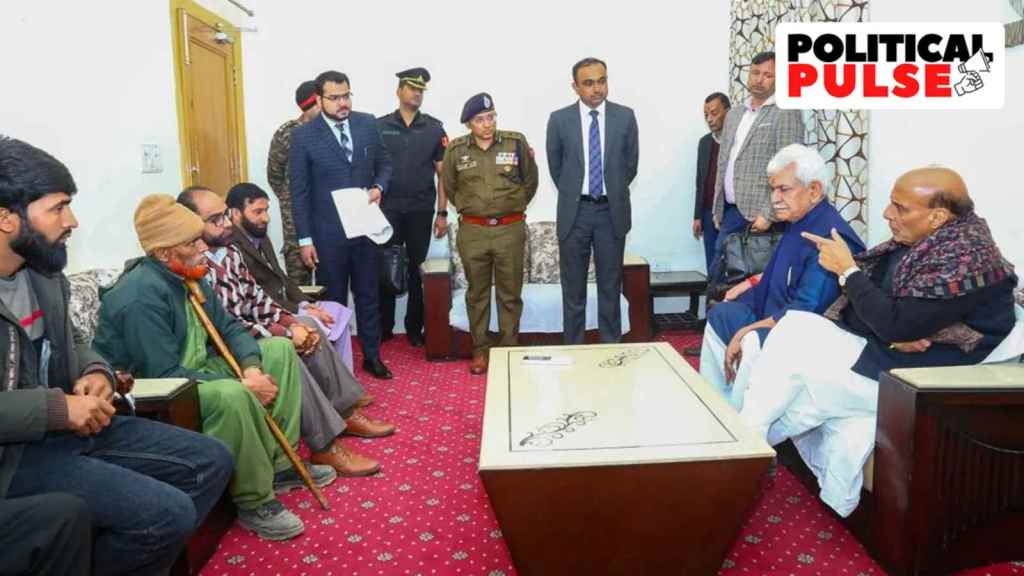
Four days after a video surfaced of suspected Indian Army personnel torturing civilians in Jammu, Defence Minister Rajnath Singh met the families of the three civilians who died allegedly in Army custody and the five men who were injured. He not only assured them justice but during his interaction with the Army also instructed it to avoid mistakes and win the hearts of local people.
In a region with a history of custodial deaths since the early 1990s, it was rare for a Defence Minister to reach out to the families of civilians and admit to mistakes. Following the incident, sources said Home Minister Amit Shah too established immediate contact with the J&K administration and ensured an FIR was registered and compensation given to the civilians and their kin.

The developments underline the alacrity with which the government acted after the video came to the fore last week. Sources in the security establishment said while courts of inquiry are instituted and FIRs are registered in every case of encounter or suspected custodial death, the Jammu case was peculiar because of the video that generated instant public reaction and the attention of the international press.
“All encounters are investigated. Here, the torture video made it an open-and-shut case in the eyes of the public. Thus, the process of ensuring justice was not just to be initiated but also seen to have been initiated,” said a senior officer from the security establishment.
Moreover, the civilians belong to a community that has been traditionally considered a friend of the Indian armed forces and helped security forces neutralise militancy in the region in the past. Losing the trust of the Gujjar-Bakarwal community, to which the civilians belonged, will be detrimental to security operations in the region.
Sources said the day the video became public, Rajnath Singh met top Army and ministry officials. “He not only took stock of the situation but also passed on instructions for steps to be immediately taken to instil trust among people and the belief that justice will be done,” said a source close to the minister.
Sources said immediately after this the Army announced a Court of Inquiry into the matter and the decision was taken to shift out the commanding officers under whose watch the deaths occurred. Army chief General Manoj Pande, too, visited Jammu on Monday and told soldiers to conduct operations in a “professional manner”.
A day before Singh visited Rajouri to meet the injured civilians, senior Army officers were dispatched to meet them. Brigadier M P Singh, Commander of Sector 6 Rashtriya Rifles and Commanding Officer of the 16 Rashtriya Rifles, visited the families of the deceased around 4 pm on Tuesday and assured strict action against those responsible. They also assured the families that the Army was with them. “The Defence Minister also met the injured, which was not part of the plan but an impromptu decision of the minister after reaching there,” said a Defence Ministry official.
Meanwhile, the Ministry of Home Affairs too had swung into action following the ambush of the Army convoy in which four soldiers were killed. Sources said that after the video emerged, the Centre was clear that quick and visible action was required. A compensation of around Rs 30 lakh was immediately announced for the next of kin of the three killed and the Jammu and Kashmir Police registered an FIR for murder. The compensation cheques have already been handed to the families of those killed while the injured are being provided the best medical care, according to government sources.
For over two decades, the Gujjar-Bakarwals have been the eyes and ears of security agencies in the forests of the Pir Panjal region. When the Army launched Operation Sarp Vinash in 2003 in the Hilkaka mountains of Pir Panjal — one of the biggest military operations in Jammu and Kashmir to date — the community fought alongside the Army. It was the first region where Village Defence Committees (VDC) were formed and VDCs formed by women also took on militants.
“The victims belonged to the Gujjar-Bakarwal community. They have been the most trusted friends of the Army through the days of militancy in Jammu and Kashmir. They played a crucial role in finishing militancy in the region in the early 2000s. Given their nomadic lifestyle, they are among the best informers. A rift in the relationship between security forces and the community will be counter-productive for the government’s war on terrorism in the region,” said an officer in the Armed Forces.
Previous cases
Since the onset of militancy in J&K, there have been multiple allegations of fake encounters and custodial deaths against the Indian Army, the Border Security Force (BSF) and the J&K Police. Some of the major incidents include the 2000 Pathribal fake encounter case in which five civilians were killed, with the Army claiming they were terrorists involved in the Chittisinghpora massacre; the 2004 Lolab encounter in which five labourers were killed after being falsely blamed as terrorists; the 2010 Machhil fake encounter case in which three civilians were killed; and the 2020 Amshipora encounter killing in which three labourers branded as terrorists were killed.
While in the Pathribal case, Army officers were charge-sheeted by the CBI, a trial held by the Army’s Court of Inquiry acquitted them. In the Lolab case, an Army captain suspected to have blown the lid off the case was found dead in suspicious circumstances in 2005. No Army man was ever punished for the encounter. In the Machhil and Amshipora cases, while the responsible officers and personnel stand convicted, their sentences have been suspended by an Army Tribunal, which has also released them on bail.

 Share


