As the Maharashtra Assembly on Wednesday passed the Maharashtra Lokayukta Act, 2022, Deputy Chief Minister Devendra Fadnavis hailed the move to bring the Chief Minister and state ministers under the ambit of the law. While Fadnavis claimed Maharashtra was the first to enact such a law, Odisha did it in 2014.
The anti-corruption ombudsman in Maharashtra now has additional powers to direct state agencies to not only recommend action but also direct state agencies to undertake investigations, according to Fadnavis.
Here is a look at the history of the Lokpal and Lokayuktas.
The idea of a Lokpal — the central anti-corruption ombudsman — first came up in 1963 during a discussion on Budget allocation of the Union Law Ministry. Bills seeking an ombudsman were introduced in Parliament eight times between 1968 and 2001 but were not passed, noted a 2020 report by anti-corruption organisation Transparency International India.
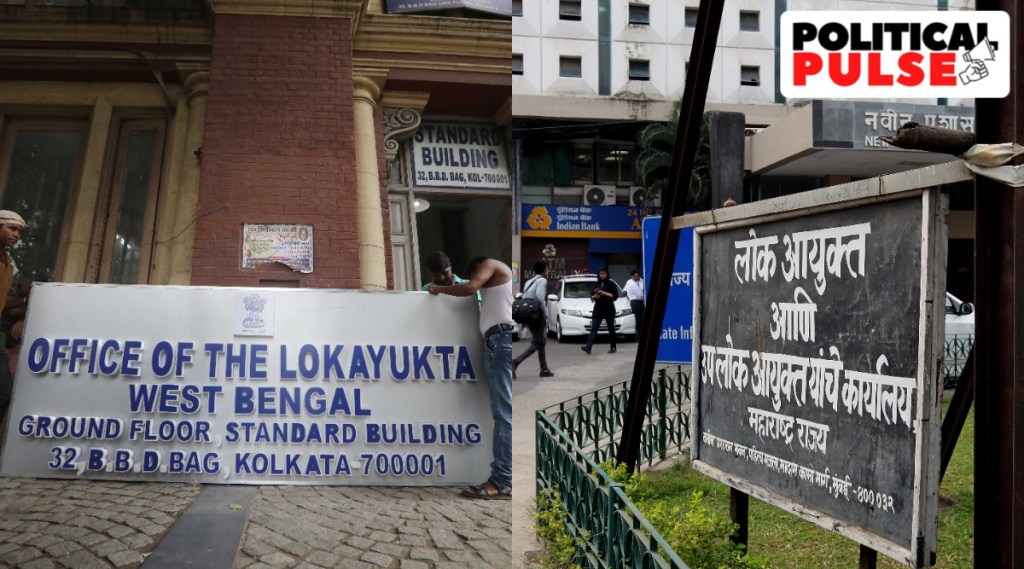
However, over the years, different states set up their own Lokayuktas — the state equivalent of the Lokpal. Maharashtra was first in this respect with its Lokayukta body established in 1971 under the Maharashtra Lokayukta and Upayukta Act.
Although the demand for stronger anti-corruption legislation had been around for decades, it received widespread attention during the anti-corruption movement led by Anna Hazare.
The Lokpal and Lokayuktas Act, 2013, subsequently came into force on January 16, 2014. The Act provides for establishing a Lokpal headed by a Chairperson, who is or has been a Chief Justice of India, or is or has been a judge of the Supreme Court, or an eminent person who fulfils eligibility criteria as specified. Of its other members, not exceeding eight, 50 per cent are to be judicial members, provided that not less than 50 per cent belong to the Scheduled Caste (SC), Scheduled Tribe (ST), Other Backward Classes, or minority communities, or are women. The Lokpal and Lokayukta deal with complaints against public servants, including the Lokpal chairperson and members.
The Lokpal’s jurisdiction involves inquiry into allegations of corruption against a current or former Prime Minister, a Union Minister, an MP and officials of the Union government under Groups A, B, C and D.
In some states, including Maharashtra, Lokayuktas were already functional when the 2013 Act was passed. However, in 2018, the Supreme Court observed that Jammu and Kashmir, Manipur, Meghalaya, Mizoram, Nagaland, Puducherry, Tamil Nadu, Telangana, Tripura, West Bengal, and Arunachal Pradesh had not appointed any Lokpal, Lokayukta or Up-Lokayukta.
As per statistics on its official website, the Lokpal received 1,427 complaints in 2019-’20, 110 in 2020-’21, and 30 in 2021-’22 up to July 2021.
The case of Maharashtra
In January 2019, in a bid to lend more teeth to the anti-corruption watchdog, the state brought in an amendment to the 1971 law to include the CM under the purview of the law after the “CM demits the office”.
Speaking on December 19, Fadnavis said that the 1971 Lokayukta law did not include the anti-corruption Act. “So the anti-corruption Act has been made part of this Act (new law),” he added.
The new law placed the legislation along the lines of the Centre’s 2013 Lokpal and Lokayuktas Act.
As per previous data acquired by Transparency International India through RTIs, a total of 3,76,109 complaints were received by the state Lokayuktas. Maharashtra had received 50,500 complaints till 2020, the report said.
Other states
Karnataka has had an interesting history with the anti-corruption body. Set up in 1984 under Chief Minister Ramakrishna Hegde, the Karnataka Lokayukta Act was responsible for Hegde quitting twice on charges of corruption. Over the years, the Lokayukta in the state has functioned either as a high-profile corruption-buster (2011 report on illegal mining naming three CMs), or a quiet public grievances forum.
In an interview with The Indian Express earlier this year, retired Supreme Court Justice Santosh Hegde, who was the state Lokayukta between 2006 to 2011, spoke about how subsequent governments in the state took away the power of the ombudsman to investigate corruption cases and relegated it to the Anti Corruption Bureau.
In July 2015, Karnataka brought in an amendment to its Lokayukta Act amid allegations that then Lokayukta Justice (retired) Y Bhaskar Rao’s son Ashwin Rao was involved in an extortion racket.
The amendment said the removal of the Lokayukta was to be initiated by one-third of the members of either House — lowering the threshold from the two-thirds required earlier — with the final decision approved by two-thirds of members in both Houses.
Also, under the amended law, the Lokayukta would be “precluded from discharge of his duties during the pendency of motion for his removal”. That December, months after refusing to step down, Rao resigned.
Meanwhile, in a controversial move this January, the CPI(M)-led government in Kerala decided to bring an ordinance to amend the Kerala Lok Ayukta Act to give itself the power to reject the report of the anti-corruption body.
The amendment aims to give the government the power to “either accept or reject the verdict of the Lokayukta, after giving an opportunity of being heard’’, with the Lokayukta being reduced to having just enough powers to make recommendations or send reports to the government.
The move came at a time when complaints were pending before the Lokayukta against CM Pinarayi Vijayan — on anomalies in the distribution of financial aid from the CM’s Disaster Relief Fund — and Higher Education Minister R Bindu.


 Share


