The term, Deep Throat, has become part of our vocabulary in recognition of the whistleblower who provided invaluable leads to The Washington Post reporters in the Watergate investigations. But despite the reams of publicity on the Bofors affair over nearly 30 years, few are aware of the identity of the low key senior Swedish police officer who surreptitiously handed over scores of secret documents to investigative journalist Chitra Subramaniam, which conclusively nailed the lies of successive Congress governments that no kickbacks were involved in the Bofors field gun purchase.
Subramaniam nicknamed her principal source simply as “Sting’’. His real name, Sten Lindstrom, surfaced for the first time in 2012 and even then went largely unnoticed.

The fascinating story of the whistleblower, who stuck his neck out and provided a plethora of evidence of payments in commissions in Swiss banks in the $1.3-billion gun deal is told in detail for the first time in Subramaniam’s new book Bofors Gate (Juggernaut).
Appropriately, the book is to be released next month by Lindstrom’s daughter Ylva Laestadius in Delhi. It’s also a celebration of the finest in investigative journalism, ironically, when everything about the profession is being contested – the latest being the bizarre directive from the owner, of none else than The Washington Post, to its editors on what views to publish and what not to publish!
If there was a political outcry in India when Swedish Radio first broke the story that Bofors had won Sweden’s biggest arms contract by paying bribes to senior Indian politicians through secret Swiss bank accounts, the sense of betrayal in Sweden was no less. If then Prime Minister Rajiv Gandhi’s reputation as Mr Clean lay in tatters, there was similar fury in Sweden against its political class, including the late Prime Minister Olaf Palme, who in January 1985 had agreed on the broad outlines of the howitzer deal with Rajiv Gandhi.
Both PMs had proclaimed that there would be no middlemen. The image of Sweden and Palme, as the world’s conscience keeper championing world peace and disarmament, was in question. (Palme was fatally wounded by a single gunshot while walking home from the cinema in February 1986).
The Bofors scandal exposed the political involvement in Sweden which broke all rules including those which the pacifist country had set for itself, forbidding arms and ammunition export to countries at war or in volatile areas. This clause was waived for the Indian deal. Institutions were by-passed and upright Swedish officials and politicians kept in the dark.
When Carl Fredrik Algernon, Head of the National Swedish War Materials Inspectorate, learnt how Sweden was, systematically, circumventing laws to sell arms abroad, he had a heated discussion with top Bofors and Swedish government officials, furious that his office had been compromised behind his back. Soon after the meeting, he fell to his death in a Stockholm subway, three months before the story broke on Swedish radio. Incidentally, notes found in his briefcase mentioned illegal sales.
Bofors marketing head Martin Ardbo was to acknowledge that Bofors routinely paid commissions to middlemen to win contracts. This was legally permissible so long as it did not involve politicians. The problem cropped up when Hans Ekblom, then head of Bofors marketing, became curious about a mysterious company A E Services. Ekblom wanted to know how had the company entered the picture so late, in August 1985, and questioned what work it had done to merit $7.3 million – and a cut in others’ commissions. According to sources, Ekblom was on the verge of a nervous breakdown over the howitzer deal.
The story of the Bofors payoffs might have remained untold if Riksbank, Sweden’s national bank, surprised that such large sums of money had been transferred to Swiss bank accounts, had not asked for a clarification whether these huge amounts were correctly coded as commissions. Per Ove Morberg, then the administrative head of Bofors, personally went to the bank and waved a piece of paper saying it was part of the Bofors India contract. The bank then asked if the money was a legitimate three per cent commission why was it paid secretly in Switzerland. The response was enough to make the government suspicious and order an inquiry. Shortly, Swedish Radio made its sensational disclosure.
The Swedish National Audit Bureau submitted a report inquiring into the allegations made by Swedish Radio. Parts of the audit report were redacted. Following this, Sweden’s chief prosecutor Lars Ringberg launched an independent investigation. As a journalist based in Switzerland working for The Hindu newspaper, Subramaniam was desperately chasing the story following every possible lead by phoning dozens of potential sources, from arms dealers to journalists and investigators.
A week before the birth of her son, a friend gave her the phone number of someone in Sweden who might be able to help. At that time, she had no clue who the man on the phone was, whom she nicknamed Sting. She was not even aware of his occupation. At first, she did not find him particularly helpful. His standard response being that she would have to “wait and see’’ for Ringberg’s inquiry.
She had no clue until much later that this uncommunicative stranger would eventually turn out to be her principal source. In October 1987, Sting suggested she come to Sweden if she was serious about pursuing the story but cautioned that he would call her — she should not try and contact him. When Subramaniam arrived in Sweden, where she had gone to meet several contacts, Sting finally came to meet her on the last day. Subramaniam could not believe what she was hearing when he introduced himself as the head of Swedish police who was leading the investigation into the Bofors-India gun deal.
Sting explained he had been checking her antecedents and testing her resolve before he decided to share any information. Over time, he provided a treasure trove of evidence and shared dozens of documents including the famous Ardbeg diaries with its giveaway references to Q, H and N.
It even had a telling sentence about Ardbeg meeting a Gandhi trust lawyer with the account holder of the mysterious shell company, A E Services. Sting expected Subramaniam to work out the significance of the various documents for herself. He made clear he was helping her as an individual and not her newspaper proprietor.
Sting, like many Swedes of his generation, had been raised in the best traditions of social democracy. Idealists who believed institutions and political and social systems should be built around principles. Bofors-India was a wake up for most Swedes who thought that corruption happened only in faraway countries and not in their beloved homeland. Sting turned whistle blower – and broke a silence that, to this day, echoes in the discourse around corruption and politics.

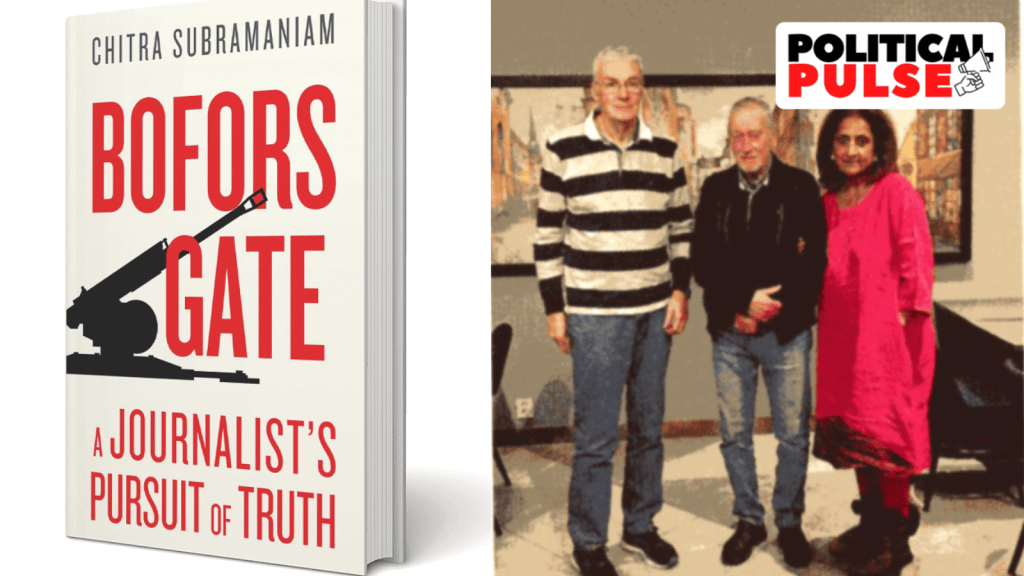 Journalist and author Chitra Subramaniam with Sten Lindstrom (File photo)


 Share


