5 min read
© The Indian Express Pvt Ltd



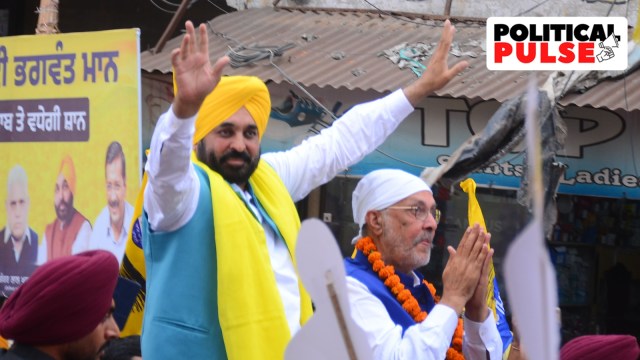 Punjab Chief Minister Bhagwant Mann (Express Photo by Harmeet Sodhi)
As its 13 Lok Sabha seats go to polls on June 1, a look at the previous six general elections in Punjab reveals that in almost all, barring the 1998 and 2009 elections, the state has preferred the the party or alliance which has ended up in the Opposition benches in Parliament.
The most stark example of this is Punjab’s acceptance of the Aam Aadmi Party (AAP), when it was still finding its feet in 2014, electing as many as four of its MPs to the Lok Sabha. The launch helped the party grow and eventually win the Assembly polls in 2022 with a thumping majority, winning 92 of its 117 seats.
1998 Lok Sabha elections
At the time, the state was ruled by the Shiromani Akali Dal (SAD)-BJP combine. The two parties had worked out an alliance in February 1996 and the following year, had formed the government in the state, collectively winning 95 seats.
The 1998 Lok Sabha elections was an exception when Punjab went with the winning party at the Centre. The SAD and BJP together won 11 of the 13 seats in the state, with the BJP winning three. The other two MPs included former PM I K Gujral of the Janata Dal and an Independent, Satnam Singh Kainth.
At the Centre, the BJP, with 182 seats in a House of 543, stitched an NDA coalition together, after no side got a majority, and Atal Bihari Vajpayee was selected as the Prime Minister. However, his government fell within months after J Jayalalithaa’s AIADMK, which had 18 MPs, withdrew support alleging “failure by the Centre” to act following a court’s order to attach Jayalalithaa’s properties worth Rs 11.5 crore.
Son of the then Punjab CM Parkash Singh Badal, Sukhbir made his electoral debut in these polls. He won from Faridkot and was made Union Minister of State in the Vajpayee government.
1999 Lok Sabha elections
The NDA yet again formed the government under Vajpayee’s leadership, with exactly the same number of seats as the previous polls and this time went on to serve its full term.
But in Punjab, the SAD and BJP collectively managed to win only three of the 13 seats, down from 11, despite the fact that the state had a SAD-BJP government. The Congress, which had drawn a blank in the state in 1998, won eight seats while the SAD (Amritsar) and CPI won one seat each. One of the major upsets in the state was Sukhbir’s loss from Faridkot.
2004
Despite the high-pitched India Shining campaign, the NDA was voted out of power and was replaced by the Congress-led UPA government under Prime Minister Manmohan Singh.
This time too, the results were contrary in Punjab, with the Congress winning only two seats while the SAD and BJP won eight and three seats respectively.
The state was ruled at the time by the Congress under Captain Amarinder Singh.
2009
This time, the UPA went into the polls with Manmohan Singh as its prime ministerial face and won the polls, winning 206 seats. The BSP, JD(S) and RJD extended the UPA government external support.
Even as the Parkash Singh Badal-led SAD government held the reins in Punjab, the state — in a second exception — voted in favour of the Congress, which won eight seats in the state, largely due the projection of a Sikh PM face. The SAD won four seats while the BJP managed a single seat.
2014
The Lok Sabha elections saw the BJP securing a majority on its own under Narendra Modi, winning 282 seats as the Congress recorded its worst-ever performance with 44 seats. In the state, the SAD-BJP alliance had formed the government in 2012 with Badal senior at the helm.
The polls in Punjab, however, proved to be crucial for the AAP, which got a boost for its national ambitions, and won four seats – Sangrur, Faridkot, Fatehgarh Sahib and Patiala.
CM Bhagwant Mann won his maiden election from Sangrur while Dharamvira Gandhi (then in AAP) emerged as the “giant killer” from Patiala, where he defeated then Congress candidate Preneet Kaur, the wife of Captain Amarinder Singh.
The Congress managed to win three seats while the SAD and BJP won four and one seat respectively.
2019
The BJP stormed to power, winning 303 seats, but Punjab voted against the NDA, with the Congress winning eight seats.
The SAD managed to secure only two of the 10 seats it contested in alliance with the BJP, which won 2 of the three seats it contested.
The AAP’s seat share also fell, with Mann its sole candidate who won.