



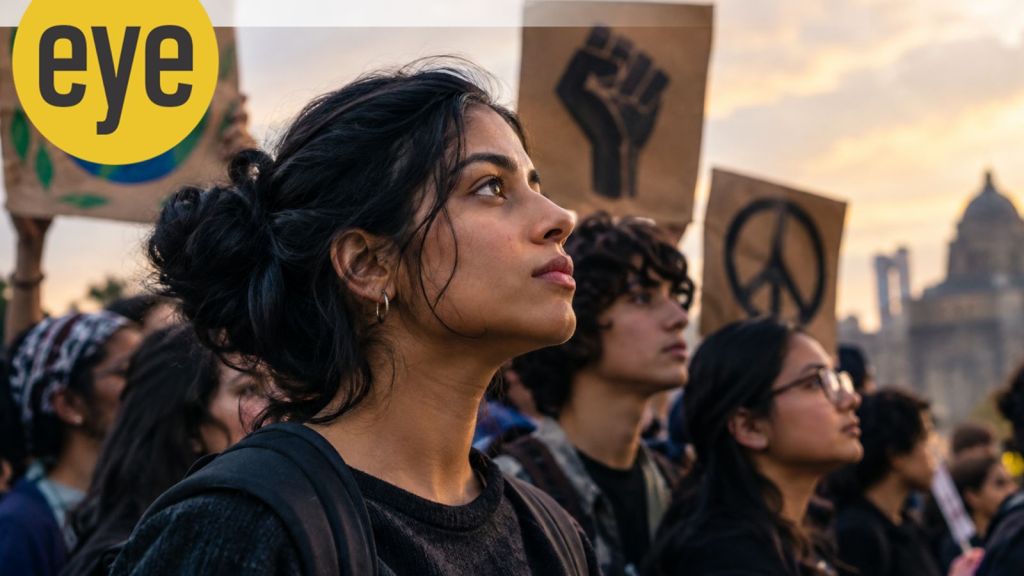


Across the world, we watch from a safe distance as young people stand up to the fire that they have inherited from us. They are the so-called ‘Gen Zs’ who are boldly speaking up, protesting about genocide, wars, climate crisis, patriarchy, political oppression, crumbling educational system, and more. Maybe historically it has been the same. Teens are too young to take on the world, and those beyond their twenties are too comfortable to be inconvenienced. They are the ones who have fought the revolutions, the freedom movements, and brought down oppressive regimes. While we conveniently participate in their surveillance, trolling, or reverence from behind the screens, depending on our political leanings.
We find ourselves in a cultural moment where we know something has changed for the young, something I don’t remember experiencing or seeing my friends experience in our twenties. A young woman, Jia, once asked me, “Did you have faith in the world around you when you were young?” I immediately said, “Yes”, because despite the inevitable turbulence and cluelessness of my twenties, I had faith that life would work out and that the larger systems were somewhat benign, despite their structural incompetence. Speaking for her generation, she went on to say, “See, we do not feel that. There is a sense that our environment is being ravaged for profit and we are brutalised for speaking up. There is unemployment, uncertainty about the future, and nobody is really looking out for us.” Throw in patriarchy, fascism, hypercapitalism, classism, casteism, Islamophobia, along with the super speed at which AI is morphing, and we are looking at a world which is not fit for consumption.
It would be so convenient to dismiss Jia’s concerns as “depression,” but we cannot diagnose young people’s struggles away. As Sami Timimi, child and adolescent psychiatrist, reminds us, “Diagnoses are facts of culture and not nature.” Are young people struggling in terms of their mental health? Yes, they are. In large numbers. But not because something is wrong with them, but because they are being forced to survive in a culture that is hostile to their well-being. Mental health struggles hide issues of social injustice.
As a parent of young people in their twenties, I experience sleepless nights, churning over the world they are up against. Even though they live with unearned privilege due to our caste, class, religion, and access to educational opportunities. It can become so much worse for children when there is a disability, poverty, or discrimination. They are being measured against society’s achievement standards at every step and declared a failure.
There is a social pressure to “don’t waste your life”, “build your career,” with the background hum of, “at your age I was doing this,” “at this rate you will fail”, “you are wasting your life” and the inevitable “log kya kahenge.”
A parent of a 24-year-old daughter with disability shared with me, “When they are little, we live in hope that things will work out. But once they reach their twenties, there is a finality to it. Maybe things will never get better for them and for us. Our hypercompetitive world is not designed to take care of them.” That is a crushing thought to live with. We live in fear and inevitably pass it on to them.
Yet, young people give me hope. They are fighting for justice in the most innovative ways. They use tools of resistance that power structures cannot quash; their phones record, document, and upload injustices for all to see. Their language is humour, memes, reels, poetry, music, art, dance, and street theatre, which state power tries to stifle in sinister ways, yet they persist.
Story continues below this ad
We have to put skin in the game and use our privilege and platform to co-conspire with our youth. Co-conspiracy has its roots in Alicia Garza’s work (co-founder Black Lives Matter). A fellow narrative practitioner, David Nylund, urges “to move from allyship to co-conspiracy”. He explains, ‘Co-conspirators do not merely ‘support’ movements; they organise, disrupt and act alongside.” It has to involve shared material risk and shared commitment. If we do not, then we are participating in systems of harm.
Being just passive ‘allies’ can become problematic and performative when we are doing it without any material risk to our lives. Just railing at the ‘this coercive state’ at dinner parties, forwarding posts on WhatsApp and doomscrolling the reels is not enough. Ask any young person, and they will tell you it is sheer virtue signalling. As Gen Z reminds us, “Grow a spine.” Co-conspiracy can take diverse forms. Go out, join the protests, speak up, write about it. If you are not comfortable doing that because “it’s too political”, then open doors for more job opportunities or mentoring, volunteer, donate, offer legal aid and pro bono work. Host gatherings where they get a safe space to share. Stay curious, listen to them without lapsing into reassurance or glib advice. As co-conspirators, we can also start questioning the idea that by their twenties they should have figured it all out, reached that illusory successful goal, and “settle down”.
Young people are unstoppable when they believe they are valued and that what they have to offer matters to others. No wonder they speak up despite the material risk to their lives and futures. Because they get to show up and fight for issues that matter to them — fairness, justice, and livelihood. Let’s not dismiss their actions with a cynical, “It will not make a difference.” As I heard a young person say, “Yeh haar jeet ki baat nahi he, baat he ki hum hosle se maidan mein aye to” (More than winning or losing a battle, it is about having the courage to step into the arena).
I am often asked, “You are a therapist, so how can you be political?” Caring about children and youth is not limited to the therapy space. It is about not turning away from the brutality and oppression that they have to survive every day. Ibuka practitioners who work with the Rwandan genocide survivors describe it well: “Healing is a form of justice and justice is a form of healing.”
Story continues below this ad
Active hope is not a feeling or a sentiment. It is a call to action; it is ever-evolving, and it is about collective accountability. The world may be on fire, but we get to decide whether we stay passive, choose convenience, or stand alongside our youth as they demand a just world.
[In this column, Shelja Sen curates the know-how of the children and youth she has the honour of working with. Email her at shelja.sen@childrenfirstindia.com]