
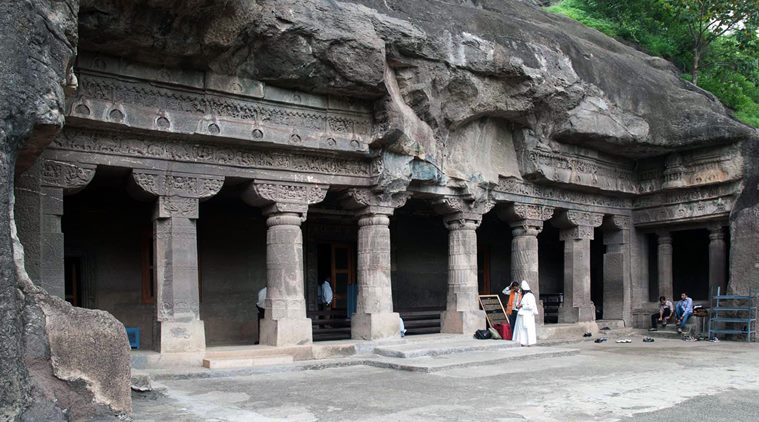
 Ajanta, Cave 1, exterior view (Source: Sahapedia.org)
By Samayita Banerjee
The rock-cut Buddhist cave monasteries of Ajanta started to be built more than 2000 years ago, but have not received the attention they deserve despite being declared a UNESCO World Heritage Site in 1983. Lack of conservation efforts, poor restoration, and the ravages of time have ensured that only a small part of the 30-odd caves and its beautifully expressive paintings can be admired. As Dieter Schlingloff, renowned expert on Ajanta cave art, writes in an article for Sahapedia, the paintings inspire “an aesthetic and intellectual sensation, which can never be conveyed by photographs of details”.

Indeed, Schlingloff accords Ajanta Caves the same status in ancient Indian art and culture as what the frescos of Pompeii signify for Greco-Roman antiquity. Not only are the caves a unique archaeological monument, they are almost the sole preserved records of India’s ancient richness, which are not only breathtakingly flawless but wondrous to behold.
Discovery, History and Patronage
In 1819, a British cavalry officer named John Smith reportedly came across the group of caves while hunting tigers. Situated on the Jalgaon-Aurangabad highway, near Fardapur in the Aurangabad district of Maharashtra, the Ajanta Caves were strategically cut into the 250-ft mountain wall above the Waghora river, probably on the border of the ancient province called Risika.
Ajanta, which many say is derived from a nearby village called Ajintha, served as a pilgrimage site as well as a centre of learning for Buddhism. Painstakingly carved by hand over periods ranging from second century BCE to fifth century CE, the caves contain paintings depicting themes from Buddhist mythology and legends, as well as sculptures of various theological figures. The present complex comprised four halls of worship and 26 dwelling caves. Not all caves were painted as some of them were intended as residences and assemblies for Buddhist monastics. In some of the caves, statues were sculpted so that they could serve as temples. While the main purpose of the caves was to celebrate the glory of Gautama Buddha’s life and achievements, they also provide an important insight into the Buddhist life and belief system and the reflection of its values in art.
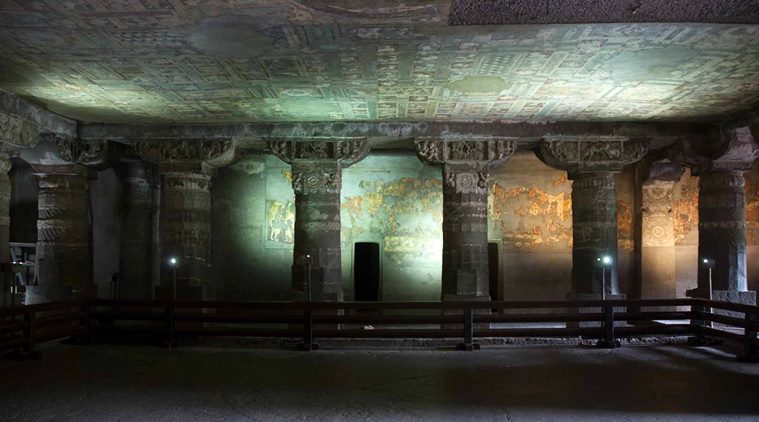 Ajanta Cave 1, hall: the right section seen from the centre of the hall (Source: Sahapedia.org)
In many ways, the Ajanta caves were a watershed in subcontinental architecture. While the lands under the Gupta rulers saw a proliferation of Hindu structural temples, the Western Ghats saw a heightened activity in Buddhist temple architecture, of which the Ajanta caves are perhaps the best specimen. The caves were built in two clear phases, both under Hindu rule: the first during the second and first centuries BCE under the rule of the Satavahanas; and the second, in a renaissance, during the rule of the Vakatakas. The caves of the first period are classified under the early Hinayana Buddhism, which grew under the Satavahana patronage. The second phase, attributed to the theistic Mahayana tradition, flourished mostly under the rule of Harisena, the powerful Vakataka king who ruled the entire region from the western to the eastern sea and helped create an architectural splendour that outlived him.
Paintings and Preservation
Susan Huntington, one of the foremost scholars of Indian art and architecture of the early historic and medieval periods, claims that due to the nature of preservation of the paintings at Ajanta, it remains an astonishing repository of pre-Muslim Indic art. According to Walter M. Spink (in an article for Sahapedia), author of the six-volume Ajanta: History and Development, the second phase of constructions and art and architecture at Ajanta corresponds to the very apogee of India’s golden age. Spink posits that in the second phase, the caves were completed very quickly, yet meticulously, in a very short time of only 18 years, over 462 CE to 480 CE. His argument is based on Visrutacarita by Dandin, a Pallava court poet who narrated the final years of the Vakataka dynasty in his works. Although the Architectural Survey of India has yet to accept the period-the inscription says they started around fifth-sixth centuries and continued for the next two-most scholars have generally accepted Spink’s chronology of the caves.
In all likelihood, from the variety of styles of painting discerned, a group of artists hired from nearby villages worked on the caves. The wall paintings range from scenes of Buddha’s life, stories of his attendants, tales from the Jatakas to urban and village landscapes. The caves of the first phase were fully painted but fell into disuse, so only a small part of the original paintings has survived. Schlingloff has noted extensive narrative representations in the second phase, which are basically numerous individual scenes interwoven to form a visual storyline. The narratives comprise hunting scenes, travel adventures, romantic and comical tales, and mostly aim to depict ethical behaviour. Similar narratives can be seen in the reliefs of Sanchi and Bharhut as well. Many believe while the Ellora Caves were a sequel to Ajanta, the former stands out more for its sculptures and the latter for its luminescent art.
One wonders who funded the massive exercise. Historians attribute it to collective patronage. Artists were commissioned by the royals and sometimes, by the monks who lived there. Spink says that Cave 1, universally recognised as the one with the most beautiful and well-preserved paintings, was funded by King Harisena. The makers were aware of the geographical necessities of the caves, as evidenced by the extensive use of white used in the ceilings to ensure the presence of sufficient light in the dim interiors. According to Schlingloff, “that such caves were painted at all is only because sponsors who were favourably disposed to Buddhism wished to give the monks the opportunity to impart their teachings to the numerous monastery visitors through pictures as well as through words.”
Of late, the Ajanta caves have made news for the state of its conservation. The deterioration of the frescoes and murals at Ajanta are caused by many factors. Among the natural ones is the progressive structure deterioration caused by climate condition and vegetation growth that causes disruption of the rocks and seepage of water. There is also an inherent weakening of the rocks, resulting in weathering and increased activation of micro-organisms. The paintings, however, are damaged more by human factors than natural ones, such as marking, writing over, and scratching. Ineffective cleaning operations too have done great damage to the paintings, sometimes scrubbing intricate details straight off them.
The story of the Ajanta Caves is unparalleled in the history it houses. The paintings have been copied and recopied, the walls have been coated and re-coated, with the hope and desire to preserve them for eternity. But Ajanta’s story is also one of human negligence as well as failed attempts to hold on to its glory. What we owe to these caves is respect and a commitment to protect it for eternity.
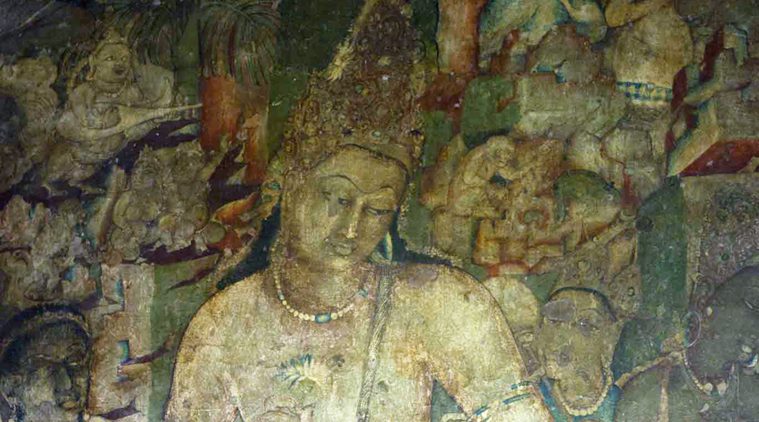 Bodhisatva king a mountainous landscape (Source: Sahapedia.org)
Did You Know?
1. The Ajanta Caves are also referred to as Ajintha by scholars, some of whom claim the name comes from a nearby village. Art historian R.K. Singh writes on Sahapedia that since the British officers and European scholars pronounced Aji??ha as Ajanta, the prevalent spelling and pronunciation were perpetuated and well established.
2. The popularity of the Ajanta Caves is also the leading cause of its deterioration. According to UNESCO, the increase in humidity due to the huge number of visitors leads to fungus growth that ends up attracting insects and bats, which damage the monument further.
3. Nashik-based artist and photographer Prasad Pawar has been trying to make a digital archive of the Ajanta paintings by documenting and photographing them for the last 27 years, without touching them.
4. According to Walter M. Spink, British cavalry officer named John Smith, the man responsible for the discovery of the Ajanta Caves in 1819 was also the first to have vandalised one of the paintings by engraving his name and date over it.
5. Copies of the Ajanta murals have been attempted by a variety of artists, from early colonial officers to Nandalal Bose and Abanindranath Tagore, and are found at museums all over the world.
6. The Ajanta sculptures and paintings are highly coveted by the global antiquities theft market.
This article is based on the module on Ajanta Caves on http://www.sahapedia.org, an open online resource on the arts, cultures and heritage of India. Sahapedia offers encyclopedic content on India’s vast and diverse heritage in multimedia format, authored by scholars and curated by experts to creatively engage with culture and history to reveal connections for a wide public using digital media.

 Share


