
Opinion An intelligence historian writes | Jack Teixeira, Chelsea Manning, Edward Snowden: Understanding intelligence leaks in the US
There are three main reasons: The 9/11 terror attack where intelligence failure led to wider dissemination of information, outsourcing security and intelligence responsibilities to contractors, and security clearances being retained by former government security employees
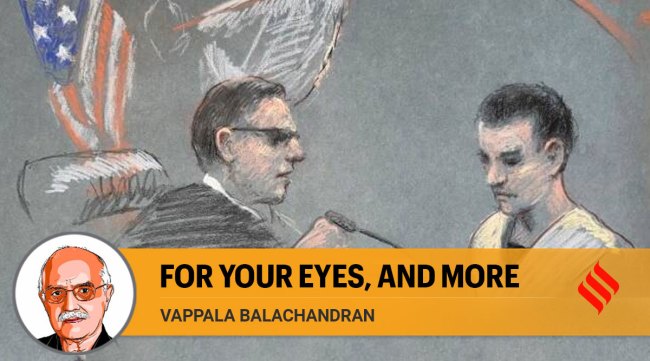 Massachusetts Air National Guardsman Jack Teixeira, right, appears in U.S. District Court in Boston. (AP)



How could such young, junior-level defence intelligence employees in the US as Jack Teixeira (21), Bradley Edward Manning now known as Chelsea Elizabeth Manning (22) and Edward Snowden (24) manage to get access to top-secret security documents? As an intelligence historian, I would give three reasons for this favourable ecosystem: The 9/11 terror attack, the arrangement of “outsourcing” security and intelligence responsibilities to contractors, and the system of retaining security clearance certificates by employees even after retirement from government security jobs.
Prior to the 9/11 attack, the CIA and FBI worked in silos and did not share prior information, which resulted in the calamity. This was severely criticised by the 9/11 National Commission. Like in all democratic bureaucracies, the pendulum swung in the opposite direction: From a rigorously restrictive circulation of intelligence reports to more widespread dissemination.

Unlike in India, security clearance in the US is given to individuals even after they’ve changed jobs, and even if they are working for defence contractors. True, periodical reviews are done: The “Top Secret” label is reviewed after five years, “Secret” after 10 years, and “confidential” after 15 years. This is not a totally reliable system. In India, the day one changes one’s security job, the security clearance ends.
The Indian media has not mentioned one more case where a security clearance certificate was mixed with a misguided sense of “patriotism”: Twenty five-year-old Reality Leigh Winner, working for an NSA intelligence contractor in Georgia. Earlier, she had worked in the US Air Force for six years as a cryptologic linguist (Persian-Dari) assigned to the Drone programme. After an honourable discharge from the Air Force, she was employed in 2016 by Pluribus Corporation which was working for the National Security Agency (NSA) where she was translating Iran’s aerospace documents.
However, she went beyond her charter when she saw an NSA document on Russian interference in the 2016 presidential elections. It stated that Russian GRU had executed a cyber attack on US voting software and sent “spear phishing” emails to more than 100 election officials just before the November 8 elections. Out of “patriotic” considerations she sent it anonymously to The Intercept, which published it before the NSA verified its authenticity. The FBI was informed, and she was arrested, tried, and sentenced.
Teixeira, the “Ukraine war intelligence leaker” was only an Air National Guard (Massachusetts), roughly equivalent to the lowest rank in our Corps of Army Air Defence (AAD). He joined the National Guard in 2019. While AAD is an active corps of the Indian army giving combat support to the air defence of India, the US Air National Guard does the US Air Force’s tactical airlift support and combat communications and also has total responsibility for the air defence of the entire country. The US National Guards (Army and Air) are federal reserve forces which, during peacetime, work under the governor of each state.
Teixeira does not appear to have had any intentions of betraying the country. He did it more to “show off” his leadership qualities by posting important news on Discord, a social media messaging site, popular with gamers. He wanted his friends to recognise him as the “OG”, their de facto leader. Like Winner, he also had “Top Secret” and “sensitive compartmented information” clearance because of his job.
Glenn Gerstell, who was General Counsel for NSA (2015-2020) was quoted by USA Today as saying that the whole system of security clearances has gone out of control: “But maybe all these millions of people don’t need access to everything the way we’ve got things going now”.
Manning, the “Wikileaks” leaker, who released more than 700,000 classified documents in 2010 as a “form of protest” against American wars in the Middle East, joined the army in 2007 at the age of 20. He was physically small and was bullied by his peers. He also had a difficult childhood due to gender dysphoria and parental alienation. On August 22, 2013, he announced that he was taking the name of Chelsea Manning. President Barack Obama commuted her prison sentence and on March 13, 2020, she was released from prison. Reportedly, her main reason for leaking was that the military was misleading the American public about the Iraq war.
Edward Snowden took advantage of the NSA system of allowing access to 1,000 “system administrators”, most of them contractors. An intelligence official was quoted by ABC News as saying, “It’s 2013 and the NSA is stuck in 2003 technology”. In that outdated system, Snowden, then working for an NSA contractor in Honolulu, had direct access to NSA’s Fort Meade server.
There could be one more reason for this situation, drawn from the Indian experience in 1994. The episode worked to our advantage, as we got to know in advance Pakistan’s plans to have a showdown with India at the annual September session of the United Nations General Assembly. That year was particularly sensitive for India’s diplomacy on Kashmir due to many reasons, including Prime Minister Benazir Bhutto’s personal influence over US Congressional leaders, the Bill Clinton White House and Assistant Secretary Robin Raphel in the State Department. India had also scored a commendable victory at the Geneva meeting of the UN Human Rights Council early in 1994, due to the sagacious decision of Prime Minister Narasimha Rao to designate Atal Bihari Vajpayee as the leader of the Indian delegation with the prominent presence of Farooq Abdullah. India’s Permanent Representative Hamid Ansari, later our Vice President, was also present in Geneva to help.
We were fortunate to get a copy of PM Bhutto’s instructions to the Pakistan mission at the UN with copies to all their embassies on how India should be put on the mat. Although this secret circular was sent through coded telegrams, an overzealous “Babu” in her office also sent it by open fax to New York which came into our possession. Needless to say, our foreign office was overjoyed.
The writer is a former Special Secretary, Cabinet Secretariat and author of Intelligence Over Centuries. Views are personal

 Share
Share


