On December 15, 2019, when students on the Jamia Millia Islamia (JMI) campus organised a protest over police violence against anti-CAA protestors two days before, the police and paramilitary personnel attempted to stop them using methods that went beyond simple crowd-control means (batons, teargas, rubber bullets and live ammunition). Similar treatment was meted out to anti-CAA student protestors at Aligarh Muslim University (AMU) who voiced their concerns against the excessive force meted out earlier to JMI students. The use of force against protesting and non-protesting students of JMI and AMU continued in the hostels, library, mosque, etc. long after they had retreated inside the campus.

The violence documented in several civil society efforts, court petitions, student testimonials, and videography, all indicate disproportionate use of force and prohibited ill-treatment (cruel, inhuman and degrading treatment or CIDT and torture) under international law framework. This piece seeks to explore these aspects as they operate both, inside a custodial framework and outside through the violent curbing of demonstrations.
The prohibition on the excessive use of force and ill-treatment is a part of several international treaties, including the International Covenant on Civil and Political Rights (ICCPR) and the United Nations Convention Against Torture (UN CAT), with the latter being the primary treaty that imposes obligations on states parties to it, to establish legislative, administrative and other measures to eliminate torture. Apart from this, these prohibitions are embedded as a part of jus cogens — norms considered so fundamental within the international community, that there can be no derogations from it, and customary international law — principles which the states objectively practice and also believe they are legally bound to comply with. In case a state does not take measures against its officials practising torture, foreign states have the discretion to commence proceedings against them (also known as universal jurisdiction). Additionally, not only individual officers but also their superiors who have ordered the acts or failed to take actions against their subordinates must be punished (command responsibility) and no administrative discretion can be exercised while proceeding against them (as is the case under section 197 of the Criminal Procedure Code).
Although India is not a party to the UN CAT, it is still bound by treaties such as the ICCPR that it has ratified and these unwritten principles of law. This creates an obligation upon the state apparatus to prohibit and where inflicted, redress torture and CIDT. The Supreme Court has also previously interpreted the scope of Article 21 widely to include these aspects, although sparingly and only when inflicted inside prisons, while making an arrest (see, Francis Corallie, DK Basu, Prem Shankar Shukla, Sube Singh) or in case of malicious prosecution (see Nambi Narayanan). It has also given recognition to not only physical but also mental and psychological torture, although within the above limits.
In this respect, international jurisprudence is much more illustrative. Courts such as the Inter-American and European Courts of Human Rights have found that violent beatings and use of less-lethal modes of weaponry (lathis, batons, chemical irritants) against unarmed demonstrators, as opposed to individuals who continue to engage in violence, or force inflicted to retaliate or humiliate, could amount to torture, especially where they result in death and grievous injuries (for example, fractures, blindness). In 2017, the UN General Assembly, composed of Member States, also adopted a resolution accepting these legal implications. While the legal threshold for proving torture is high in several jurisdictions — requiring the showing of a motive- police brutality can nevertheless amount to CIDT. Motive is usually inferred through an objective analysis of the number of victims, the circumstances in which the attacks took place, and, state response to such attacks — whether the executive ceased to use repressive measures, whether prosecutions were undertaken against errant officials.
Any democratic state is marked by a separation between its internal affairs which lies under the police’s domain, and external aggression where the paramilitary and military officials operate. The latter possess power not merely to control but to eliminate. At the outset, nothing would justify calling upon paramilitary personnel or even the police towards peaceful protestors. Even where such use of force commences, it is subject to principles of proportionality and precaution. Again, the Indian jurisprudence on these principles has been lacking, and summarised in a handful of cases, such as Anuradha Bhasin, and Ramlila Maidan. What it means is that force is used for preventative purposes and once any violence perceived ceases to operate, so should the force. Methods of force must also be such as to inflict the least amount of pain.
In the specific case of university students, this meant that the police and paramilitary’s alleged use of force on unarmed and retreating students, in private and confined spaces, and with lethal and less-lethal weaponries, the subsequent denial of medical access to students who were in pain, and the vindictive attack on symbolic structures (masjids, holy books) reinforced by anti-Muslim statements, was nothing short of torture and ill-treatment. AMU and JMI have existed as bastions of minority education. Seen in that light, the attacks were not merely physical but also sought to create a deep impact upon the collective that similar consequences could follow in case they did not refrain.
As a part of a state-wide analysis, international law also examines whether adjudicatory bodies stepped in to remedy the wrongs — whether it instituted any oversight upon complaints, whether it placed the victims under any procedural protections and so on. The National Human Rights Commission probes into JMI-AMU incidents were carried out under the supervision of an officer of the UP police cadre, the same state in which the alleged violations were carried out, and who has a history of justifying extra-judicial killings in the state, thereby casting doubt on the impartiality of the process itself. It gave limited relief to the students who were injured, ordered disciplinary action against erring officials in the library incident at Jamia, but failed to account for the continued use of force by the police and paramilitary elsewhere.
Over the past year, peaceful modes of demonstration in India have come under the scrutiny of an executive that has sculpted narratives best suited to meet its political ends, and of some individuals who have, in the larger public interest, gone on to challenge a model sit-in protest, and also successfully obtained a judicial embargo long after the cause of action ceased to exist. What happened at Jamia and Aligarh on the night of December 15, 2019, was unprecedented. Individuals who, in the larger public interest, challenged police excesses committed on the campuses of JMI and AMU have, however, not been as successful yet in their plea seeking an independent inquiry by the court. In the absence of an effective legal framework dealing with torture and CIDT, and with the increasing criminalisation of peaceful protests, students, especially those in minority educational institutions, who would be heading to their campuses after the pandemic, would remain vulnerable to police violence as was seen at JMI and AMU.
(The writers are researchers and lawyers based in New Delhi)

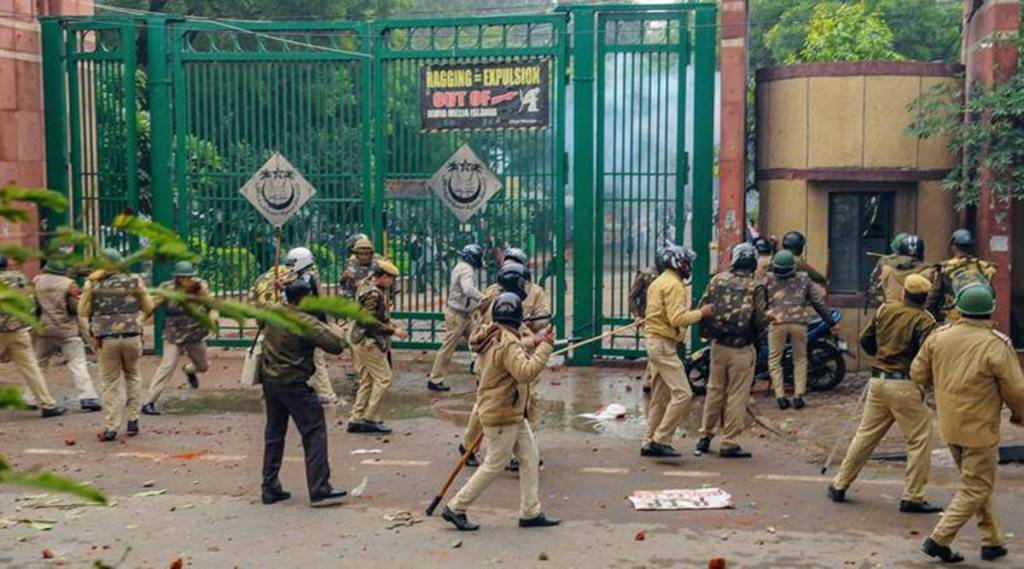 The use of force against protesting and non-protesting students of JMI and AMU continued in the hostels, library, mosque, etc. long after they had retreated inside the campus. (PTI/File)

 Share


