Indian civilisation, like the Chinese, rose on the banks of great rivers. And Indra, or Shakra, is the most spectacular leader of the early pantheon. By the fact of divinity, he was the chief water authority — and also the least modest of the gods. Along with the cycle of rains, he also controlled thunder, electric storms and lightning (vajra). His moods were reflected in how he unleashed them upon his earthly devotees, mostly farming communities and nomadic cattle rearers. His worshippers held him in great awe and paid him obeisance in the form of splendid rituals.
Indra’s empire gradually dissolved and made way for Ram and later, Krishna. But his legacy continued with his banner, the Indra Dhwaja, which was also adopted by Buddhists and Jain sects.

The dhwaja, since Indra, has summed up the power and unification of an amorphous mass of states under one flag. Since 2014, the BJP-led coalition has sought to capture the people’s attention and their fears and hopes for the future and in the process, the Indian national flag, the tricolour or tiranga, was given a steady build-up. It was underscored by the political leadership as a symbol of mighty India. And that necessitated its prominent display everywhere. Much was also made of the tiranga replacing the flag of Jammu and Kashmir when the state was trifurcated and Article 370 struck down. This started a race among the NDA-ruled states and offices and universities controlled by the Centre to compete in displaying the tallest and most prominent tiranga on their premises. It became the new Indra Dhwaja. Even movie theatre audiences were instructed to stand up and sing the national anthem at the beginning of each show, when the Indra Dhwaja of the 21st century appeared on the screen.
At this point, we see K Prabhakar Bhatt, an RSS leader from Karnataka, suggesting that the Hindus unite under the full saffron flag, the Bhagwa Dhwaja of the RSS. If Hindu members of Parliament unite, it could be done easily by a parliamentary vote. A grand felicitation mounted recently by the NRI community in Germany for the Indian prime minister’s visit, was a further attempt to fit into the Indra tradition. This was underscored by the image of a man with a saffron scarf and topi, hopping up and down with the saffron pennant. In the visuals, the national flag was noticeably absent.
It is noted in the Mahabharat that having consolidated his followers as a mass, Indra ascended to heaven. But before that, he formed a coalition with King Uparichara, the ruler of the Chedi Janpad (roughly the area known now as Bundelkhand), one of the most water-scarce regions in the land. He appointed the king as his partner and put him in charge of his estates. But like all politically-savvy emperors, Indra left space for Shiva — the “Adi Dev”, the alpha god — and ensured he would be part of all festivities and celebrations in Indra Mah, the rituals mounted under his name. This Indra did by presenting his earthly representative with three gifts, each with a symbolic value: A viman (vehicle) to travel in the air like the gods, an ever-fresh garland (vyjayanti mala) of lotus flowers and a robust bamboo staff (vaishnavi yashti), which was 32 arms (about 48 feet) high.
This robust yashti, Indra told the king, stood for the pure laughter of Lord Shiva around which all community celebrations must revolve henceforth. Multi-coloured flags must be mounted on it to symbolise Indra’s joyful union with his senior and predecessor. Then, Indra began a tour of Chedi Janpad, with the king holding his yashti in the front, heralding Indra’s visit. The Indra Dhwaja mounted on the yashti fluttered with pieces of cloth, and was decorated with flower garlands, pieces of sugarcane and various shiny ornaments. At the city centre, the Indra Dhwaja, the flag of the newly-blessed ruler, was firmly planted upon the earth, signalling that revelries may begin.
Over the years, the replay of this occasion began to be called a yatra (jatra), meaning a travelling folk festival replete with feasting and storytelling. In the Himalayan region, including Nepal, all festivals still begin by mounting a travelling Indra Dhwaja, called jaat. As the Indra cult travelled south, Indra or Shakra Dhwaja began to surface in tales there.
The Harivansh Purana reports that in the Dvapara Yuga, a new dark-skinned hero called Krishna challenged fair-skinned Indra’s hegemony. Brought up among cowherds, Krishna had a spectacular tussle with Indra that nearly wiped out the latter’s following. The power was Krishna’s, as also the Indra Dhwaj. He allowed the tradition of collective merry-making around the Indra Dhwaj by common people and artists of all kinds. Why? Because all leaders need drama. When they go to war or undertake a tour, they like to be heralded by the blowing of conches and flutes, drums and rows of men and women in colourful attire dancing to music. Bharata Muni’s Natyashastra had by now effortlessly linked the royal yatras all over the land with music, dance, drinking and theatre. Indra or no Indra, the multicoloured Indra Dhwaja became the mother lode of all sorts of creativity once again.
By the time the Muslims rode in, the Indra Dhwaja was thriving and the common folks were happy to mount it as the central point at each city festival. The erection of Shiva’s yashti and Indra’s colourful pennants heralded all sorts of celebrations: Vasant Panchami, Rang Panchami, Holi, Dussehra tableaus of Ram’s life, Ma Durga’s arrival and departure in Bengal, Nanda and Sunanda riding through villages in Garhwal towards Mount Kailash, home to their lord Shiva.
The poet Jayasi sums up the Dhwaja and all the joy and colour it ushered into the lives of ordinary folk in India: “Yah vasant sab ker tyoharu”.
Can any party’s dhwaja overtake the Indra Dhwaja in that?
This column first appeared in the print edition on May 19, 2022 under the title ‘Heavenly emblem, earthly successors’. The writer is former chairperson, Prasar Bharati

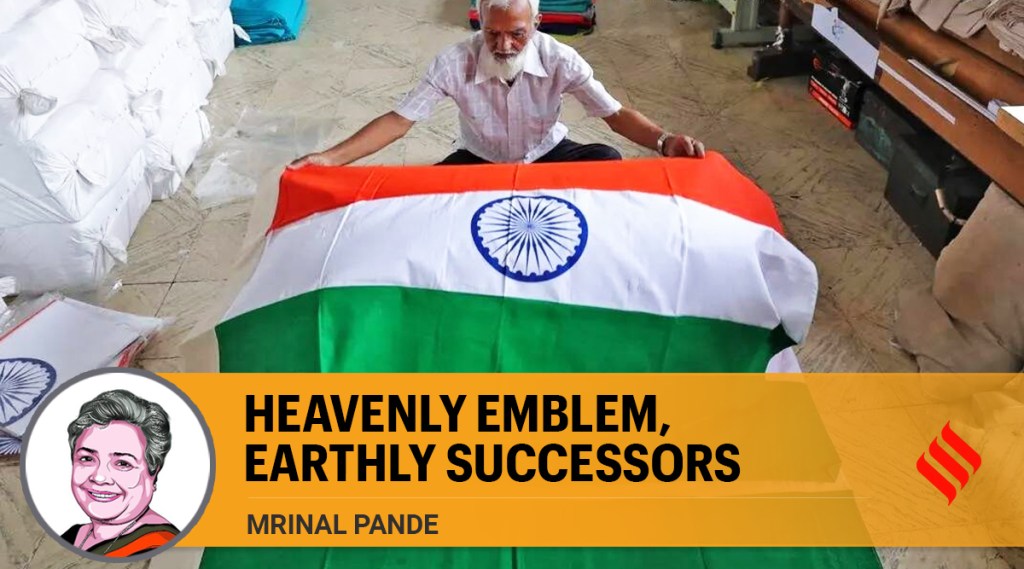 Since 2014, the BJP-led coalition has sought to capture people’s attention and their fears and hopes for the future and in the process, the Indian national flag was given a steady build-up. (Representational)


 Share


