5 min readSep 12, 2026 02:56 PM IST
First published on: Sep 12, 2026 at 02:56 PM IST
When Xi Jinping arrives at Bharat Mandapam for the 18th BRICS Summit this weekend, it will be his first visit to India in close to seven years. Less noticed is that, within a fortnight, he is due at the White House. The same guest will sit at two very different tables, and much of India’s economic calculus for the coming decade lies between them. New Delhi has framed its BRICS chairship around Building for Resilience, Innovation, Cooperation and Sustainability, an acronym that reads less like a slogan than an investment brief. Whether this summit matters will depend on whether BRICS can turn that brief into capital that actually builds things.
For India, the year has been productive. India’s chairship has yielded 20 sectoral outcomes. They include a Global Value Chains Action Plan for 2026-2030, a network linking startups and incubators across members, an in-principle customs agreement, and principles on energy storage and smart grids. Yet many of these are voluntary platforms, and the proposed BRICS Startup Innovation Fund still has no stated corpus or launch date. For nearly two decades, BRICS has invested heavily in the architecture of finance, from the New Development Bank to reserve pooling and payment links. However, it has invested far less in the architecture of production: Who invests where, in what, and what it leaves behind for the host economy.

India and China are where that gap is widest and the stakes highest. China is now India’s largest trading partner, and India’s deficit with it has widened to more than $112 billion. Much of that deficit is in components and machinery that Indian factories cannot yet make at scale. New Delhi has responded by adjusting the door rather than shutting it on Chinese investment. Since May, global funds with small, non-controlling Chinese shareholdings can invest without prior approval, and proposals from Chinese firms in selected manufacturing sectors, such as electronic components and solar materials, are being fast-tracked, provided Indian partners keep majority control.
Nevertheless, just before Xi’s visit, reports suggest that some Chinese-made equipment for Indian solar, electronics and infrastructure projects had been held up at Chinese customs. This follows last year’s recall of around 300 Chinese engineers by Foxconn, Apple’s main iPhone assembler, from its Yuzhan Technology plant in Tamil Nadu. Easing investment rules is only the first step; to build lasting capacity, investment must be matched by equipment and technical expertise.
Washington is following the summit closely, but its main economic concern is less about BRICS itself than about where goods are really made. Chinese goods generally face higher US tariffs than Indian goods, and if Chinese parts are lightly assembled in a third country and exported as that country’s product, they can avoid the higher duty. A White House report in August described such operations as “screwdriver factories” and placed India in its first tier of economies to watch for this kind of rerouting, alongside the EU, Japan and South Korea, though it accused no Indian firm. This is not opposition to Chinese investment as such; in May, Washington itself agreed with Beijing to set up a US-China Board of Investment to manage investment between the two countries. The question is whether a product has genuinely been made in India or merely relabelled there. India has a solid base to meet that test: It rose to become the world’s eleventh-largest FDI destination last year, with growing investment in electronics and advanced manufacturing.
Clean energy shows how BRICS partners can build on each other’s strengths. India is now the world’s second-largest solar module maker, and its next step is to move into upstream components such as polysilicon and wafers, where Chinese firms have long-standing expertise. Investment within the grouping is also increasingly led by member economies themselves, with sovereign investors and emerging-market firms active in renewables and digital infrastructure.
Joint ventures with Indian majority ownership, such as the Dixon-Vivo smartphone partnership cleared in July, show how foreign experience and Indian scale can work together. The best such partnerships are judged not only by the capital they bring but by how deeply they work with local suppliers, train workers and support smaller firms. The New Development Bank could help by bringing governments, companies and domestic firms together and sharing some of the risk in such long-term projects.
None of this requires India to choose between Chinese investment and the American market, since both depend on the same thing: investment that creates real value in India. Ultimately, Beijing’s recent closeness to New Delhi and Washington within a fortnight shows that the major economies are managing their economic ties rather than cutting them. As host, India’s practical task is to ensure that investment coming in, whether bilaterally or through BRICS, builds lasting capacity at home, giving the economy a sturdier footing against the geopolitical shocks, supply chain disruptions and health emergencies that have repeatedly tested the world in recent years.
The writer is with the Observer Research Foundation

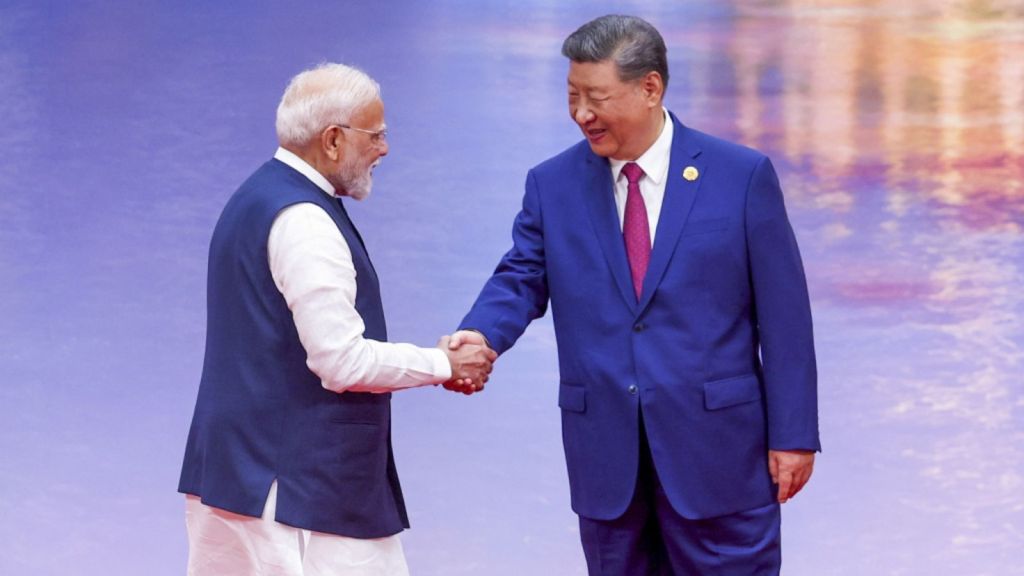 China is now India's largest trading partner, and India's deficit with it has widened to more than $112 billion.


 Share


